
纳武利尤单抗联合化疗治疗表皮生长因子受体突变型转移性非小细胞肺癌:表皮生长因子受体酪氨酸激酶抑制剂治疗进展后的 CheckMate 722 最终结果。
Nivolumab Plus Chemotherapy in Epidermal Growth Factor Receptor-Mutated Metastatic Non-Small-Cell Lung Cancer After Disease Progression on Epidermal Growth Factor Receptor Tyrosine Kinase Inhibitors: Final Results of CheckMate 722.
机构信息
State Laboratory of Translational Oncology, The Chinese University of Hong Kong, Hong Kong, China.
Kindai University Faculty of Medicine, Osaka, Japan.
出版信息
J Clin Oncol. 2024 Apr 10;42(11):1252-1264. doi: 10.1200/JCO.23.01017. Epub 2024 Jan 22.
PURPOSE
The phase III CheckMate 722 trial (ClinicalTrials.gov identifier: NCT02864251) evaluated nivolumab plus chemotherapy versus chemotherapy in patients with epidermal growth factor receptor ()-mutated metastatic non-small-cell lung cancer (NSCLC) after disease progression on EGFR tyrosine kinase inhibitors (TKIs).
METHODS
Patients with disease progression after first- or second-generation EGFR TKI therapy (without T790M mutation) or osimertinib (with/without T790M mutation) were randomly assigned 1:1 to nivolumab (360 mg once every 3 weeks) plus platinum-doublet chemotherapy (once every 3 weeks) or platinum-doublet chemotherapy alone (once every 3 weeks) for four cycles. Primary end point was progression-free survival (PFS). Secondary end points included 9- and 12-month PFS rates, overall survival (OS), objective response rate (ORR), and duration of response (DOR).
RESULTS
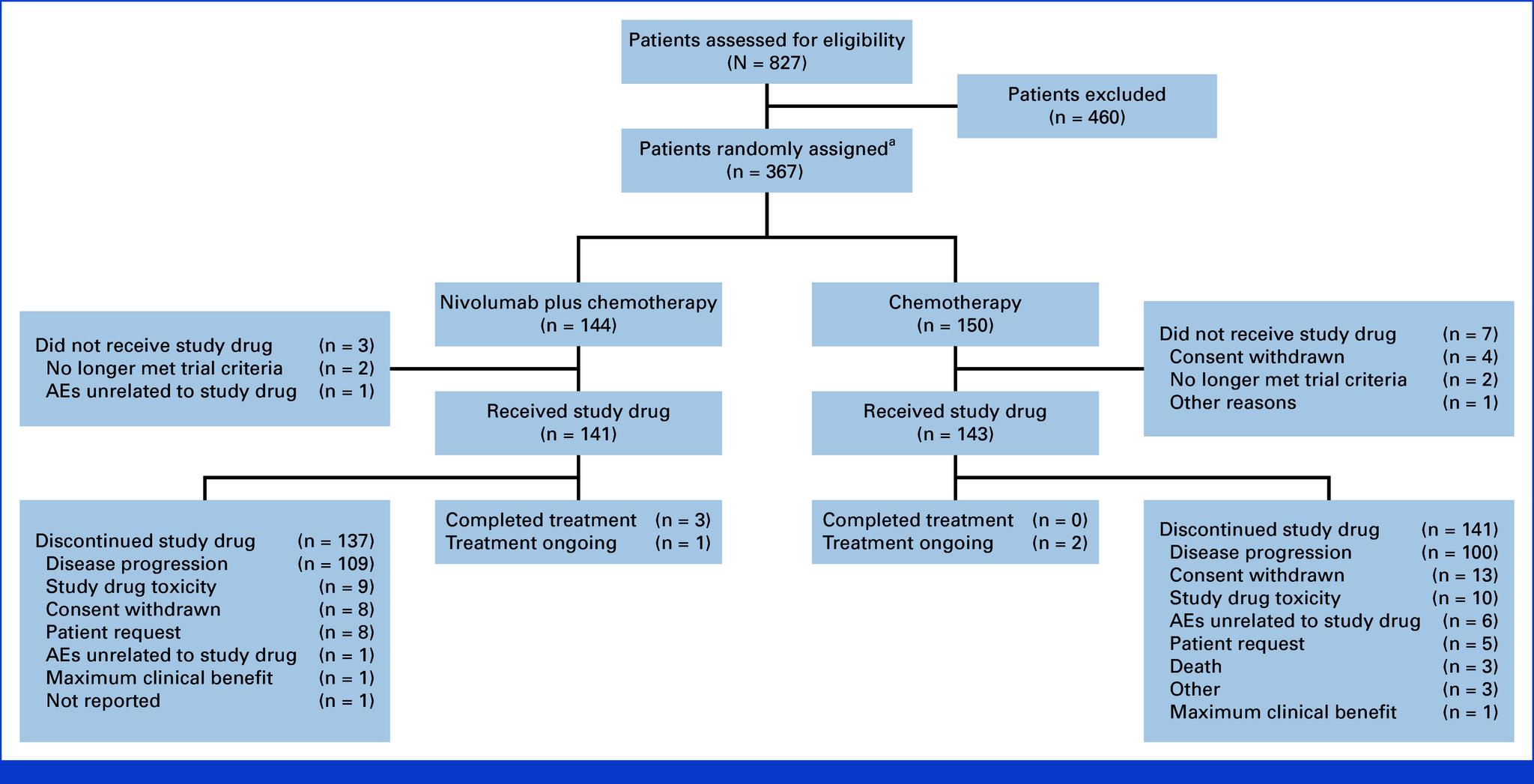
Overall, 294 patients were randomly assigned. At final analysis (median follow-up, 38.1 months), PFS was not significantly improved with nivolumab plus chemotherapy versus chemotherapy (median, 5.6 5.4 months; hazard ratio [HR], 0.75 [95% CI, 0.56 to 1.00]; = .0528), with 9- and 12-month PFS rates of 25.9% versus 19.8%, and 21.2% versus 15.9%, respectively. Post hoc PFS subgroup analyses showed a trend favoring nivolumab plus chemotherapy in patients with tumors harboring sensitizing mutations (HR, 0.72 [95% CI, 0.54 to 0.97]), one line of previous EGFR TKI (0.72 [95% CI, 0.54 to 0.97]), or both (0.64 [95% CI, 0.47 to 0.88]). Median OS was 19.4 months with nivolumab plus chemotherapy versus 15.9 months with chemotherapy, while ORR was 31.3% versus 26.7%, and median DOR was 6.7 versus 5.6 months, respectively. Grade 3/4 treatment-related adverse events occurred in 44.7% and 29.4% of patients treated with nivolumab plus chemotherapy and chemotherapy alone, respectively.
CONCLUSION
Nivolumab plus chemotherapy did not significantly improve PFS versus chemotherapy in patients with mutated metastatic NSCLC previously treated with EGFR TKIs. No new safety signals were identified.
目的
III 期 CheckMate 722 试验(ClinicalTrials.gov 标识符:NCT02864251)评估了纳武利尤单抗联合化疗与化疗在表皮生长因子受体(EGFR)-突变的转移性非小细胞肺癌(NSCLC)患者中的疗效,这些患者在接受 EGFR 酪氨酸激酶抑制剂(TKI)治疗后疾病进展。
方法
在第一代或第二代 EGFR TKI 治疗(无 T790M 突变)或奥希替尼(有/无 T790M 突变)后疾病进展的患者中,按 1:1 随机分配接受纳武利尤单抗(360mg,每 3 周一次)联合铂类双药化疗(每 3 周一次)或单独铂类双药化疗(每 3 周一次),共 4 个周期。主要终点是无进展生存期(PFS)。次要终点包括 9 个月和 12 个月的 PFS 率、总生存期(OS)、客观缓解率(ORR)和缓解持续时间(DOR)。
结果
总体而言,共有 294 名患者被随机分配。在最终分析(中位随访 38.1 个月)时,与化疗相比,纳武利尤单抗联合化疗并未显著改善 PFS(中位 PFS 5.6 vs 5.4 个月;风险比[HR],0.75[95%CI,0.56 至 1.00];=.0528),9 个月和 12 个月的 PFS 率分别为 25.9%和 21.2%,12 个月的 PFS 率分别为 19.8%和 15.9%。事后 PFS 亚组分析显示,在携带敏感突变的患者中,纳武利尤单抗联合化疗有改善 PFS 的趋势(HR,0.72[95%CI,0.54 至 0.97])、接受过一线 EGFR TKI(0.72[95%CI,0.54 至 0.97])或二线 EGFR TKI(0.64[95%CI,0.47 至 0.88])治疗。纳武利尤单抗联合化疗组的中位 OS 为 19.4 个月,化疗组为 15.9 个月,ORR 分别为 31.3%和 26.7%,中位 DOR 分别为 6.7 个月和 5.6 个月。纳武利尤单抗联合化疗组和化疗组分别有 44.7%和 29.4%的患者发生 3/4 级治疗相关不良事件。
结论
与化疗相比,纳武利尤单抗联合化疗并未显著改善 EGFR TKI 治疗后进展的转移性 NSCLC 患者的 PFS。未发现新的安全性信号。



 Zotero 插件