
桉叶油纳米乳凝胶的制备、体外及体内评价:一种新型伤口愈合范例
Fabrication, In Vitro, and In Vivo Assessment of Eucalyptol-Loaded Nanoemulgel as a Novel Paradigm for Wound Healing.
作者信息
Rehman Anis, Iqbal Muhammad, Khan Barkat A, Khan Muhammad Khalid, Huwaimel Bader, Alshehri Sameer, Alamri Ali H, Alzhrani Rami M, Bukhary Deena M, Safhi Awaji Y, Hosny Khaled M
机构信息
Drug Delivery and Cosmetic Lab (DDCL), Gomal Center of Pharmaceutical Sciences, Faculty of Pharmacy, Gomal University, Dera Ismail Khan 29050, Pakistan.
Department of Pharmaceutical Chemistry, College of Pharmacy, University of Ha'il, Ha'il 81442, Saudi Arabia.
出版信息
Pharmaceutics. 2022 Sep 19;14(9):1971. doi: 10.3390/pharmaceutics14091971.
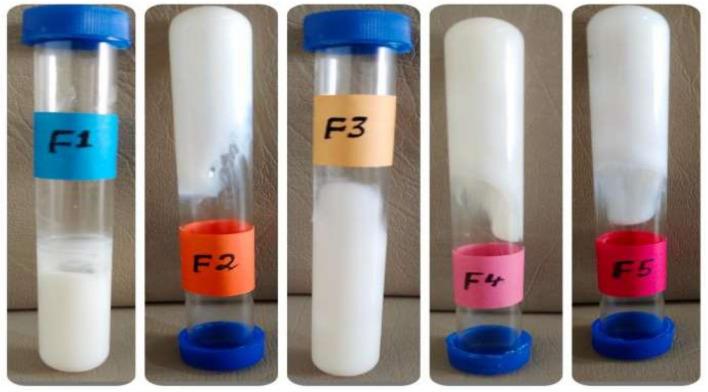
Wounds are the most common causes of mortality all over the world. Topical drug delivery systems are more efficient in treating wounds as compared to oral delivery systems because they bypass the disadvantages of the oral route. The aim of the present study was to formulate and evaluate in vitro in vivo nanoemulgels loaded with eucalyptol for wound healing. Nanoemulsions were prepared using the solvent emulsification diffusion method by mixing an aqueous phase and an oil phase, and a nanoemulgel was then fabricated by mixing nanoemulsions with a gelling agent (Carbopol 940) in a 1:1 ratio. The nanoemulgels were evaluated regarding stability, homogeneity, pH, viscosity, Fourier-transform infrared spectroscopy (FTIR), droplet size, zeta potential, polydispersity index (PDI), spreadability, drug content, in vitro drug release, and in vivo study. The optimized formulation, F5, exhibited pH values between 5 and 6, with no significant variations at different temperatures, and acceptable homogeneity and spreadability. F5 had a droplet size of 139 ± 5.8 nm, with a low polydispersity index. FTIR studies showed the compatibility of the drug with the excipients. The drug content of F5 was 94.81%. The percentage of wound contraction of the experimental, standard, and control groups were 100% ± 0.015, 98.170% ± 0.749, and 70.846% ± 0.830, respectively. Statistically, the experimental group showed a significant difference (p < 0.03) from the other two groups. The results suggest that the formulated optimized dosage showed optimum stability, and it can be considered an effective wound healing alternative.
伤口是全球最常见的死亡原因。与口服给药系统相比,局部给药系统在治疗伤口方面更有效,因为它们避免了口服途径的缺点。本研究的目的是制备并体外和体内评价负载桉叶油醇的纳米乳凝胶用于伤口愈合。采用溶剂乳化扩散法,通过混合水相和油相制备纳米乳,然后将纳米乳与胶凝剂(卡波姆940)按1:1比例混合制备纳米乳凝胶。对纳米乳凝胶的稳定性、均匀性、pH值、粘度、傅里叶变换红外光谱(FTIR)、液滴大小、zeta电位、多分散指数(PDI)、铺展性、药物含量、体外药物释放和体内研究进行了评价。优化后的制剂F5的pH值在5至6之间,在不同温度下无显著变化,具有可接受的均匀性和铺展性。F5的液滴大小为139±5.8nm,多分散指数较低。FTIR研究表明药物与辅料具有相容性。F5的药物含量为94.81%。实验组、标准组和对照组的伤口收缩率分别为100%±0.015、98.170%±0.749和70.846%±0.830。统计学上,实验组与其他两组有显著差异(p<0.03)。结果表明,所制备的优化剂型具有最佳稳定性,可被认为是一种有效的伤口愈合替代方案。



 Zotero 插件