
用于莫匹罗星局部应用的纳米乳凝胶的研发。
Development of a Nanoemulgel for the Topical Application of Mupirocin.
作者信息
Alhasso Bahjat, Ghori Muhammad Usman, Rout Simon P, Conway Barbara R
机构信息
Department of Pharmacy, School of Applied Sciences, University of Huddersfield, Huddersfield HD1 3DH, UK.
Department of Biological and Geographical Sciences, University of Huddersfield, Huddersfield HD1 3DH, UK
出版信息
Pharmaceutics. 2023 Sep 26;15(10):2387. doi: 10.3390/pharmaceutics15102387.
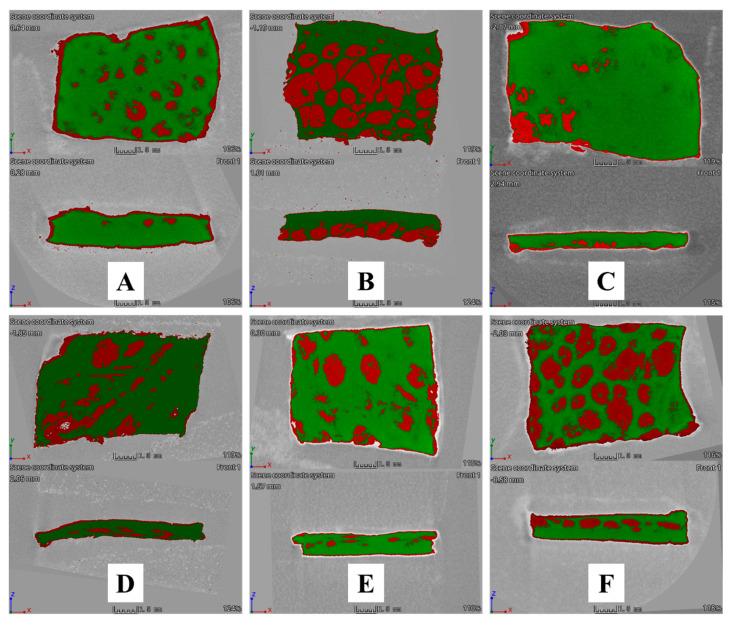
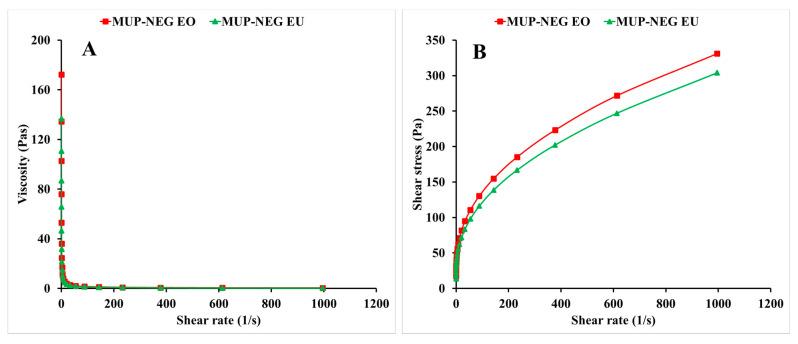
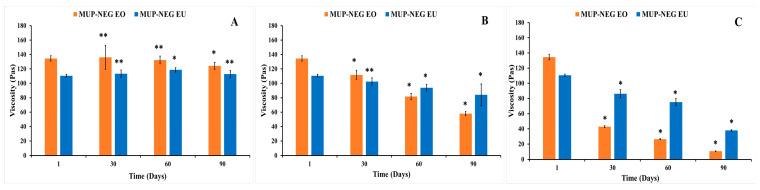
Mupirocin (MUP) is an effective topical antibiotic with poor skin permeability; however, its skin permeability can be improved by a nanoemulsion formulation based on eucalyptus oil or eucalyptol. Despite this improvement, the nanoemulsion has limitations, such as low viscosity, low spreadability, and poor retention on the skin. To overcome these limitations, the aim of this study was to develop a nanoemulgel formulation that would enhance its rheological behaviour and physicochemical properties. The MUP nanoemulgel was prepared by incorporating a preprepared MUP nanoemulsion into Carbopol gel at a concentration of 0.75% in a 1:1 ratio. The nanoemulgel formulations were characterised and evaluated for their physicochemical and mechanical strength properties, rheological behaviour, and in vitro skin permeation and deposition, as well as antibacterial studies. Both nanoemulgels exhibited stability at temperatures of 4 and 25 °C for a period of 3 months. They had a smooth, homogenous, and consistent appearance and displayed non-Newtonian pseudoplastic behaviour, with differences in their viscosity and spreadability. However, both nanoemulgels exhibited lower skin permeability compared to the marketed control. The local accumulation efficiency of MUP from nanoemulgel after 8 h was significantly higher than that of the control, although there was no significant difference after 24 h. Micro-CT scan imaging allowed visualisation of these findings and interpretation of the deposited drug spots within the layers of treated skin. While there were no significant differences in the antibacterial activities between the nanoemulgels and the control, the nanoemulgels demonstrated superiority over the control due to their lower content of MUP. These findings support the potential use of the nanoemulgel for targeting skin lesions where high skin deposition and low permeability are required, such as in the case of topical antibacterial agents.
莫匹罗星(MUP)是一种有效的局部用抗生素,但其皮肤渗透性较差;然而,基于桉叶油或桉叶醇的纳米乳剂配方可提高其皮肤渗透性。尽管有这种改进,纳米乳剂仍有局限性,如低粘度、低铺展性和在皮肤上的滞留性差。为克服这些局限性,本研究的目的是开发一种纳米乳凝胶配方,以增强其流变行为和物理化学性质。通过将预先制备的MUP纳米乳剂以1:1的比例以0.75%的浓度掺入卡波姆凝胶中来制备MUP纳米乳凝胶。对纳米乳凝胶配方进行了表征,并评估了其物理化学和机械强度性质、流变行为、体外皮肤渗透和沉积以及抗菌研究。两种纳米乳凝胶在4℃和25℃下均表现出3个月的稳定性。它们外观光滑、均匀且一致,表现出非牛顿假塑性行为,其粘度和铺展性存在差异。然而,与市售对照相比,两种纳米乳凝胶的皮肤渗透性均较低。尽管24小时后无显著差异,但纳米乳凝胶给药8小时后MUP的局部蓄积效率显著高于对照。微型计算机断层扫描(Micro-CT)扫描成像使这些结果可视化,并能解释处理过的皮肤层内沉积的药斑。虽然纳米乳凝胶与对照之间的抗菌活性无显著差异,但纳米乳凝胶由于其较低的MUP含量而显示出优于对照的性能。这些发现支持了纳米乳凝胶在靶向皮肤病变方面的潜在用途,例如局部用抗菌剂的情况,在这些情况下需要高皮肤沉积和低渗透性。







 Zotero 插件