
槲皮素对食品表面生物膜的抗菌效果及毒力基因的下调
Antimicrobial Efficacy of Quercetin against Biofilm on Food Surfaces and Downregulation of Virulence Genes.
作者信息
Roy Pantu Kumar, Park Sung-Hee, Song Min Gyu, Park Shin Young
机构信息
Institute of Marine Industry, Department of Seafood Science and Technology, Gyeongsang National University, Tongyeong 53064, Korea.
World Institute of Khimchi, Gwangju 61755, Korea.
出版信息
Polymers (Basel). 2022 Sep 14;14(18):3847. doi: 10.3390/polym14183847.
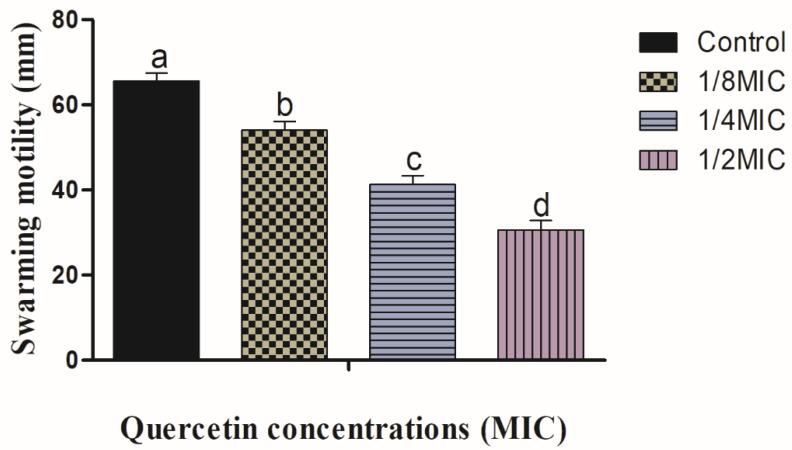
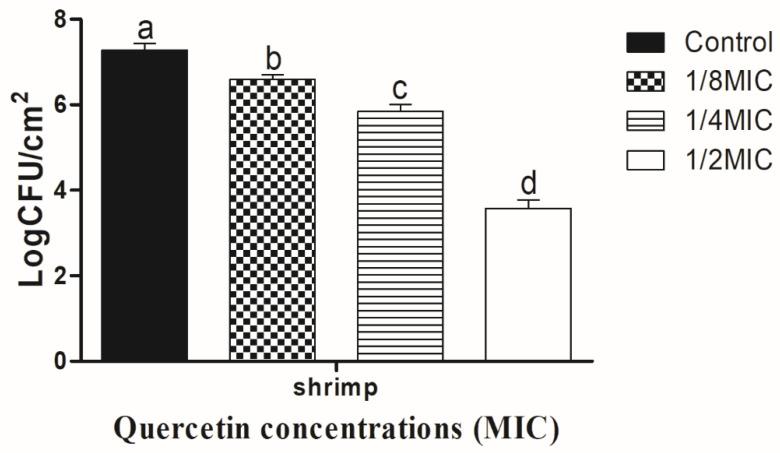
For the seafood industry, Vibrio parahaemolyticus, one of the most prevalent food-borne pathogenic bacteria that forms biofilms, is a constant cause of concern. There are numerous techniques used throughout the food supply chain to manage biofilms, but none are entirely effective. Through assessing its antioxidant and antibacterial properties, quercetin will be evaluated for its ability to prevent the growth of V. parahaemolyticus biofilm on shrimp and crab shell surfaces. With a minimum inhibitory concentration (MIC) of 220 µg/mL, the tested quercetin exhibited the lowest bactericidal action without visible growth of bacteria. In contrast, during various experiments in this work, the inhibitory efficacy of quercetin without (control) and with sub-MICs levels (1/2, 1/4, and 1/8 MIC) against V. parahaemolyticus was examined. With increasing quercetin concentration, swarming and swimming motility, biofilm formation, and expression levels of related genes linked to flagella motility (flaA and flgL), biofilm formation (vp0952 and vp0962), and quorum-sensing (luxS and aphA) were all dramatically reduced (p < 0.05). Quercetin (0−110 μg/mL) was investigated on shrimp and crab shell surfaces, the inhibitory effects were 0.68−3.70 and 0.74−3.09 log CFU/cm2, respectively (p < 0.05). The findings were verified using field emission scanning electron microscopy (FE-SEM), which revealed quercetin prevented the development of biofilms by severing cell-to-cell contacts and induced cell lysis, which resulted in the loss of normal cell shape. Furthermore, there was a substantial difference in motility between the treatment and control groups (swimming and swarming). According to our findings, plant-derived quercetin should be used as an antimicrobial agent in the food industry to inhibit the establishment of V. parahaemolyticus biofilms. These findings suggest that bacterial targets are of interest for biofilm reduction with alternative natural food agents in the seafood sector along the entire food production chain.
对于海产品行业来说,副溶血性弧菌是最常见的形成生物膜的食源致病菌之一,一直令人担忧。在整个食品供应链中使用了许多技术来管理生物膜,但没有一种是完全有效的。通过评估槲皮素的抗氧化和抗菌特性,将对其预防副溶血性弧菌在虾和蟹壳表面形成生物膜的能力进行评估。测试的槲皮素最低抑菌浓度(MIC)为220μg/mL,显示出最低的杀菌作用,且无可见细菌生长。相比之下,在本研究的各种实验中,研究了无槲皮素(对照组)和亚MIC水平(1/2、1/4和1/8 MIC)的槲皮素对副溶血性弧菌的抑制效果。随着槲皮素浓度的增加,群体运动和游动运动、生物膜形成以及与鞭毛运动(flaA和flgL)、生物膜形成(vp0952和vp0962)和群体感应(luxS和aphA)相关的基因表达水平均显著降低(p<0.05)。在虾和蟹壳表面研究了槲皮素(0−110μg/mL),其抑制效果分别为0.68−3.70和0.74−3.09 log CFU/cm2(p<0.05)。使用场发射扫描电子显微镜(FE-SEM)验证了研究结果,结果显示槲皮素通过切断细胞间接触来阻止生物膜的形成,并诱导细胞裂解,从而导致细胞正常形态丧失。此外,处理组和对照组之间在运动性方面存在显著差异(游动和群体运动)。根据我们的研究结果,植物来源的槲皮素应在食品工业中用作抗菌剂,以抑制副溶血性弧菌生物膜的形成。这些研究结果表明,在整个食品生产链的海产品领域,细菌靶点对于使用替代性天然食品剂减少生物膜具有重要意义。




 Zotero 插件