
毛蕊异黄酮和槲皮素抑制耐甲氧西林金黄色葡萄球菌(MRSA)和耐甲氧西林表皮葡萄球菌(MRSE)菌株的 ATP 合成并降低其能量平衡。
Cirsiliol and Quercetin Inhibit ATP Synthesis and Decrease the Energy Balance in Methicillin-Resistant (MRSA) and Methicillin-Resistant (MRSE) Strains Isolated from Patients.
机构信息
Department of Experimental Medicine, University of Genoa, 16132 Genoa, Italy.
Department of Earth, Environmental and Life Sciences (DISTAV), University of Genoa, Corso Europa 26, 16132 Genoa, Italy.
出版信息
Molecules. 2023 Aug 22;28(17):6183. doi: 10.3390/molecules28176183.
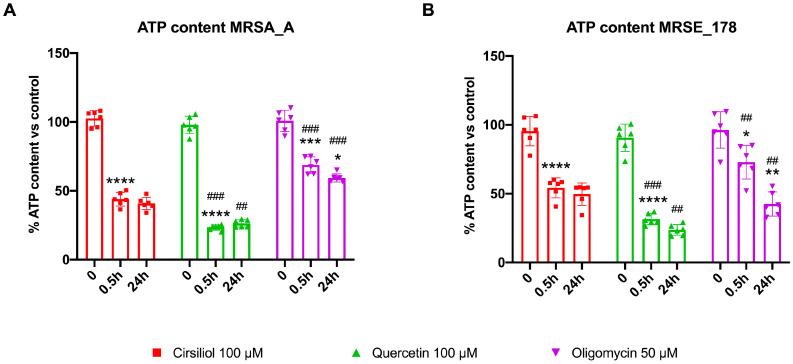
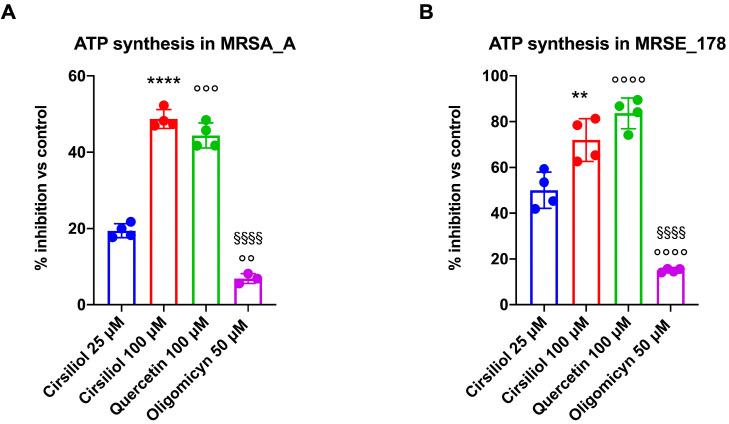
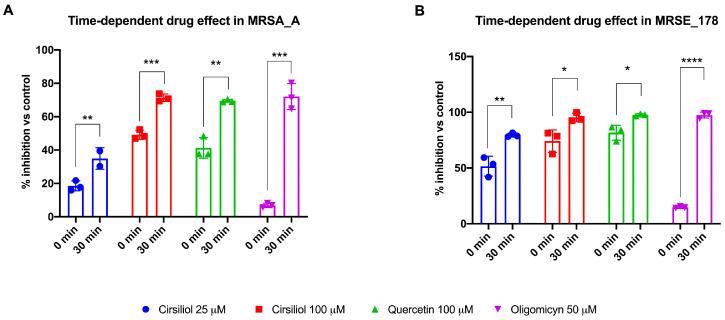
Polyphenols have attracted attention in the fight against antibiotic-resistant bacteria, as they show antibacterial action. Considering that polyphenols inhibit FF-ATP synthase (ATP synthase) and that bacteria need a constant energy production to maintain their homeostasis, we evaluated the effect of two flavones, cirsiliol (tri-hy-droxy-6,7-dimethoxyflavone) and quercetin (3,3,4,5,7-pentahydroxyflavone), on energy production and intracellular ATP content in a methicillin-resistant (MRSA) strain and a methicillin-resistant (MRSE) strain isolated from patients, comparing the results to those obtained by treating the bacteria with oligomycin, a specific ATP synthase F moiety inhibitor. Real-time quantitative ATP synthesis and total ATP content of permeabilized Gram-positive bacteria were assayed by luminometry. The results showed that cirsiliol and quercetin inhibited ATP synthase and decreased the intracellular ATP levels in both strains, although the effect was higher in MRSE. In addition, while cirsiliol and quercetin acted immediately after the treatment, oligomycin inhibited ATP synthesis only after 30 min of incubation, suggesting that the different responses may depend on the different permeability of the bacterial wall to the three molecules. Thus, cirsiliol and quercetin could be considered potential additions to antibiotics due to their ability to target ATP synthase, against which bacteria cannot develop resistance.
多酚在对抗抗生素耐药菌方面引起了关注,因为它们具有抗菌作用。考虑到多酚抑制 FF-ATP 合酶(ATP 合酶),并且细菌需要恒定的能量产生来维持其体内平衡,我们评估了两种类黄酮,芫花素(三羟基-6,7-二甲氧基黄酮)和槲皮素(3,3,4,5,7-五羟基黄酮),对能量产生和细胞内 ATP 含量的影响在耐甲氧西林金黄色葡萄球菌(MRSA)和耐甲氧西林表皮葡萄球菌(MRSE)分离自患者的菌株中,并将结果与用寡霉素(一种特定的 ATP 合酶 F 部分抑制剂)处理细菌的结果进行比较。通过发光法测定实时定量 ATP 合成和通透性革兰氏阳性菌的总 ATP 含量。结果表明,芫花素和槲皮素抑制 ATP 合酶并降低两种菌株的细胞内 ATP 水平,尽管在 MRSE 中效果更高。此外,虽然芫花素和槲皮素在处理后立即起作用,但寡霉素仅在孵育 30 分钟后才抑制 ATP 合成,这表明不同的反应可能取决于细菌细胞壁对这三种分子的不同通透性。因此,由于芫花素和槲皮素能够靶向 ATP 合酶,而细菌无法对此产生耐药性,因此它们可以被认为是抗生素的潜在替代品。

 Zotero 插件