
内脏脂肪蓄积量与中国西南部女性心血管疾病的相关性:一项基于人群的前瞻性研究。
Visceral adiposity measures are strongly associated with cardiovascular disease among female participants in Southwest China: A population-based prospective study.
机构信息
Key Laboratory of Public Health Safety, NHC Key Laboratory of Health Technology Assessment, School of Public Health, Fudan University, Shanghai, China.
Guizhou Province Center for Disease Prevention and Control, Chronic Disease Prevention and Cure Research Institute, Guiyang, China.
出版信息
Front Endocrinol (Lausanne). 2022 Sep 8;13:969753. doi: 10.3389/fendo.2022.969753. eCollection 2022.
BACKGROUND AND AIMS
Controversy remains regarding the prediction effects of different adiposity measure indicators for the risk of cardiovascular disease (CVD). Our study aimed to assess the associations of three traditional anthropometric indicators, namely, waist circumference (WC), waist-to-height ratio (WHtR), and body mass index (BMI) as well as three non-traditional anthropometric indicators, namely, the Chinese visceral adiposity index (CVAI), lipid accumulation product (LAP), and body shape index (ABSI), with the risk of CVD among Southwest Chinese population.
METHODS
Our study was based on the Guizhou Population Health Cohort Study (GPHCS) conducted from 2010 to 2020. A total of 9,280 participants were recruited from 12 areas in Guizhou Province, China, from November 2010 to December 2012, and followed up for major chronic diseases until December 2020. A total of 7,837 individuals with valid data were included in this analysis. The gender-specific associations of WC, WHtR, BMI, CVAI, LAP, and ABSI with CVD were evaluated using Cox proportional hazards models. Receiver operating characteristic (ROC) curve analysis was used to estimate the prediction powers of different indicators for CVD.
RESULTS
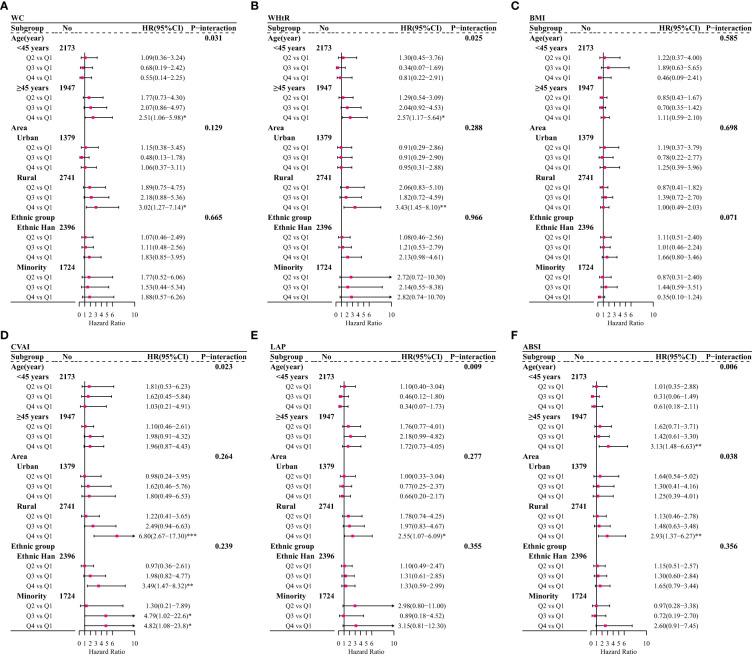
No association of six indicators with CVD was observed among male participants. Female participants with either WC-based central obesity (HR: 1.82, 95% CI: 1.12-2.97) or WHtR-based central obesity (HR: 1.68, 95% CI: 1.07-2.64) had a higher risk of CVD, after adjusted for age, area, ethnic group, smoking, alcohol drinking, MET, previous history of diabetes, hypertension and dyslipidemia, medication use, and nutraceutical intake. Compared with female participants in the lowest quartile (Q1), those in the highest quartile (Q4) of WHtR (HR: 2.24, 95% CI: 1.17-4.27), CVAI (HR: 3.98, 95% CI: 1.87-8.49), and ABSI (HR: 1.94, 95% CI: 1.06-3.52) had an increased risk for incident CVD. CAVI showed the maximum predictive power of CVD with the biggest AUC of 0.687 (95% CI: 0.654-0.720) compared to other indicators in female participants.
CONCLUSIONS
Visceral adiposity measures, especially CVAI, are stronger predictive indicators of CVD among female and not male participants in Southwest China. Different anthropometric indexes need to be combined to comprehensively assess health risks.
背景和目的
不同肥胖指标对心血管疾病(CVD)风险的预测效果仍存在争议。本研究旨在评估三种传统人体测量指标(腰围[WC]、腰高比[WHtR]和体重指数[BMI])以及三种非传统人体测量指标(中国内脏脂肪指数[CVAI]、脂联素积聚产物[LAP]和身体形状指数[ABSI])与西南地区中国人群 CVD 风险的相关性。
方法
本研究基于 2010 年至 2020 年进行的贵州人口健康队列研究(GPHCS)。2010 年 11 月至 2012 年 12 月,从中国贵州省 12 个地区招募了 9280 名参与者,并对主要慢性病进行了随访,直到 2020 年 12 月。在这项分析中,共有 7837 名具有有效数据的人被纳入。使用 Cox 比例风险模型评估 WC、WHtR、BMI、CVAI、LAP 和 ABSI 与 CVD 的性别特异性相关性。接收器工作特征(ROC)曲线分析用于估计不同指标对 CVD 的预测能力。
结果
在男性参与者中,没有发现六个指标与 CVD 相关。经年龄、地区、民族、吸烟、饮酒、MET、既往糖尿病、高血压和血脂异常史、药物使用和营养补充剂摄入调整后,WC 为中心性肥胖(HR:1.82,95%CI:1.12-2.97)或 WHtR 为中心性肥胖(HR:1.68,95%CI:1.07-2.64)的女性参与者 CVD 风险更高。与 WHtR 最低四分位数(Q1)的女性参与者相比,WHtR 最高四分位数(Q4)(HR:2.24,95%CI:1.17-4.27)、CVAI(HR:3.98,95%CI:1.87-8.49)和 ABSI(HR:1.94,95%CI:1.06-3.52)的女性参与者发生 CVD 的风险增加。与其他指标相比,CAVI 对 CVD 的预测能力最大,AUC 为 0.687(95%CI:0.654-0.720),是女性参与者 CVD 的最佳预测指标。
结论
内脏脂肪测量值,尤其是 CVAI,是西南地区女性而非男性参与者 CVD 的更强预测指标。需要结合不同的人体测量指标来全面评估健康风险。


 Zotero 插件