
嵌合抗原受体T细胞治疗前淋巴瘤肿瘤负荷:RECIL与卢加诺标准对比代谢性肿瘤评估
Lymphoma tumor burden before chimeric antigen receptor T-Cell treatment: RECIL vs. Lugano vs. metabolic tumor assessment.
作者信息
Winkelmann Michael, Bücklein Veit L, Blumenberg Viktoria, Rejeski Kai, Ruzicka Michael, Unterrainer Marcus, Schmidt Christian, Dekorsy Franziska J, Bartenstein Peter, Ricke Jens, von Bergwelt-Baildon Michael, Subklewe Marion, Kunz Wolfgang G
机构信息
Department of Radiology, University Hospital, Ludwig Maximilian University (LMU) Munich, Munich, Germany.
Department of Medicine III, University Hospital, Ludwig Maximilian University (LMU) Munich, Munich, Germany.
出版信息
Front Oncol. 2022 Sep 8;12:974029. doi: 10.3389/fonc.2022.974029. eCollection 2022.
PURPOSE
High tumor burden has emerged as a negative predictor of efficacy in chimeric antigen receptor T-cell therapy (CART) in patients with refractory or relapsed large B-cell lymphoma. This study analyzed the deviation among imaging-based tumor burden (TB) metrics and their association with progression-free (PFS) and overall survival (OS).
MATERIALS AND METHODS
In this single-center observational study, we included all consecutively treated patients receiving CD19 CART with available baseline PET-CT imaging. Imaging-based TB was determined based on response evaluation criteria in lymphoma (RECIL), the Lugano criteria, and metabolic tumor volume. Total, nodal and extranodal TB were represented, according to the respective criteria, by sum of longest diameters (TB), sum of product of perpendicular diameters (TB), and metabolic tumor volume (TB). Correlation statistics were used for comparison. Proportional Cox regression analysis studied the association of TB metrics with PFS and OS.
RESULTS
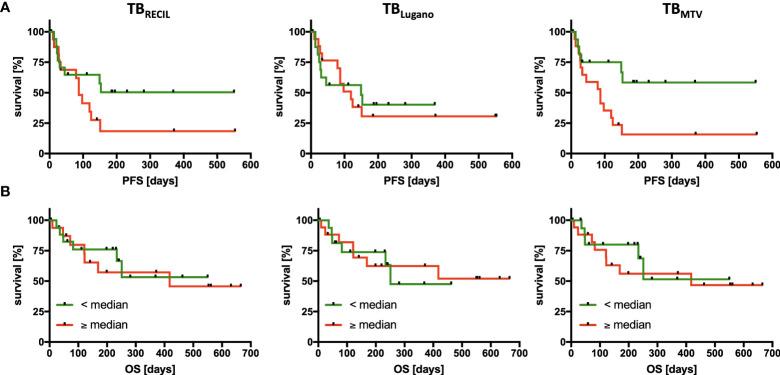
34 consecutive patients were included (median age: 67 years, 41% female) with total median baseline TB of 12.5 cm, TB of 4,030 mm and TB of 330 mL. The correlation of TB and TB with TB was strong (ρ=0.744, p<0.001 and ρ=0.741, p<0.001), with lowest correlation for extranodal TB with TB (ρ=0.660, p<0.001). Stratification of PFS was strongest by total TB (HR=2.915, p=0.042), whereas total TB and total TB were not significant (both p>0.05). None of the total TB metrics were associated with OS (all p>0.05).
CONCLUSION
Pre-CART TB metrics vary significantly based on the assessment method, impacting their association with survival outcomes. The correlation between TB, TB and TB was influenced by disease phenotype and prior bridging therapy. TB method of assessment must be considered when interpreting the impact of TB on outcomes in clinical trials. Considering the heterogeneity, our results argue for standardization and harmonization across centers.
目的
高肿瘤负荷已成为难治性或复发性大B细胞淋巴瘤患者嵌合抗原受体T细胞疗法(CART)疗效的负面预测指标。本研究分析了基于影像学的肿瘤负荷(TB)指标之间的差异及其与无进展生存期(PFS)和总生存期(OS)的关联。
材料与方法
在这项单中心观察性研究中,我们纳入了所有连续接受CD19 CART治疗且有可用基线PET-CT影像的患者。基于影像学的TB根据淋巴瘤反应评估标准(RECIL)、卢加诺标准和代谢肿瘤体积来确定。根据各自标准,总TB、淋巴结TB和结外TB分别用最长径总和(TB)、垂直径乘积总和(TB)和代谢肿瘤体积(TB)表示。采用相关统计进行比较。比例Cox回归分析研究TB指标与PFS和OS的关联。
结果
连续纳入34例患者(中位年龄:67岁,41%为女性),总基线TB中位数为12.5 cm,TB为4030 mm,TB为330 mL。TB与TB以及TB与TB之间相关性较强(ρ=0.744,p<0.001和ρ=0.741,p<0.001),结外TB与TB相关性最低(ρ=0.660,p<0.001)。PFS分层中总TB最强(HR=2.915,p=0.042),而总TB和总TB不显著(p均>0.05)。所有总TB指标均与OS无关(p均>0.05)。
结论
CART治疗前的TB指标因评估方法而异,影响其与生存结果的关联。TB、TB和TB之间的相关性受疾病表型和先前桥接治疗影响。在解释TB对临床试验结果的影响时,必须考虑TB评估方法。考虑到异质性,我们的结果支持各中心进行标准化和统一。


 Zotero 插件