
配体内电荷转移实现可见光介导的镍催化交叉偶联反应。
Intraligand Charge Transfer Enables Visible-Light-Mediated Nickel-Catalyzed Cross-Coupling Reactions.
作者信息
Cavedon Cristian, Gisbertz Sebastian, Reischauer Susanne, Vogl Sarah, Sperlich Eric, Burke John H, Wallick Rachel F, Schrottke Stefanie, Hsu Wei-Hsin, Anghileri Lucia, Pfeifer Yannik, Richter Noah, Teutloff Christian, Müller-Werkmeister Henrike, Cambié Dario, Seeberger Peter H, Vura-Weis Josh, van der Veen Renske M, Thomas Arne, Pieber Bartholomäus
机构信息
Department of Biomolecular Systems, Max-Planck-Institute of Colloids and Interfaces, Am Mühlenberg 1, 14476, Potsdam, Germany.
Department of Chemistry and Biochemistry, Freie Universität Berlin, Arnimallee 22, 14195, Berlin, Germany.
出版信息
Angew Chem Int Ed Engl. 2022 Nov 14;61(46):e202211433. doi: 10.1002/anie.202211433. Epub 2022 Oct 21.
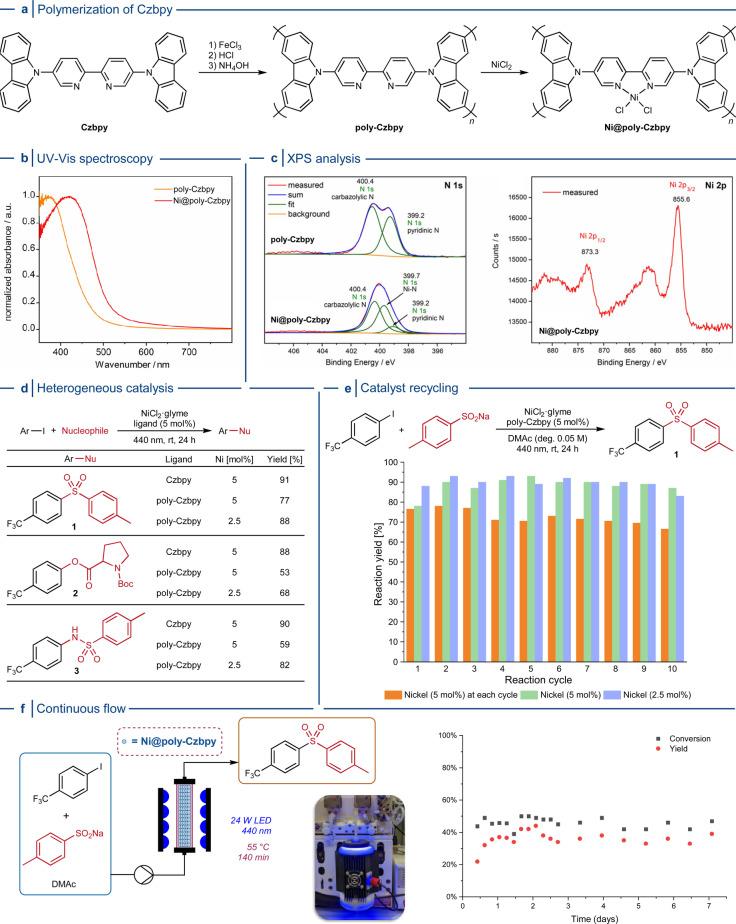
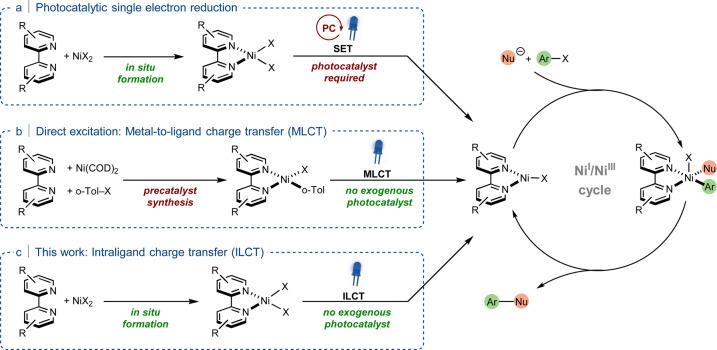
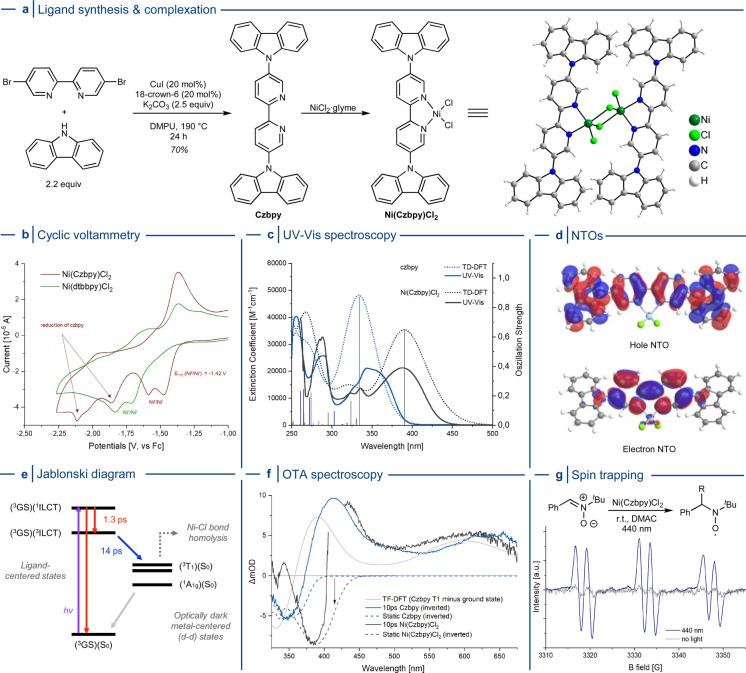
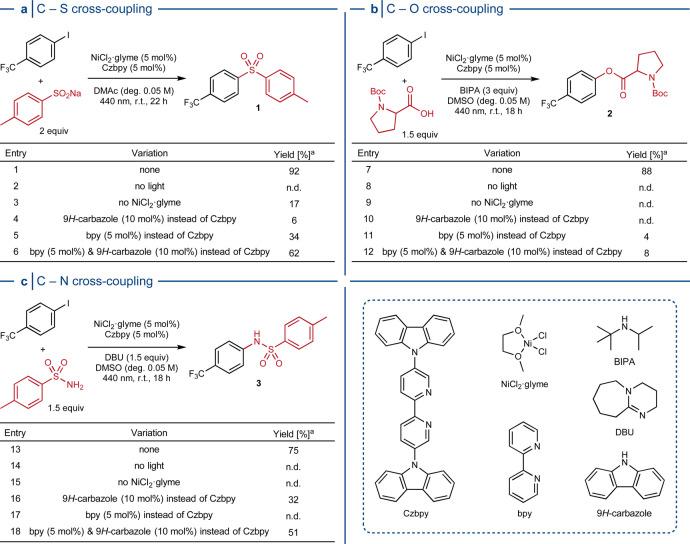
We demonstrate that several visible-light-mediated carbon-heteroatom cross-coupling reactions can be carried out using a photoactive Ni precatalyst that forms in situ from a nickel salt and a bipyridine ligand decorated with two carbazole groups (Ni(Czbpy)Cl ). The activation of this precatalyst towards cross-coupling reactions follows a hitherto undisclosed mechanism that is different from previously reported light-responsive nickel complexes that undergo metal-to-ligand charge transfer. Theoretical and spectroscopic investigations revealed that irradiation of Ni(Czbpy)Cl with visible light causes an initial intraligand charge transfer event that triggers productive catalysis. Ligand polymerization affords a porous, recyclable organic polymer for heterogeneous nickel catalysis of cross-coupling reactions. The heterogeneous catalyst shows stable performance in a packed-bed flow reactor during a week of continuous operation.
我们证明,使用一种光活性镍预催化剂可以进行几种可见光介导的碳-杂原子交叉偶联反应,该预催化剂由镍盐和带有两个咔唑基团的联吡啶配体原位形成(Ni(Czbpy)Cl)。这种预催化剂对交叉偶联反应的活化遵循一种迄今未公开的机制,该机制不同于先前报道的经历金属到配体电荷转移的光响应镍配合物。理论和光谱研究表明,用可见光照射Ni(Czbpy)Cl会引发初始的配体内电荷转移事件,从而触发有效的催化作用。配体聚合提供了一种用于交叉偶联反应的多相镍催化的多孔、可回收有机聚合物。在填充床流动反应器中连续运行一周期间,这种多相催化剂表现出稳定的性能。
 Zotero 插件