
大学生心理健康的数字干预措施:系统评价和荟萃分析。
Digital Interventions for Psychological Well-being in University Students: Systematic Review and Meta-analysis.
机构信息
Healthy Brain and Mind Research Centre, Australian Catholic University, Sydney, Australia.
School of Health and Wellbeing, University of Glasgow, Glasgow, United Kingdom.
出版信息
J Med Internet Res. 2022 Sep 28;24(9):e39686. doi: 10.2196/39686.
BACKGROUND
Life at university provides important opportunities for personal growth; however, this developmental phase also coincides with the peak period of risk for the onset of mental health disorders. In addition, specific university lifestyle factors, including impaired sleep and academic and financial stress, are known to exacerbate psychological distress in students. As a result, university students have been identified as a vulnerable population who often experience significant barriers to accessing psychological treatment. Digital psychological interventions are emerging as a promising solution for this population, but their effectiveness remains unclear.
OBJECTIVE
This systematic review and meta-analysis aimed to assess digital interventions targeting psychological well-being among university students.
METHODS
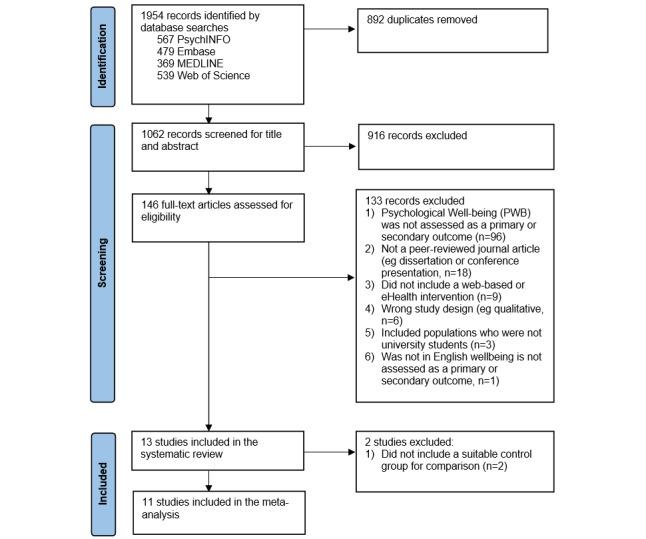
Database searches were conducted on December 2, 2021, via Embase, MEDLINE, PsycINFO, and Web of Science.
RESULTS
A total of 13 eligible studies were identified, 10 (77%) of which were included in the meta-analysis. Mean pre-post effect sizes indicated that such interventions led to small and significant improvement in psychological well-being (Hedges g=0.32, 95% CI 0.23-0.4; P<.001). These effects remained, albeit smaller, when studies that included a wait-list control group were excluded (Hedges g=0.22, 95% CI 0.08-0.35; P=.002). An analysis of acceptance and commitment therapy approaches revealed small and significant effects (k=6; Hedges g=0.35, 95% CI 0.25-0.45; P<.001).
CONCLUSIONS
Digital psychological interventions hold considerable promise for university students, although features that optimize service delivery and outcomes require further assessment.
TRIAL REGISTRATION
PROSPERO CRD42020196654; https:/www.crd.york.ac.uk/prospero/display_record.php?RecordID=196654.
背景
大学生活为个人成长提供了重要机会;然而,这一发展阶段也恰逢心理健康障碍发病的高峰期。此外,已知特定的大学生活方式因素,包括睡眠障碍、学业和经济压力,会使学生的心理困扰加剧。因此,大学生被认为是一个弱势群体,他们通常在获得心理治疗方面面临重大障碍。数字心理干预措施作为解决这一问题的一种有前途的方法应运而生,但它们的有效性仍不清楚。
目的
本系统评价和荟萃分析旨在评估针对大学生心理幸福感的数字干预措施。
方法
2021 年 12 月 2 日,通过 Embase、MEDLINE、PsycINFO 和 Web of Science 进行数据库检索。
结果
共确定了 13 项符合条件的研究,其中 10 项(77%)纳入荟萃分析。平均前后测效应量表明,这些干预措施导致心理幸福感有较小但显著的改善(Hedges g=0.32,95%CI 0.23-0.4;P<.001)。当排除包括等待名单对照组的研究时,这些效果仍然存在,尽管较小(Hedges g=0.22,95%CI 0.08-0.35;P=.002)。对接受和承诺疗法方法的分析显示出较小但显著的效果(k=6;Hedges g=0.35,95%CI 0.25-0.45;P<.001)。
结论
数字心理干预措施为大学生提供了很大的希望,尽管需要进一步评估优化服务提供和结果的特征。
试验注册
PROSPERO CRD42020196654;https://www.crd.york.ac.uk/prospero/display_record.php?RecordID=196654。


 Zotero 插件