
研究种族特异性参考值与肺功能损害、呼吸困难和预后:NHANES 2007-2012 分析。
Research race-specific reference values and lung function impairment, breathlessness and prognosis: Analysis of NHANES 2007-2012.
机构信息
Faculty of Medicine, Department of Clinical Sciences Lund, Respiratory Medicine, Allergology and Palliative Medicine, Lund University, Lund, Sweden.
Department of Medicine, Blekinge Hospital, SE-37185, Karlskrona, Sweden.
出版信息
Respir Res. 2022 Oct 1;23(1):271. doi: 10.1186/s12931-022-02194-4.
BACKGROUND
Spirometry reference values differ by race/ethnicity, which is controversial. We evaluated the effect of race-specific references on prevalence of lung function impairment and its relation to breathlessness and mortality in the US population.
METHODS
Population-based analysis of the National Health and Nutrition Examination Survey (NHANES) 2007-2012. Race/ethnicity was analyzed as black, white, or other. Reference values for forced expiratory volume in one second (FEV) and forced vital capacity (FVC) were calculated for each person using the Global Lung Initiative (GLI)-2012 equations for (1) white; (2) black; and (3) other/mixed people. Outcomes were prevalence of lung function impairment (< lower limit of normal [LLN]), moderate/severe impairment (< 50%pred); exertional breathlessness; and mortality until 31 December, 2015.
RESULTS
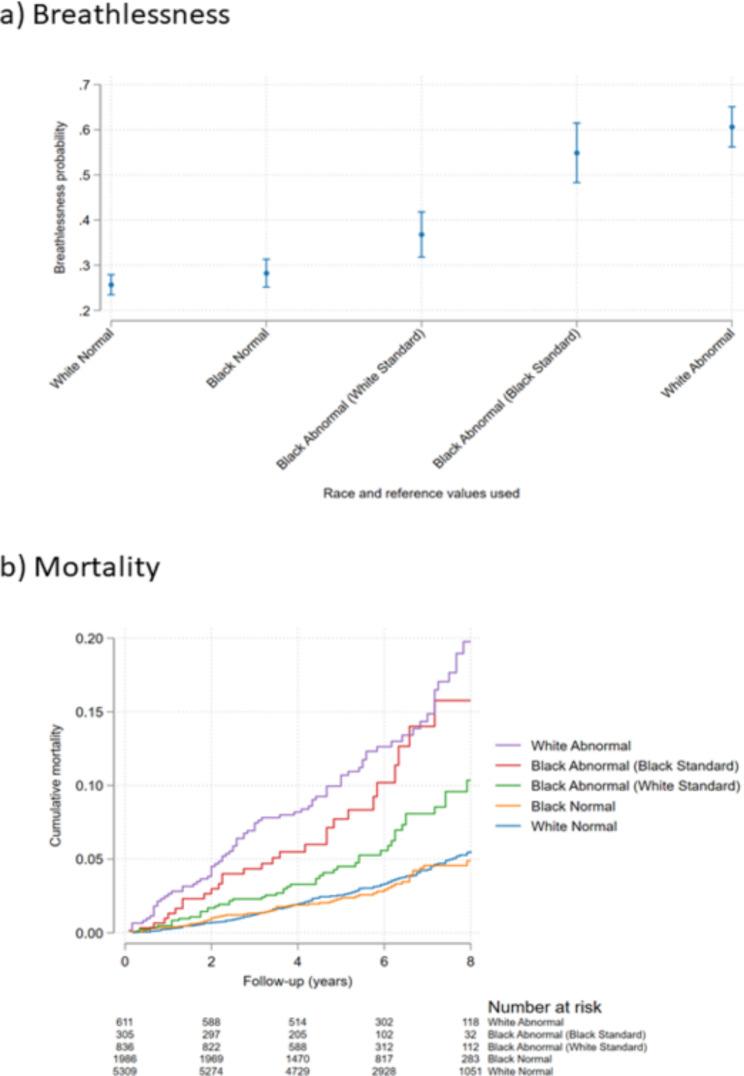
We studied 14,123 people (50% female). Compared to those for white, black reference values identified markedly fewer cases of lung function impairment (FEV) both in black people (9.3% vs. 36.9%) and other non-white (1.5% vs. 9.5%); and prevalence of moderate/severe impairment was approximately halved. Outcomes by impairment differed by reference used: white (best), other/mixed (intermediate), and black (worst outcomes). Black people with FEV ≥ LLN but < LLN had 48% increased rate of breathlessness and almost doubled mortality, compared to blacks ≥ LLN. White references identified people with good outcomes similarly in black and white people. Findings were similar for FEV and FVC.
CONCLUSION
Compared to using a common reference (for white) across the population, race-specific spirometry references did not improve prediction of breathlessness and prognosis, and may misclassify lung function as normal despite worse outcomes in black people.
背景
肺功能参考值因种族/民族而异,这存在争议。我们评估了种族特异性参考值对美国人群肺功能损害的流行程度及其与呼吸困难和死亡率的关系的影响。
方法
对 2007-2012 年国家健康和营养检查调查(NHANES)进行基于人群的分析。种族/民族分析为黑人、白人或其他。使用全球肺倡议(GLI)-2012 方程为每个人计算了一秒用力呼气量(FEV)和用力肺活量(FVC)的参考值,用于(1)白人;(2)黑人;和(3)其他人/混合人。结果是肺功能损害的流行程度(<正常下限[LLN])、中重度损害(<50%预测值)、运动性呼吸困难和截至 2015 年 12 月 31 日的死亡率。
结果
我们研究了 14123 人(50%为女性)。与白人参考值相比,黑人参考值明显较少地识别出黑人(9.3%对 36.9%)和其他非白人(1.5%对 9.5%)的肺功能损害病例;中重度损害的患病率约减半。使用不同的参考值,结果因损害而异:白人(最佳)、其他人/混合(中等)和黑人(最差)。与黑人≥LLN 相比,FEV≥LLN 但<LLN 的黑人呼吸困难发生率增加 48%,死亡率几乎翻了一番。白人参考值在黑人和白人中同样确定了具有良好结果的人群。FEV 和 FVC 的结果相似。
结论
与在人群中使用通用参考值(用于白人)相比,种族特异性肺功能参考值并未改善呼吸困难和预后的预测,并且可能错误地将黑人的肺功能分类为正常,尽管结果较差。
 Zotero 插件