
番茄耐盐机制及其在应对盐度方面的潜在应用:综述
Tomato salt tolerance mechanisms and their potential applications for fighting salinity: A review.
作者信息
Guo Meng, Wang Xin-Sheng, Guo Hui-Dan, Bai Sheng-Yi, Khan Abid, Wang Xiao-Min, Gao Yan-Ming, Li Jian-She
机构信息
School of Agriculture, Ningxia University, Yinchuan, China.
Key Laboratory of Modern Molecular Breeding for Dominant and Special Crops in Ningxia, Yinchuan, China.
出版信息
Front Plant Sci. 2022 Sep 14;13:949541. doi: 10.3389/fpls.2022.949541. eCollection 2022.
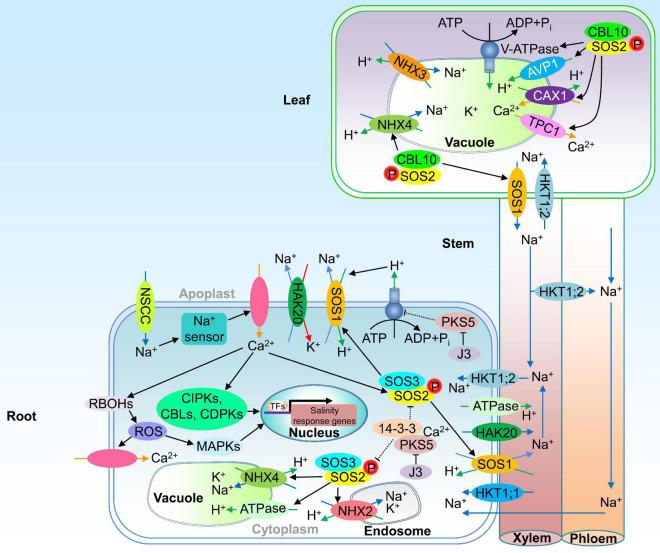
One of the most significant environmental factors affecting plant growth, development and productivity is salt stress. The damage caused by salt to plants mainly includes ionic, osmotic and secondary stresses, while the plants adapt to salt stress through multiple biochemical and molecular pathways. Tomato ( L.) is one of the most widely cultivated vegetable crops and a model dicot plant. It is moderately sensitive to salinity throughout the period of growth and development. Biotechnological efforts to improve tomato salt tolerance hinge on a synthesized understanding of the mechanisms underlying salinity tolerance. This review provides a comprehensive review of major advances on the mechanisms controlling salt tolerance of tomato in terms of sensing and signaling, adaptive responses, and epigenetic regulation. Additionally, we discussed the potential application of these mechanisms in improving salt tolerance of tomato, including genetic engineering, marker-assisted selection, and eco-sustainable approaches.
影响植物生长、发育和生产力的最重要环境因素之一是盐胁迫。盐对植物造成的损害主要包括离子胁迫、渗透胁迫和次生胁迫,而植物通过多种生化和分子途径适应盐胁迫。番茄(L.)是种植最广泛的蔬菜作物之一,也是双子叶模式植物。它在整个生长发育过程中对盐分中度敏感。提高番茄耐盐性的生物技术工作取决于对耐盐性潜在机制的综合理解。本文综述了番茄在感知和信号传导、适应性反应以及表观遗传调控等方面控制耐盐性机制的主要进展。此外,我们还讨论了这些机制在提高番茄耐盐性方面的潜在应用,包括基因工程、标记辅助选择和生态可持续方法。

 Zotero 插件