
桑科(Moraceae)植物叶绿体基因组的比较分析:对适应性进化和突变热点区域的洞察
Comparative chloroplast genome analysis of (Moraceae): Insight into adaptive evolution and mutational hotspot regions.
作者信息
Zhang Zheng-Ren, Yang Xue, Li Wei-Ying, Peng Yan-Qiong, Gao Jie
机构信息
CAS Key Laboratory of Tropical Forest Ecology, Xishuangbanna Tropical Botanical Garden, Chinese Academy of Sciences, Mengla, China.
University of Chinese Academy of Sciences, Beijing, China.
出版信息
Front Plant Sci. 2022 Sep 15;13:965335. doi: 10.3389/fpls.2022.965335. eCollection 2022.
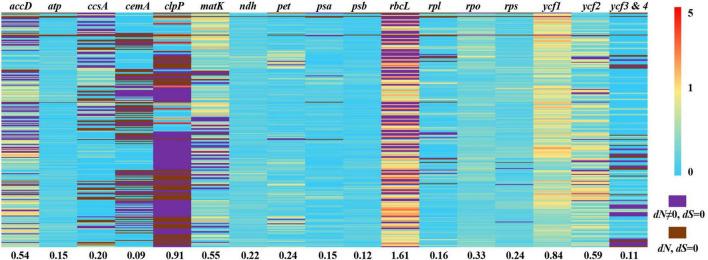
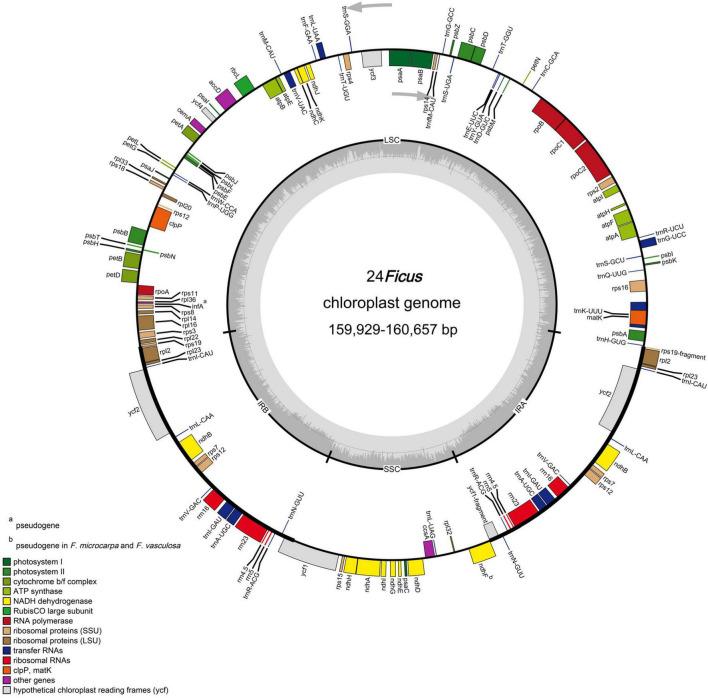
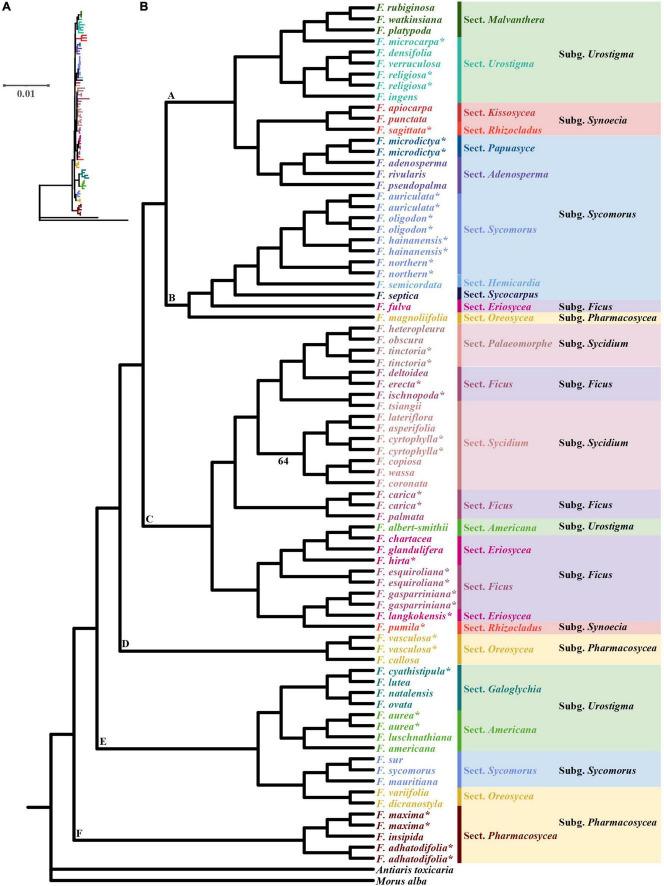
As the largest genus in Moraceae, is widely distributed across tropical and subtropical regions and exhibits a high degree of adaptability to different environments. At present, however, the phylogenetic relationships of this genus are not well resolved, and chloroplast evolution in remains poorly understood. Here, we sequenced, assembled, and annotated the chloroplast genomes of 10 species of , downloaded and assembled 13 additional species based on next-generation sequencing data, and compared them to 46 previously published chloroplast genomes. We found a highly conserved genomic structure across the genus, with plastid genome sizes ranging from 159,929 bp () to 160,657 bp (). Most chloroplasts encoded 113 unique genes, including a set of 78 protein-coding genes, 30 transfer RNA (tRNA) genes, four ribosomal RNA (rRNA) genes, and one pseudogene (). The number of simple sequence repeats (SSRs) ranged from 67 () to 89 () and generally increased linearly with plastid size. Among the plastomes, comparative analysis revealed eight intergenic spacers that were hotspot regions for divergence. Additionally, the , , and genes showed evidence of positive selection. Phylogenetic analysis indicated that none of the six traditionally recognized subgenera of were monophyletic. Divergence time analysis based on the complete chloroplast genome sequences showed that species diverged rapidly during the early to middle Miocene. This research provides basic resources for further evolutionary studies of .
作为桑科最大的属,[属名]广泛分布于热带和亚热带地区,对不同环境表现出高度适应性。然而,目前该属的系统发育关系尚未得到很好的解决,[属名]的叶绿体进化仍知之甚少。在此,我们对[属名]的10个物种的叶绿体基因组进行了测序、组装和注释,基于二代测序数据下载并组装了另外13个物种,并将它们与之前发表的46个叶绿体基因组进行了比较。我们发现该属的基因组结构高度保守,质体基因组大小从159,929 bp([物种名1])到16,657 bp([物种名2])不等。大多数叶绿体编码113个独特基因,包括一组78个蛋白质编码基因、30个转运RNA(tRNA)基因、4个核糖体RNA(rRNA)基因和1个假基因([基因名])。简单序列重复(SSR)的数量从67([物种名3])到89([物种名4])不等,并且通常随质体大小呈线性增加。在质体基因组中,比较分析揭示了8个基因间隔区是差异的热点区域。此外,[基因名1]、[基因名2]和[基因名3]基因显示出正选择的证据。系统发育分析表明,[属名]传统上认可的6个亚属均非单系。基于完整叶绿体基因组序列的分歧时间分析表明,[属名]物种在中新世早期至中期迅速分化。这项研究为[属名]的进一步进化研究提供了基础资源。


 Zotero 插件