
应用基于预训练深度学习的方法检测猴痘病毒。
Monkeypox Virus Detection Using Pre-trained Deep Learning-based Approaches.
机构信息
Department of Electrical and Computer Systems Engineering, Monash University, Wellignton Rd, Clayton, VIC, 3800, Australia.
School of Engineering and Technology, Central Queensland University, Norman Garden, QLD, 4701, Australia.
出版信息
J Med Syst. 2022 Oct 6;46(11):78. doi: 10.1007/s10916-022-01868-2.
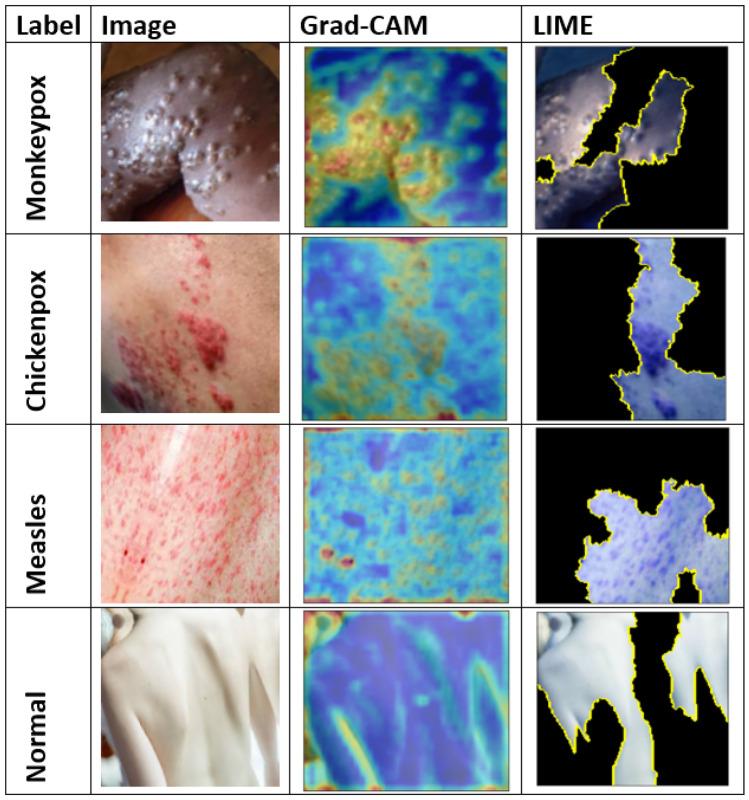
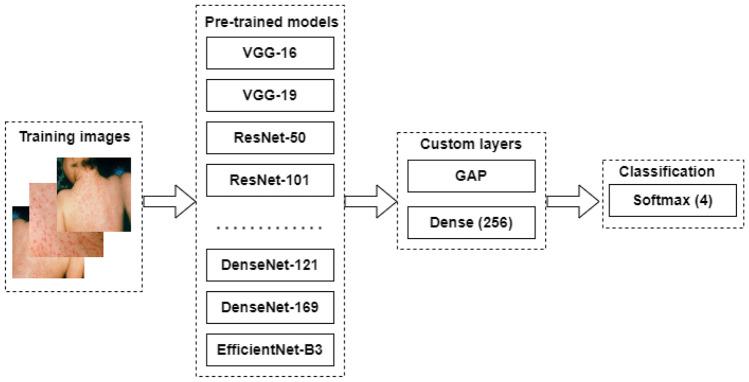
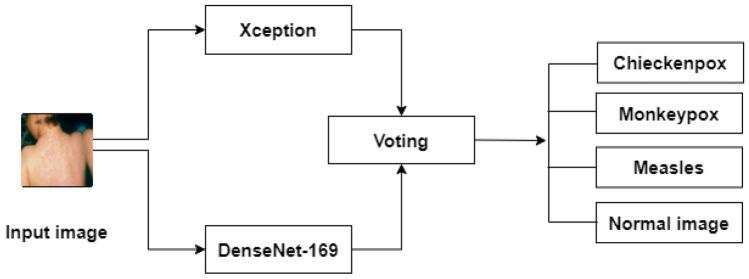
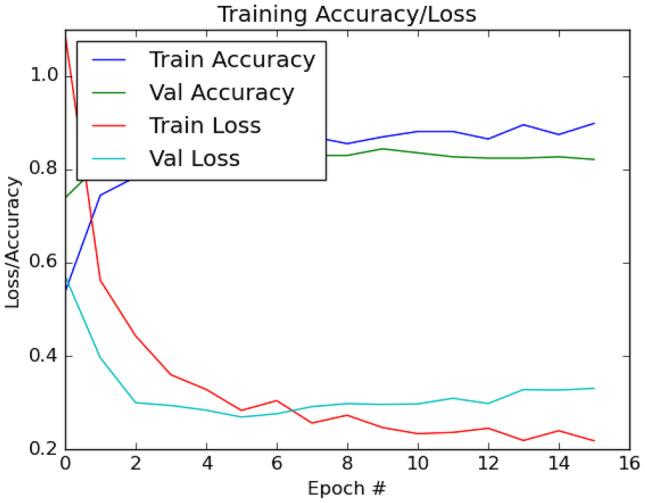
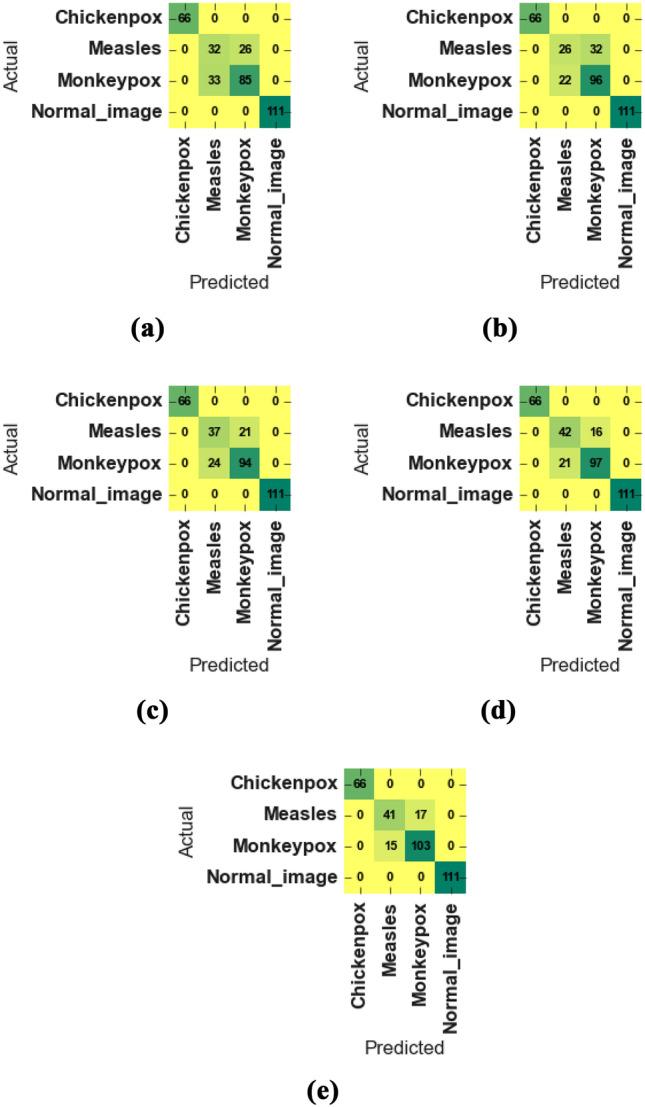
Monkeypox virus is emerging slowly with the decline of COVID-19 virus infections around the world. People are afraid of it, thinking that it would appear as a pandemic like COVID-19. As such, it is crucial to detect them earlier before widespread community transmission. AI-based detection could help identify them at the early stage. In this paper, we aim to compare 13 different pre-trained deep learning (DL) models for the Monkeypox virus detection. For this, we initially fine-tune them with the addition of universal custom layers for all of them and analyse the results using four well-established measures: Precision, Recall, F1-score, and Accuracy. After the identification of the best-performing DL models, we ensemble them to improve the overall performance using a majority voting over the probabilistic outputs obtained from them. We perform our experiments on a publicly available dataset, which results in average Precision, Recall, F1-score, and Accuracy of 85.44%, 85.47%, 85.40%, and 87.13%, respectively with the help of our proposed ensemble approach. These encouraging results, which outperform the state-of-the-art methods, suggest that the proposed approach is applicable to health practitioners for mass screening.
猴痘病毒随着全球 COVID-19 病毒感染的减少而缓慢出现。人们害怕它,认为它会像 COVID-19 一样出现大流行。因此,在广泛的社区传播之前尽早发现它们至关重要。基于人工智能的检测可以帮助在早期识别它们。在本文中,我们旨在比较 13 种不同的预训练深度学习 (DL) 模型用于猴痘病毒检测。为此,我们最初为它们都添加通用自定义层进行微调,并使用四个成熟的度量标准分析结果:精度、召回率、F1 分数和准确性。在确定性能最佳的 DL 模型后,我们使用多数投票法对它们进行集成,以通过它们获得的概率输出来提高整体性能。我们在一个公开的数据集上进行实验,在我们提出的集成方法的帮助下,平均精度、召回率、F1 分数和准确率分别为 85.44%、85.47%、85.40%和 87.13%。这些令人鼓舞的结果优于最先进的方法,表明所提出的方法适用于医疗保健从业者进行大规模筛查。
 Zotero 插件