
肿瘤微环境中谷氨酰胺代谢差异——多样性与异质性研究:一篇综述。
Differential glutamine metabolism in the tumor microenvironment - studies in diversity and heterogeneity: A mini-review.
作者信息
Claiborne Michael D, Leone Robert
机构信息
Department of Medicine, Scripps Green Hospital and Scripps Clinic, La Jolla, CA, United States.
Bloomberg-Kimmel Institute for Cancer Immunotherapy, Sidney Kimmel Comprehensive Cancer Center, Johns Hopkins Medicine, Baltimore, MD, United States.
出版信息
Front Oncol. 2022 Sep 20;12:1011191. doi: 10.3389/fonc.2022.1011191. eCollection 2022.
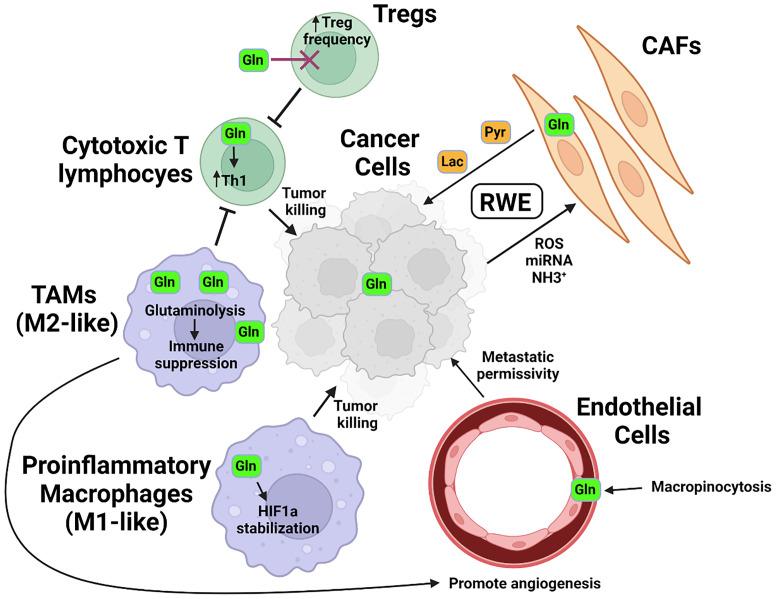
Increased glutamine metabolism is a hallmark of many cancer types. In recent years, our understanding of the distinct and diverse metabolic pathways through which glutamine can be utilized has grown more refined. Additionally, the different metabolic requirements of the diverse array of cell types within the tumor microenvironment complicate the strategy of targeting any particular glutamine pathway as cancer therapy. In this Mini-Review, we discuss recent advances in further clarifying the cellular fate of glutamine through different metabolic pathways. We further discuss potential promising strategies which exploit the different requirements of cells in the tumor microenvironment as it pertains to glutamine metabolism in an attempt to suppress cancer growth and enhance anti-tumor immune responses.
谷氨酰胺代谢增加是多种癌症类型的一个标志。近年来,我们对谷氨酰胺可通过的独特且多样的代谢途径的理解变得更加精细。此外,肿瘤微环境中多种细胞类型不同的代谢需求使将靶向任何特定谷氨酰胺途径作为癌症治疗策略变得复杂。在本综述中,我们讨论了在进一步阐明谷氨酰胺通过不同代谢途径的细胞命运方面的最新进展。我们还进一步讨论了潜在的有前景的策略,这些策略利用肿瘤微环境中细胞在谷氨酰胺代谢方面的不同需求,试图抑制癌症生长并增强抗肿瘤免疫反应。

 Zotero 插件