
健康与疾病中的人类肠道微生物群:揭示其关系。
Human gut microbiota in health and disease: Unveiling the relationship.
作者信息
Afzaal Muhammad, Saeed Farhan, Shah Yasir Abbas, Hussain Muzzamal, Rabail Roshina, Socol Claudia Terezia, Hassoun Abdo, Pateiro Mirian, Lorenzo José M, Rusu Alexandru Vasile, Aadil Rana Muhammad
机构信息
Department of Food Science, Government College University Faisalabad, Faisalabad, Pakistan.
National Institute of Food Science and Technology, University of Agriculture, Faisalabad, Pakistan.
出版信息
Front Microbiol. 2022 Sep 26;13:999001. doi: 10.3389/fmicb.2022.999001. eCollection 2022.
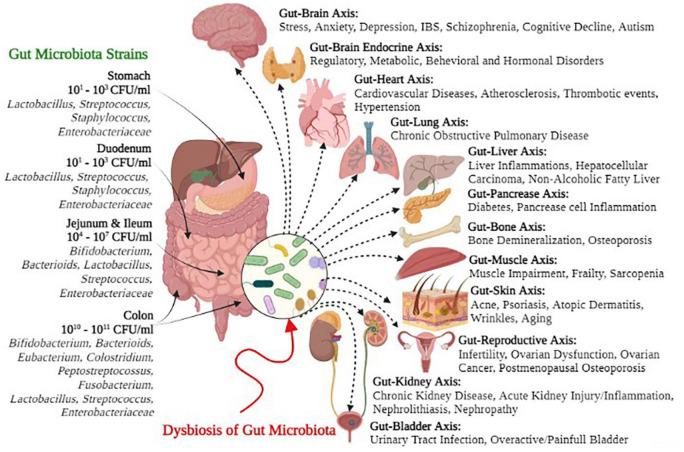
The human gut possesses millions of microbes that define a complex microbial community. The gut microbiota has been characterized as a vital organ forming its multidirectional connecting axis with other organs. This gut microbiota axis is responsible for host-microbe interactions and works by communicating with the neural, endocrinal, humoral, immunological, and metabolic pathways. The human gut microorganisms (mostly non-pathogenic) have symbiotic host relationships and are usually associated with the host's immunity to defend against pathogenic invasion. The dysbiosis of the gut microbiota is therefore linked to various human diseases, such as anxiety, depression, hypertension, cardiovascular diseases, obesity, diabetes, inflammatory bowel disease, and cancer. The mechanism leading to the disease development has a crucial correlation with gut microbiota, metabolic products, and host immune response in humans. The understanding of mechanisms over gut microbiota exerts its positive or harmful impacts remains largely undefined. However, many recent clinical studies conducted worldwide are demonstrating the relation of specific microbial species and eubiosis in health and disease. A comprehensive understanding of gut microbiota interactions, its role in health and disease, and recent updates on the subject are the striking topics of the current review. We have also addressed the daunting challenges that must be brought under control to maintain health and treat diseases.
人类肠道拥有数百万微生物,它们构成了一个复杂的微生物群落。肠道微生物群已被描述为一个重要器官,它与其他器官形成多向连接轴。这个肠道微生物群轴负责宿主与微生物的相互作用,并通过与神经、内分泌、体液、免疫和代谢途径进行通信来发挥作用。人类肠道微生物(大多数是非致病性的)与宿主具有共生关系,通常与宿主的免疫力相关联,以抵御病原体的入侵。因此,肠道微生物群的失调与多种人类疾病有关,如焦虑、抑郁、高血压、心血管疾病、肥胖症、糖尿病、炎症性肠病和癌症。导致疾病发展的机制与人类的肠道微生物群、代谢产物和宿主免疫反应密切相关。关于肠道微生物群如何产生其正面或有害影响的机制在很大程度上仍不明确。然而,最近在全球范围内进行的许多临床研究正在证明特定微生物物种与健康和疾病中的微生态平衡之间的关系。全面了解肠道微生物群的相互作用、其在健康和疾病中的作用以及该主题的最新进展是本综述的显著主题。我们还讨论了为维持健康和治疗疾病必须加以控制的艰巨挑战。

 Zotero 插件