
邻苯二胺与儿茶酚体系制备红色发射碳点的形成及荧光机理
Formation and fluorescent mechanism of red emissive carbon dots from o-phenylenediamine and catechol system.
作者信息
Li Pengfei, Xue Shanshan, Sun Lu, Zong Xupeng, An Li, Qu Dan, Wang Xiayan, Sun Zaicheng
机构信息
Center of Excellence for Environmental Safety and Biological Effects, Beijing Key Laboratory for Green Catalysis and Separation, Department of Chemistry, Beijing University of Technology, 100124, Beijing, China.
出版信息
Light Sci Appl. 2022 Oct 13;11(1):298. doi: 10.1038/s41377-022-00984-5.
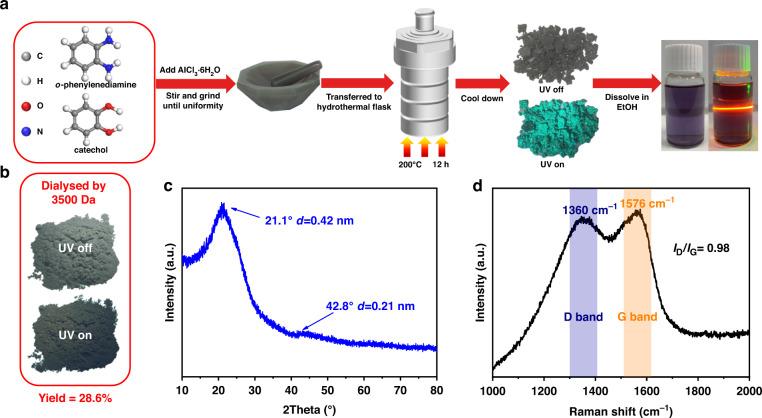
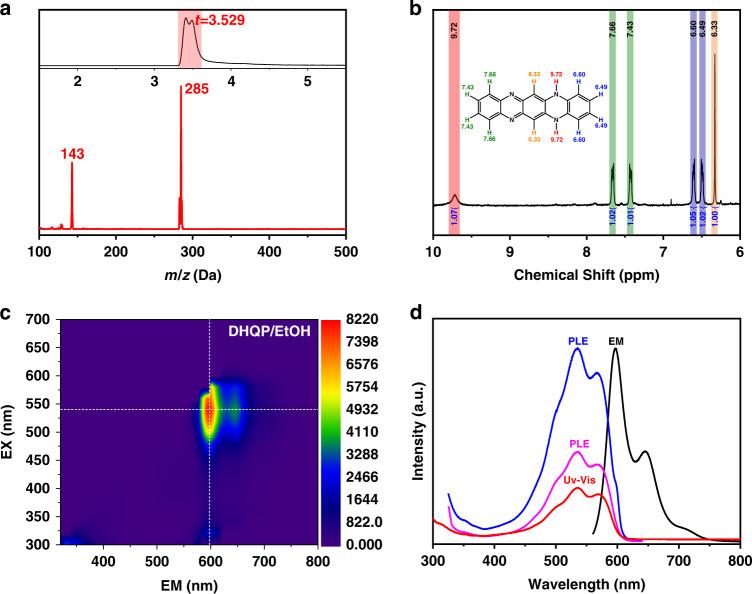
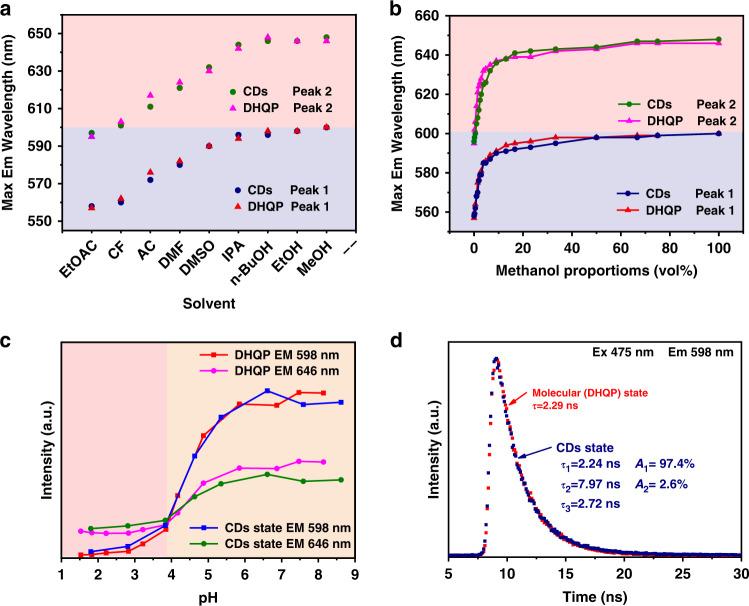
Carbon dots (CDs) as the advancing fluorescent carbon nanomaterial have superior potential and prospective. However, the ambiguous photoluminescence (PL) mechanism and intricate structure-function relationship become the greatest hindrances in the development and applications of CDs. Herein, red emissive CDs were synthesized in high yield from o-phenylenediamine (oPD) and catechol (CAT). The PL mechanism of the CDs is considered as the molecular state fluorophores because 5,14-dihydroquinoxalino[2,3-b] phenazine (DHQP) is separated and exhibits the same PL properties and behavior as the CDs. These include the peak position and shape of the PL emission and PL excitation and the emission dependence on pH and solvent polarity. Both of them display close PL lifetime decays. Based on these, we deduce that DHQP is the fluorophore of the red emissive CDs and the PL mechanism of CDs is similar to DHQP. During the PL emission of CDs, the electron of the molecule state can transfer to CDs. The formation process of DHQP is further confirmed by the reaction intermediates (phthalazine, dimers) and oPD. These findings provide insights into the PL mechanism of this type of CDs and may guide the further development of tunable CDs for tailored properties.
碳点(CDs)作为一种先进的荧光碳纳米材料具有巨大的潜力和前景。然而,其模糊的光致发光(PL)机制和复杂的结构-功能关系成为碳点开发与应用的最大障碍。在此,通过邻苯二胺(oPD)和儿茶酚(CAT)高产率合成了红色发射碳点。碳点的PL机制被认为是分子态荧光团,因为5,14-二氢喹喔啉并[2,3-b]吩嗪(DHQP)被分离出来,并且表现出与碳点相同的PL性质和行为。这些包括PL发射和PL激发的峰位置与形状以及发射对pH和溶剂极性的依赖性。它们两者都显示出相近的PL寿命衰减。基于这些,我们推断DHQP是红色发射碳点的荧光团,并且碳点的PL机制与DHQP相似。在碳点的PL发射过程中,分子态的电子可以转移到碳点上。反应中间体(酞嗪、二聚体)和oPD进一步证实了DHQP的形成过程。这些发现为这类碳点的PL机制提供了见解,并可能指导具有定制性质的可调谐碳点的进一步发展。




 Zotero 插件