
血小板 SR-PSOX/CXCL16-CXCR6 轴影响冠心病的血栓形成倾向和预后。
Platelet SR-PSOX/CXCL16-CXCR6 Axis Influences Thrombotic Propensity and Prognosis in Coronary Artery Disease.
机构信息
Department of Cardiology and Angiology, University Hospital Tübingen, Otfried Müller Straße 10, 72076 Tübingen, Germany.
Institute for Clinical Epidemiology and Applied Biostatistics, University Hospital Tübingen, 72076 Tübingen, Germany.
出版信息
Int J Mol Sci. 2022 Sep 21;23(19):11066. doi: 10.3390/ijms231911066.
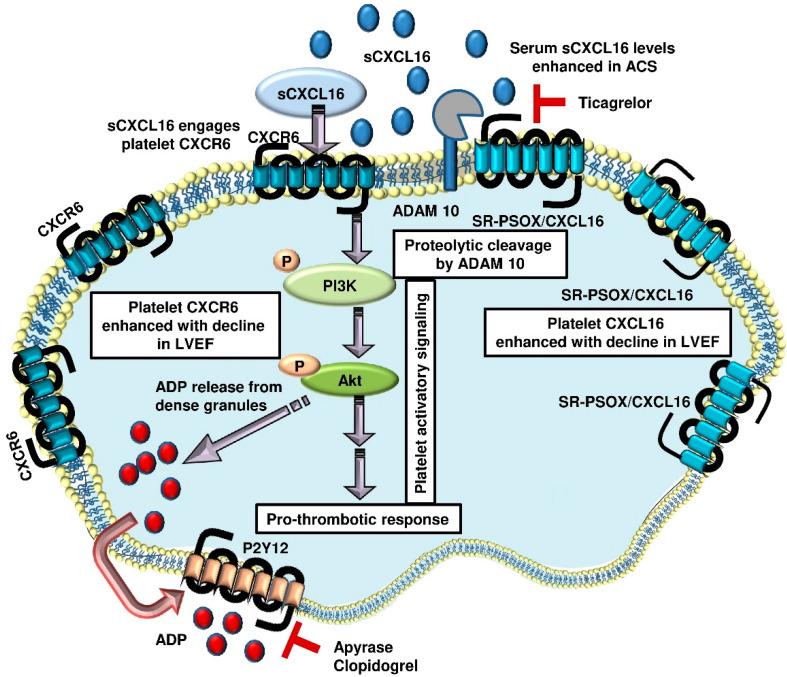
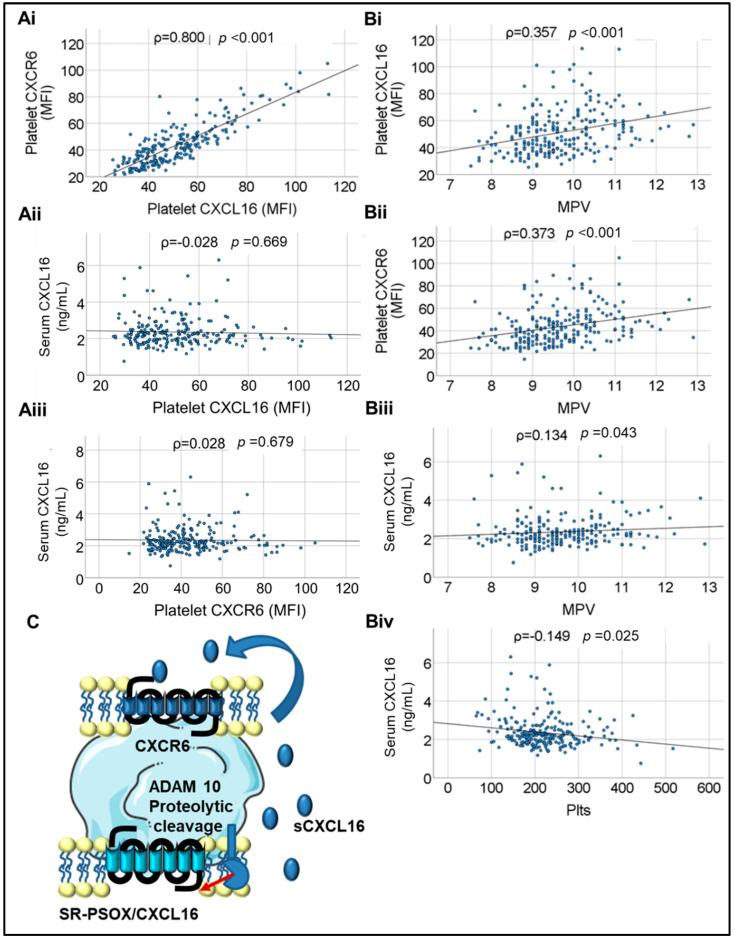
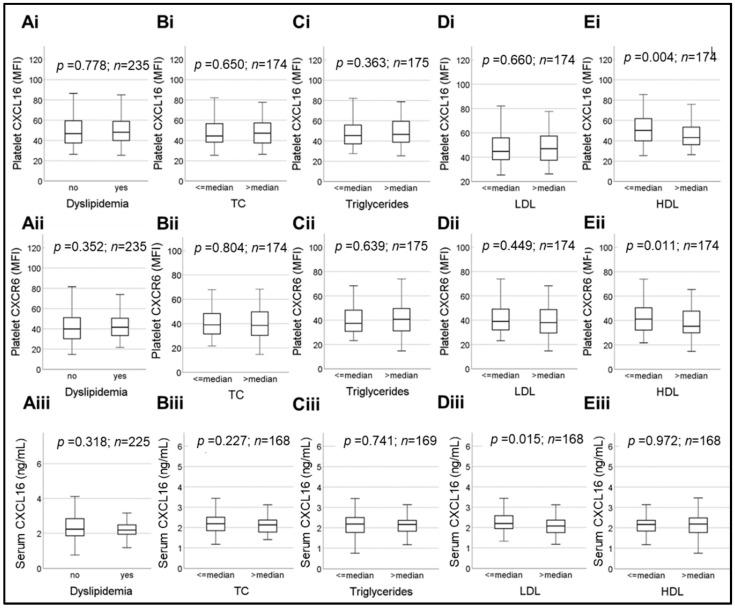
Platelets express the transmembrane chemokine SR-PSOX/CXCL16, proteolytic cleavage of which generates the sCXCL16 soluble-(s) chemokine. The sCXCL16 engages CXCR6 on platelets to synergistically propagate degranulation, aggregation and thrombotic response. Currently, we have investigated the pro-thrombotic and prognostic association of platelet CXCL16−CXCR6 axis in CAD-(n = 240; CCS n = 62; ACS n = 178) patients. Platelet surface-associated-CXCL16 and CXCR6 surface expression ascertained by flow cytometry correlated significantly with platelet activation markers (CD62P denoting degranulation and PAC-1 binding denoting α2bβ3-integrin activation). Higher platelet CXCL16 surface association (1st quartile vs. 2nd−4th quartiles) corresponded to significantly elevated collagen-induced platelet aggregation assessed by whole blood impedance aggregometry. Platelet-CXCL16 and CXCR6 expression did not alter with dyslipidemia, triglyceride, total cholesterol, or LDL levels, but higher (>median) plasma HDL levels corresponded with decreased platelet-CXCL16 and CXCR6. Although platelet-CXCL16 and CXCR6 expression did not change significantly with or correlate with troponin I levels, they corresponded with higher Creatine Kinase-(CK) activity and progressively deteriorating left ventricular ejection fraction (LVEF) at admission. Elevated-(4th quartile) platelet-CXCL16 (p = 0.023) and CXCR6 (p = 0.030) measured at admission were significantly associated with a worse prognosis. However, after Cox-PH regression analysis, only platelet-CXCL16 was ascertained as an independent predictor for all-cause of mortality. Therefore, the platelet CXCL16−CXCR6 axis may influence thrombotic propensity and prognosis in CAD patients.
血小板表达跨膜趋化因子 SR-PSOX/CXCL16,其蛋白水解切割生成可溶性-CXCL16(sCXCL16)趋化因子。sCXCL16 与血小板上的 CXCR6 结合,协同促进脱颗粒、聚集和血栓反应。目前,我们已经研究了血小板 CXCL16-CXCR6 轴在 CAD 患者(n=240;CCS 组 n=62;ACS 组 n=178)中的促血栓形成和预后相关性。通过流式细胞术确定的血小板表面相关-CXCL16 和 CXCR6 表面表达与血小板活化标志物(表示脱颗粒的 CD62P 和表示 α2bβ3 整合素激活的 PAC-1 结合)显著相关。通过全血阻抗聚集测定,与血小板 CXCL16 表面关联更高(第 1 四分位数与第 2-4 四分位数相比)与胶原诱导的血小板聚集显著升高相关。血小板-CXCL16 和 CXCR6 的表达不受血脂异常、甘油三酯、总胆固醇或 LDL 水平的影响,但较高(中位数以上)的血浆 HDL 水平与血小板-CXCL16 和 CXCR6 减少相关。尽管血小板-CXCL16 和 CXCR6 的表达没有随着肌钙蛋白 I 水平的变化而显著变化,也没有与之相关,但与较高的肌酸激酶(CK)活性和入院时逐渐恶化的左心室射血分数(LVEF)相关。入院时测定的血小板-CXCL16(p=0.023)和 CXCR6(p=0.030)的高水平(第 4 四分位数)与预后较差显著相关。然而,在 Cox-PH 回归分析后,仅血小板-CXCL16 被确定为全因死亡率的独立预测因子。因此,血小板 CXCL16-CXCR6 轴可能影响 CAD 患者的血栓形成倾向和预后。



 Zotero 插件