
近端肾小管重吸收的变化通过 TGF 系统调节微血管调节。
Changes in Proximal Tubular Reabsorption Modulate Microvascular Regulation via the TGF System.
机构信息
Department of Medicine, Division of Nephrology and Immunology, University of Alberta, Edmonton, AB T6G 2G3, Canada.
Department of Physiology, University of Alberta, Edmonton, AB T6G 2H7, Canada.
出版信息
Int J Mol Sci. 2022 Sep 23;23(19):11203. doi: 10.3390/ijms231911203.
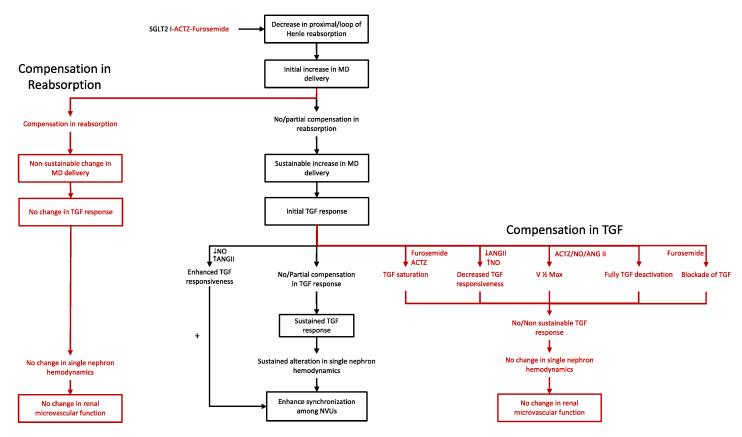
This review paper considers the consequences of modulating tubular reabsorption proximal to the macula densa by sodium-glucose co-transporter 2 (SGLT2) inhibitors, acetazolamide, and furosemide in states of glomerular hyperfiltration. SGLT2 inhibitors improve renal function in early and advanced diabetic nephropathy by decreasing the glomerular filtration rate (GFR), presumably by activating the tubuloglomerular feedback (TGF) mechanism. Central in this paper is that the renoprotective effects of SGLT2 inhibitors in diabetic nephropathy can only be partially explained by TGF activation, and there are alternative explanations. The sustained activation of TGF leans on two prerequisites: no or only partial adaptation should occur in reabsorption proximal to macula densa, and no or only partial adaptation should occur in the TGF response. The main proximal tubular and loop of Henle sodium transporters are sodium-hydrogen exchanger 3 (NHE3), SGLT2, and the Na-K-2Cl co-transporter (NKCC2). SGLT2 inhibitors, acetazolamide, and furosemide are the most important compounds; inhibiting these transporters would decrease sodium reabsorption upstream of the macula densa and increase TGF activity. This could directly or indirectly affect TGF responsiveness, which could oppose sustained TGF activation. Only SGLT2 inhibitors can sustainably activate the TGF as there is only partial compensation in tubular reabsorption and TGF response. SGLT2 inhibitors have been shown to preserve GFR in both early and advanced diabetic nephropathy. Other than for early diabetic nephropathy, a solid physiological basis for these effects in advanced nephropathy is lacking. In addition, TGF has hardly been studied in humans, and therefore this role of TGF remains elusive. This review also considers alternative explanations for the renoprotective effects of SGLT2 inhibitors in diabetic patients such as the enhancement of microvascular network function. Furthermore, combination use of SGLT2 inhibitors and angiotensin-converting enzyme inhibitors (ACEi) or angiotensin receptor blockers (ARBs). in diabetes can decrease inflammatory pathways, improve renal oxygenation, and delay the progression of diabetic nephropathy.
这篇综述文章探讨了在肾小球滤过过度状态下,通过钠-葡萄糖协同转运蛋白 2(SGLT2)抑制剂、乙酰唑胺和呋塞米调节近曲小管重吸收对肾脏的影响。SGLT2 抑制剂通过降低肾小球滤过率(GFR)改善早期和晚期糖尿病肾病患者的肾功能,推测是通过激活管球反馈(TGF)机制。本文的核心观点是,SGLT2 抑制剂在糖尿病肾病中的肾保护作用不能仅用 TGF 激活来部分解释,还有其他解释。TGF 的持续激活依赖于两个前提条件:近曲小管起始部重吸收没有或仅有部分适应,TGF 反应没有或仅有部分适应。主要的近曲小管和亨利袢升支粗段的钠离子转运体包括钠氢交换体 3(NHE3)、SGLT2 和钠-钾-2 氯共转运体(NKCC2)。SGLT2 抑制剂、乙酰唑胺和呋塞米是最重要的化合物;抑制这些转运体可减少致密斑上游的钠离子重吸收,增加 TGF 活性。这可能直接或间接影响 TGF 反应性,从而抑制 TGF 的持续激活。只有 SGLT2 抑制剂才能可持续激活 TGF,因为在肾小管重吸收和 TGF 反应方面仅有部分代偿。SGLT2 抑制剂已被证明可在早期和晚期糖尿病肾病中维持 GFR。除了早期糖尿病肾病外,晚期肾病中这些作用的坚实生理基础尚缺乏。此外,TGF 在人类中的研究甚少,因此 TGF 的作用仍然难以捉摸。本文还考虑了 SGLT2 抑制剂在糖尿病患者中的肾保护作用的其他解释,如增强微血管网络功能。此外,SGLT2 抑制剂与血管紧张素转换酶抑制剂(ACEi)或血管紧张素受体阻滞剂(ARB)联合使用可减少炎症途径,改善肾脏氧合,延缓糖尿病肾病的进展。

 Zotero 插件