
糖尿病肾病:治疗进展减缓支柱的最新进展。
Diabetic Nephropathy: Update on Pillars of Therapy Slowing Progression.
机构信息
Section of Endocrinology, Diabetes, and Metabolism, Department of Medicine, and American Heart Association Comprehensive Hypertension Center, University of Chicago Medicine, Chicago, IL.
出版信息
Diabetes Care. 2023 Sep 1;46(9):1574-1586. doi: 10.2337/dci23-0030.
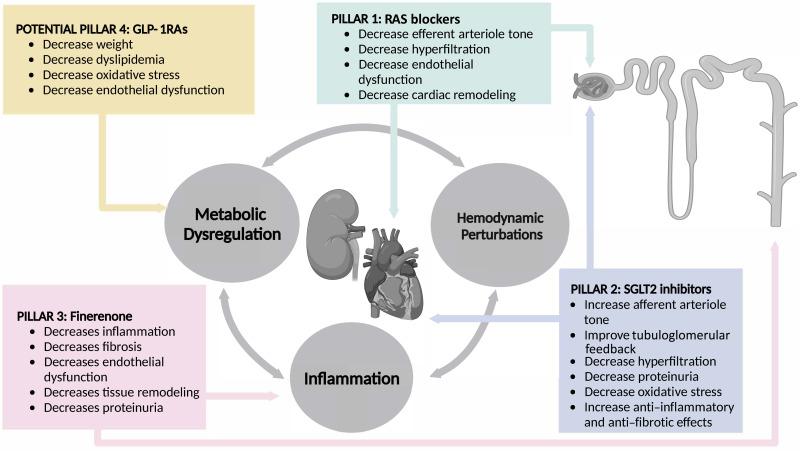
Management of diabetic kidney disease (DKD) has evolved in parallel with our growing understanding of the multiple interrelated pathophysiological mechanisms that involve hemodynamic, metabolic, and inflammatory pathways. These pathways and others play a vital role in the initiation and progression of DKD. Since its initial discovery, the blockade of the renin-angiotensin system has remained a cornerstone of DKD management, leaving a large component of residual risk to be dealt with. The advent of sodium-glucose cotransporter 2 inhibitors followed by nonsteroidal mineralocorticoid receptor antagonists and, to some extent, glucagon-like peptide 1 receptor agonists (GLP-1 RAs) has ushered in a resounding paradigm shift that supports a pillared approach in maximizing treatment to reduce outcomes. This pillared approach is like that derived from the approach to heart failure treatment. The approach mandates that all agents that have been shown in clinical trials to reduce cardiovascular outcomes and/or mortality to a greater extent than a single drug class alone should be used in combination. In this way, each drug class focuses on a specific aspect of the disease's pathophysiology. Thus, in heart failure, β-blockers, sacubitril/valsartan, a mineralocorticoid receptor antagonist, and a diuretic are used together. In this article, we review the evolution of the pillar concept of therapy as it applies to DKD and discuss how it should be used based on the outcome evidence. We also discuss the exciting possibility that GLP-1 RAs may be an additional pillar in the quest to further slow kidney disease progression in diabetes.
糖尿病肾病(DKD)的管理与我们对涉及血液动力学、代谢和炎症途径的多种相互关联的病理生理机制的理解同步发展。这些途径和其他途径在 DKD 的发生和进展中起着至关重要的作用。自最初发现以来,肾素-血管紧张素系统的阻断一直是 DKD 管理的基石,但仍有很大一部分剩余风险需要处理。钠-葡萄糖共转运蛋白 2 抑制剂的出现,随后是非甾体类盐皮质激素受体拮抗剂,在某种程度上还有胰高血糖素样肽 1 受体激动剂(GLP-1 RAs),这带来了一个响亮的范式转变,支持采用多药物联合治疗以最大限度地降低疾病风险。这种多药物联合治疗方法类似于心力衰竭治疗方法。该方法要求所有在临床试验中已被证明能更有效地降低心血管结局和/或死亡率的药物,都应联合使用,而不仅仅是单一药物类别。通过这种方式,每种药物类别都专注于疾病病理生理学的特定方面。因此,在心力衰竭中,β受体阻滞剂、沙库巴曲缬沙坦、盐皮质激素受体拮抗剂和利尿剂一起使用。在本文中,我们回顾了治疗支柱概念的演变,以及它如何根据结局证据在 DKD 中的应用。我们还讨论了 GLP-1 RAs 可能成为糖尿病肾病进展进一步减缓的另一个治疗支柱的令人兴奋的可能性。
 Zotero 插件