
非奈利酮与螺内酯在中重度慢性肾脏病顽固性高血压中的事后比较分析
A comparative post hoc analysis of finerenone and spironolactone in resistant hypertension in moderate-to-advanced chronic kidney disease.
作者信息
Agarwal Rajiv, Pitt Bertram, Palmer Biff F, Kovesdy Csaba P, Burgess Ellen, Filippatos Gerasimos, Małyszko Jolanta, Ruilope Luis M, Rossignol Patrick, Rossing Peter, Pecoits-Filho Roberto, Anker Stefan D, Joseph Amer, Lawatscheck Robert, Wilson Daniel, Gebel Martin, Bakris George L
机构信息
Richard L. Roudebush VA Medical Center and Indiana University, Indianapolis, IN, USA.
Department of Medicine, University of Michigan School of Medicine, Ann Arbor, MI, USA.
出版信息
Clin Kidney J. 2022 Oct 30;16(2):293-302. doi: 10.1093/ckj/sfac234. eCollection 2023 Feb.
BACKGROUND
Mineralocorticoid receptor antagonists (MRAs) reduce systolic blood pressure (SBP) and increase serum potassium concentration ([K]). This indirect comparison investigated any differences in SBP-lowering and hyperkalemia risk between finerenone, a nonsteroidal MRA, and the steroidal MRA spironolactone ± a potassium binder.
METHODS
In FIDELITY (a pooled analysis of FIDELIO-DKD and FIGARO-DKD), a subgroup of patients with treatment-resistant hypertension (TRH) and chronic kidney disease meeting eligibility criteria of the AMBER trial were identified (FIDELITY-TRH). The main outcomes were mean change in SBP, incidence of serum [K] ≥5.5 mmol/L and hyperkalemia-associated treatment discontinuation. Results at ∼17 weeks were compared with 12 weeks from AMBER.
RESULTS
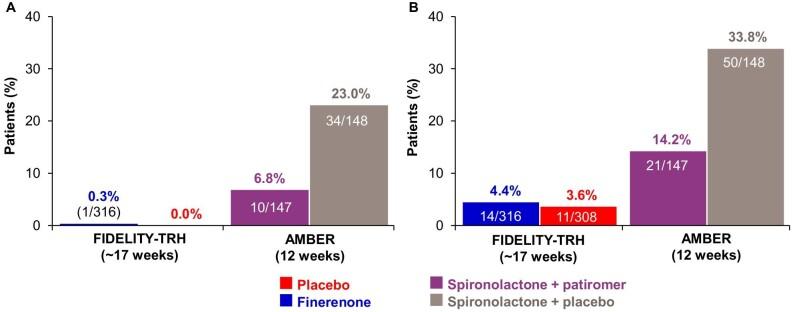
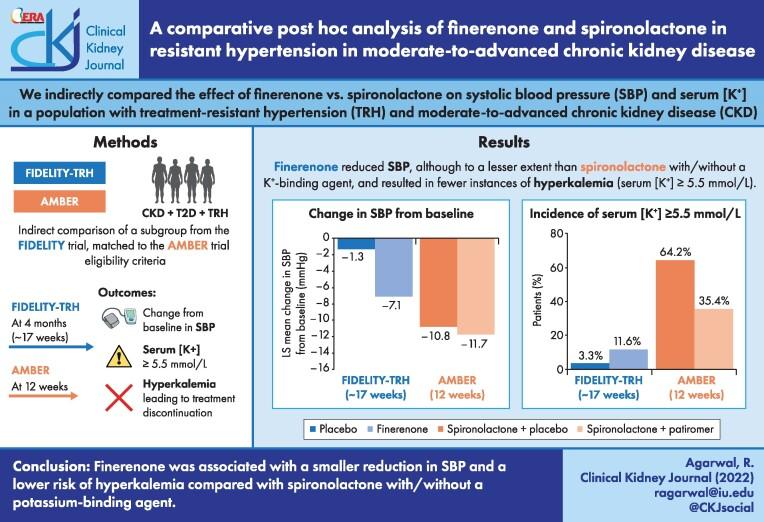
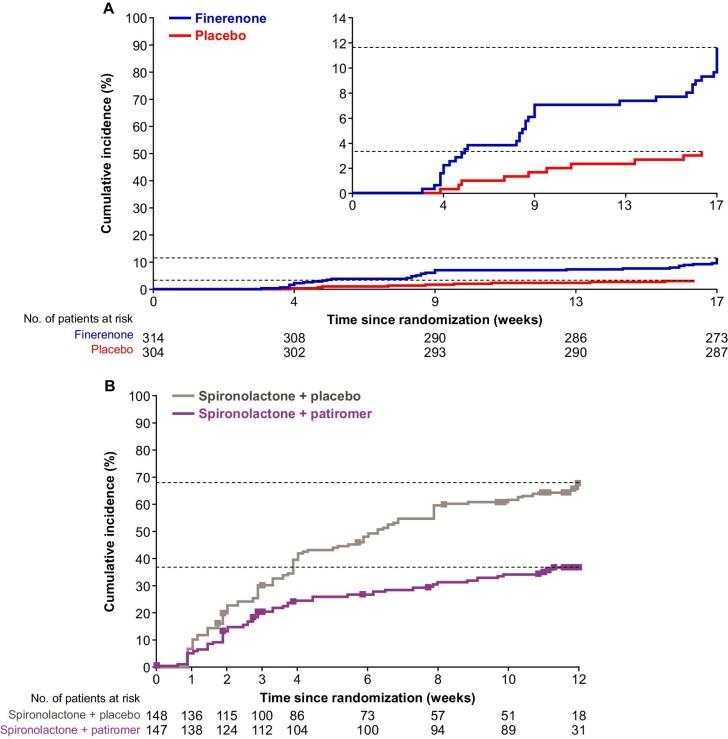
In 624 FIDELITY-TRH patients and 295 AMBER patients, the least squares mean change in SBP (mmHg) from baseline was -7.1 for finerenone and -1.3 for placebo {between-group difference -5.74 [95% confidence interval (CI) -7.99 to -3.49], < .0001} versus -11.7 for spironolactone + patiromer and -10.8 for spironolactone + placebo [between-group difference -1.0 (95% CI -4.4-2.4), = .58]. The incidence of serum [K] ≥5.5 mmol/L was 12% for finerenone and 3% for placebo versus 35% with spironolactone + patiromer and 64% with spironolactone + placebo. Treatment discontinuation due to hyperkalemia was 0.3% for finerenone and 0% for placebo versus 7% for spironolactone + patiromer and 23% for spironolactone + placebo.
CONCLUSIONS
In patients with TRH and chronic kidney disease compared with spironolactone with or without patiromer, finerenone was associated with a lower SBP reduction and lower risk of hyperkalemia and treatment discontinuation. AMBER (NCT03071263), FIDELIO-DKD (NCT02540993), FIGARO-DKD (NCT02545049).
背景
盐皮质激素受体拮抗剂(MRAs)可降低收缩压(SBP)并提高血清钾浓度([K])。本间接比较研究了非甾体类MRA非奈利酮与甾体类MRA螺内酯±钾结合剂在降低SBP和高钾血症风险方面的差异。
方法
在FIDELITY(FIDELIO-DKD和FIGARO-DKD的汇总分析)中,确定了一组符合AMBER试验纳入标准的难治性高血压(TRH)和慢性肾脏病患者亚组(FIDELITY-TRH)。主要结局指标为SBP的平均变化、血清[K]≥5.5 mmol/L的发生率以及高钾血症相关的治疗中断情况。将约17周时的结果与AMBER试验12周时的结果进行比较。
结果
在624例FIDELITY-TRH患者和295例AMBER患者中,非奈利酮组SBP自基线的最小二乘均值变化(mmHg)为-7.1,安慰剂组为-1.3{组间差异-5.74[95%置信区间(CI)-7.99至-3.49],P<0.0001};而螺内酯+帕替罗姆组为-11.7,螺内酯+安慰剂组为-10.8[组间差异-1.0(95%CI-4.4至2.4),P=0.58]。血清[K]≥5.5 mmol/L的发生率,非奈利酮组为12%,安慰剂组为3%;螺内酯+帕替罗姆组为35%,螺内酯+安慰剂组为64%。因高钾血症导致的治疗中断率,非奈利酮组为0.3%,安慰剂组为0%;螺内酯+帕替罗姆组为7%,螺内酯+安慰剂组为23%。
结论
在TRH和慢性肾脏病患者中,与联用或未联用帕替罗姆的螺内酯相比,非奈利酮降低SBP的幅度较小,高钾血症及治疗中断风险较低。AMBER(NCT03071263)、FIDELIO-DKD(NCT02540993)、FIGARO-DKD(NCT02545049)。

 Zotero 插件