
聚磺苯乙烯钠与安慰剂在抵抗性高血压和慢性肾脏病患者中联合螺内酯使用(AMBER):预先设定亚组心力衰竭的结果。
Patiromer versus placebo to enable spironolactone use in patients with resistant hypertension and chronic kidney disease (AMBER): results in the pre-specified subgroup with heart failure.
机构信息
Université de Lorraine, Inserm 1433 CIC-P CHRU de Nancy, Inserm U1116 and FCRIN INI-CRCT, Nancy, France.
Institute of Cardiovascular Science University College London (UCL) and National Institute for Health Research (NIHR) UCL/UCL Hospitals Biomedical Research Centre, London, UK.
出版信息
Eur J Heart Fail. 2020 Aug;22(8):1462-1471. doi: 10.1002/ejhf.1860. Epub 2020 May 25.
AIMS
The AMBER trial demonstrated that concomitant use of patiromer enabled the more persistent use of spironolactone by reducing the risk of hyperkalaemia in patients with resistant hypertension and advanced chronic kidney disease. We report herein the pre-specified subgroup analysis in patients with heart failure (HF).
METHODS AND RESULTS
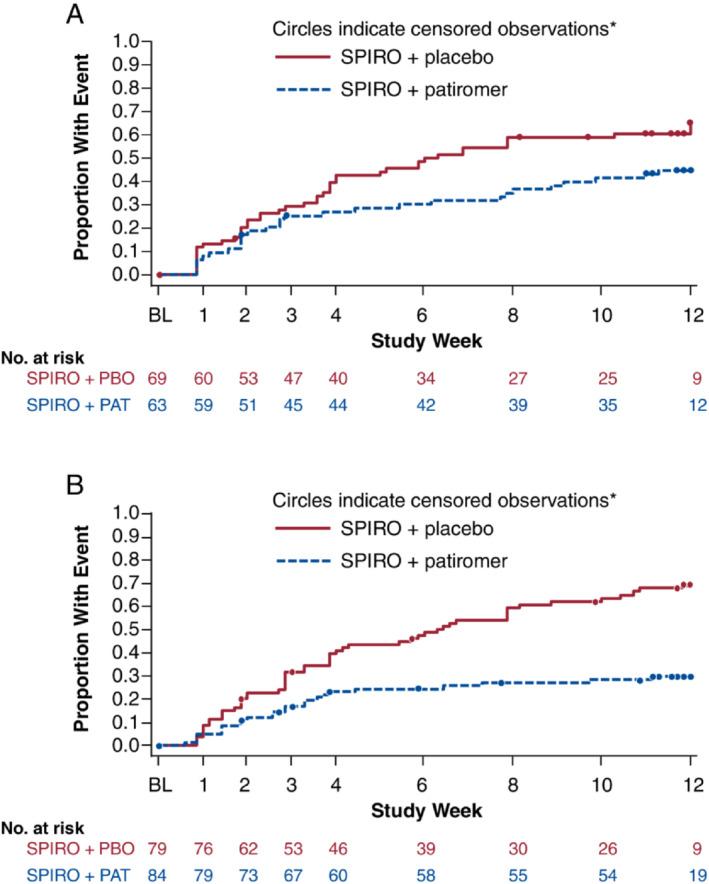
Participants were randomly assigned (1:1) to receive either placebo or patiromer (8.4 g once daily), in addition to open-label spironolactone (starting at 25 mg once daily) and their baseline blood pressure medications. Dose titrations were permitted after 1 week for patiromer/placebo and after 3 weeks for spironolactone. The primary endpoint was the between-group difference at week 12 in the proportion of patients on spironolactone. Efficacy endpoints and safety were assessed in all randomized patients (intention to treat). A total of 295 patients were enrolled, of whom 132 (45%) had HF. In the HF subgroup, 68.1% of patients receiving placebo remained on spironolactone at week 12, compared with 84.1% of patients receiving patiromer (P = 0.0504). The reason for discontinuation from spironolactone use was hyperkalaemia in the majority of both groups. There was no significant interaction between the subgroups with HF and without HF (P = 0.8085) for the primary endpoint.
CONCLUSIONS
Consistent with the overall AMBER trial results, this pre-specified subgroup analysis in patients with HF, resistant hypertension and advanced chronic kidney disease demonstrated that patiromer enabled more persistent use of spironolactone by reducing the risk of hyperkalaemia.
目的
AMBER 试验表明,培哚普利胺的联合使用通过降低耐治疗性高血压和晚期慢性肾脏病患者高钾血症的风险,使螺内酯的持续使用更为持久。我们在此报告心力衰竭(HF)患者的预先指定亚组分析。
方法和结果
参与者被随机分配(1:1)接受安慰剂或培哚普利胺(每天 8.4 g 一次),外加开放标签螺内酯(每天 25mg 一次)和他们的基线降压药物。培哚普利胺/安慰剂在 1 周后和螺内酯在 3 周后允许剂量滴定。主要终点是在第 12 周时接受培哚普利胺/安慰剂治疗的患者中继续使用螺内酯的比例与接受安慰剂治疗的患者之间的差异。在所有随机患者(意向治疗)中评估疗效终点和安全性。共纳入 295 例患者,其中 132 例(45%)患有 HF。在 HF 亚组中,68.1%接受安慰剂的患者在第 12 周时继续使用螺内酯,而接受培哚普利胺的患者为 84.1%(P=0.0504)。两组中大多数患者因高钾血症而停止使用螺内酯。在主要终点方面,HF 亚组和无 HF 亚组之间没有显著的相互作用(P=0.8085)。
结论
与 AMBER 试验的总体结果一致,这项预先指定的心力衰竭、耐治疗性高血压和晚期慢性肾脏病患者的亚组分析表明,培哚普利胺通过降低高钾血症的风险,使螺内酯的持续使用更为持久。


 Zotero 插件