
新冠疫情在经济、医疗可及性及心理影响方面的种族差异:与恢复力相关的个人资源
Race-related differences in the economic, healthcare-access, and psychological impact of COVID-19: personal resources associated with resilience.
作者信息
Schwartz Carolyn E, Borowiec Katrina, Biletch Elijah, Rapkin Bruce D
机构信息
DeltaQuest Foundation, Inc., 31 Mitchell Road, Concord, MA, 01742, USA.
Departments of Medicine and Orthopaedic Surgery, Tufts University Medical School, Boston, MA, USA.
出版信息
J Patient Rep Outcomes. 2022 Oct 17;6(1):113. doi: 10.1186/s41687-022-00514-2.
BACKGROUND
The impact of the coronavirus disease 2019 (COVID) is worse among those with fewer financial resources, in jobs not amenable to remote work, and in denser living conditions. People of color are more likely to be among these vulnerable groups. Although race itself is a social construction and not based on underlying genetic/biological differences, this study investigated race/ethnicity differences in the negative repercussions of COVID and in the benefits of psychological and social resources.
METHODS
This cross-sectional, web-based study (n = 4817) was administered to a heterogeneous United States sample in Spring/Summer 2020. Information was gathered on the following COVID-specific variables: Infection Status, Coping with Lockdown, Social Support, Post-traumatic Growth, Interpersonal Conflict, Worry about Self, Financial Impact on Family, Lack of Money, Inadequate Access to Healthcare, and Housing Instability. Resilience was operationalized as the ability to maintain a sense of wellness in the face of the pandemic, using the DeltaQuest Wellness measure. Multivariate linear regression (adjusting for demographics) and propensity-matched cohort analysis (matched on demographics) evaluated the impact of COVID-specific variables on Wellness in separate models for Whites and Non-Whites.
FINDINGS
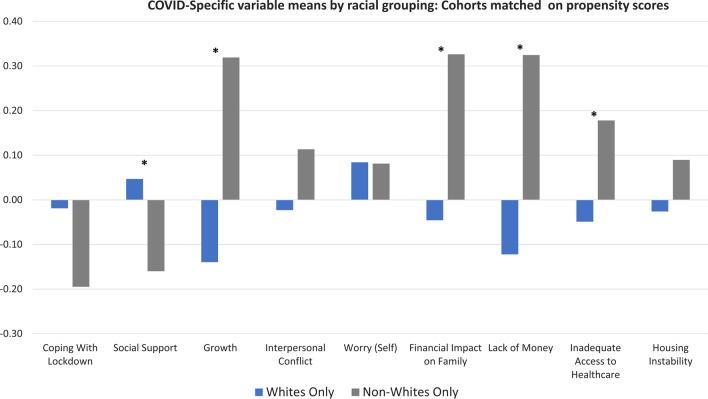
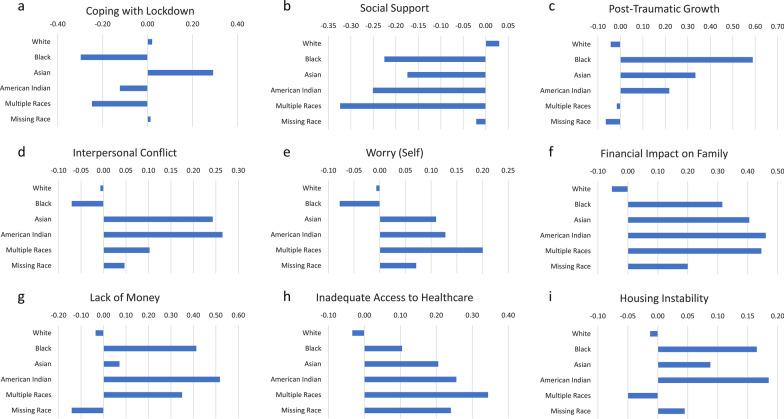
Both sets of models retained the same COVID-specific variables and explained about half of the variance in wellness. Coping with Lockdown, Social Support, and Post-traumatic Growth were associated with higher levels of Wellness in both Whites and Non-Whites, while Interpersonal Conflict and Worry about Self were associated with lower levels of Wellness. While these associations are similar, Non-Whites reported worse levels of some positive resources (e.g., social support) and more challenging levels of negative stressors (e.g., interpersonal, worry, financial). Non-Whites also reported much higher levels of post-traumatic growth.
CONCLUSION
COVID was a source of worry and even conflict, but also unlocked people's resources in use of health-enhancing behavioral strategies, social support, and renewed gratitude for sources of personal meaning and value. The similar relationships between Whites and Non-Whites on wellness and COVID-specific stressors across racial groups underscore that race is a social construction, not a biological fact. Focusing on a renewed appreciation for sources of personal meaning, and particularly faith, seemed to buffer much of the COVID-related stress for Non-Whites.
背景
2019冠状病毒病(COVID)对那些经济资源较少、从事无法远程工作的职业以及居住环境更为密集的人群影响更为严重。有色人种更有可能属于这些弱势群体。尽管种族本身是一种社会建构,并非基于潜在的基因/生物学差异,但本研究调查了COVID负面影响以及心理和社会资源益处方面的种族/族裔差异。
方法
2020年春夏对来自美国的异质样本进行了这项基于网络的横断面研究(n = 4817)。收集了以下与COVID相关的特定变量信息:感染状况、应对封锁措施、社会支持、创伤后成长、人际冲突、对自身的担忧、对家庭的经济影响、资金短缺、医疗保健获取不足以及住房不稳定。使用DeltaQuest健康指标,将复原力定义为面对疫情仍能保持健康感的能力。多变量线性回归(对人口统计学因素进行调整)和倾向匹配队列分析(按人口统计学因素进行匹配)在针对白人和非白人的单独模型中评估了与COVID相关的特定变量对健康的影响。
研究结果
两组模型保留了相同的与COVID相关的特定变量,并解释了约一半的健康差异。应对封锁措施、社会支持和创伤后成长与白人和非白人的较高健康水平相关,而人际冲突和对自身的担忧与较低的健康水平相关。虽然这些关联相似,但非白人报告的一些积极资源(如社会支持)水平较差,负面压力源(如人际、担忧、经济方面)的挑战性水平更高。非白人还报告了更高水平的创伤后成长。
结论
COVID是担忧甚至冲突的来源,但同时也激发了人们在采用促进健康的行为策略、社会支持以及重新感激个人意义和价值来源方面的资源。不同种族群体中白人和非白人在健康与COVID相关应激源之间的相似关系强调了种族是一种社会建构,而非生物学事实。对个人意义来源,尤其是对信仰的重新重视,似乎缓冲了非白人许多与COVID相关的压力。


 Zotero 插件