
HYDRHA:透明质酸水凝胶。癌症、神经退行性疾病和组织工程中的新生物医学方法。
HYDRHA: Hydrogels of hyaluronic acid. New biomedical approaches in cancer, neurodegenerative diseases, and tissue engineering.
作者信息
Grieco Maddalena, Ursini Ornella, Palamà Ilaria Elena, Gigli Giuseppe, Moroni Lorenzo, Cortese Barbara
机构信息
National Research Council-Nanotechnology Institute (CNR Nanotec), 73100, Lecce, Italy.
National Research Council-Nanotechnology Institute (CNR Nanotec), 00185, Rome, Italy.
出版信息
Mater Today Bio. 2022 Oct 8;17:100453. doi: 10.1016/j.mtbio.2022.100453. eCollection 2022 Dec 15.
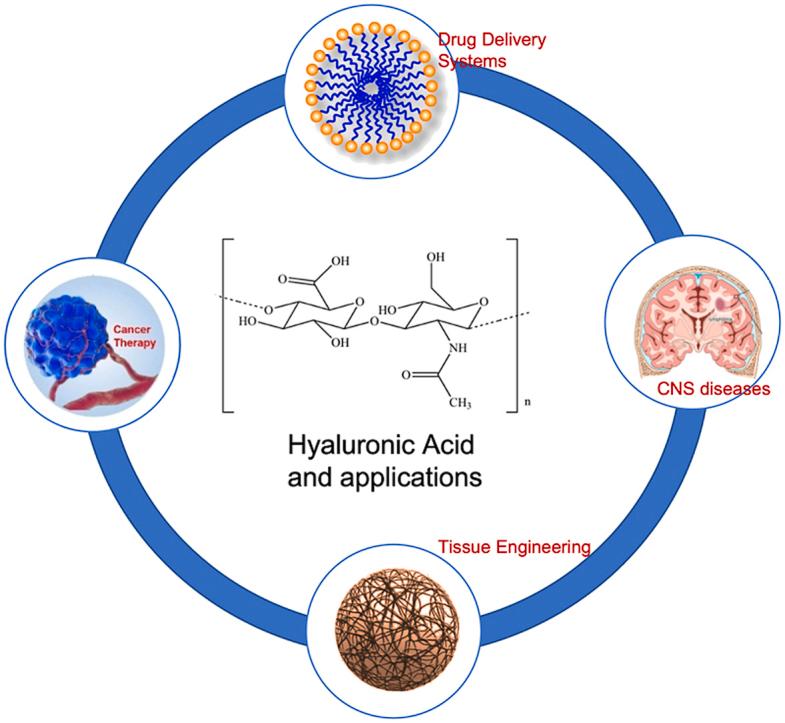
In the last decade, hyaluronic acid (HA) has attracted an ever-growing interest in the biomedical engineering field as a biocompatible, biodegradable, and chemically versatile molecule. In fact, HA is a major component of the extracellular matrix (ECM) and is essential for the maintenance of cellular homeostasis and crosstalk. Innovative experimental strategies and using three-dimensional (3D) HA systems have been increasingly reported in studies of diseases, replacement of tissue and organ damage, repairing wounds, and encapsulating stem cells for tissue regeneration. The present work aims to give an overview and comparison of recent work carried out on HA systems showing advantages, limitations, and their complementarity, for a comprehensive characterization of their use. A special attention is paid to the use of HA in three important areas: cancer, diseases of the central nervous system (CNS), and tissue regeneration, discussing the most innovative experimental strategies. Finally, perspectives within and beyond these research fields are discussed.
在过去十年中,透明质酸(HA)作为一种生物相容性、可生物降解且化学性质多样的分子,在生物医学工程领域引起了越来越广泛的关注。事实上,HA是细胞外基质(ECM)的主要成分,对维持细胞内稳态和细胞间通讯至关重要。在疾病研究、组织和器官损伤替代、伤口修复以及封装干细胞用于组织再生等方面,越来越多的研究报告了创新性的实验策略以及使用三维(3D)HA系统的情况。本工作旨在对近期关于HA系统的研究进行概述和比较,展示其优势、局限性及其互补性,以便对其应用进行全面表征。特别关注HA在三个重要领域的应用:癌症、中枢神经系统(CNS)疾病和组织再生,并讨论最具创新性的实验策略。最后,还讨论了这些研究领域内外的前景。



 Zotero 插件