
人群水平反事实趋势建模研究美国成年人吸烟率与电子烟使用之间的关系。
Population-level counterfactual trend modelling to examine the relationship between smoking prevalence and e-cigarette use among US adults.
机构信息
PinneyAssociates Inc, 201 North Craig Street, Suite 320, 15213, Pittsburgh, PA, USA.
出版信息
BMC Public Health. 2022 Oct 19;22(1):1940. doi: 10.1186/s12889-022-14341-z.
BACKGROUND
Studies have suggested that some US adult smokers are switching away from smoking to e-cigarette use. Nationally representative data may reflect such changes in smoking by assessing trends in cigarette and e-cigarette prevalence. The objective of this study is to assess whether and how much smoking prevalence differs from expectations since the introduction of e-cigarettes.
METHODS
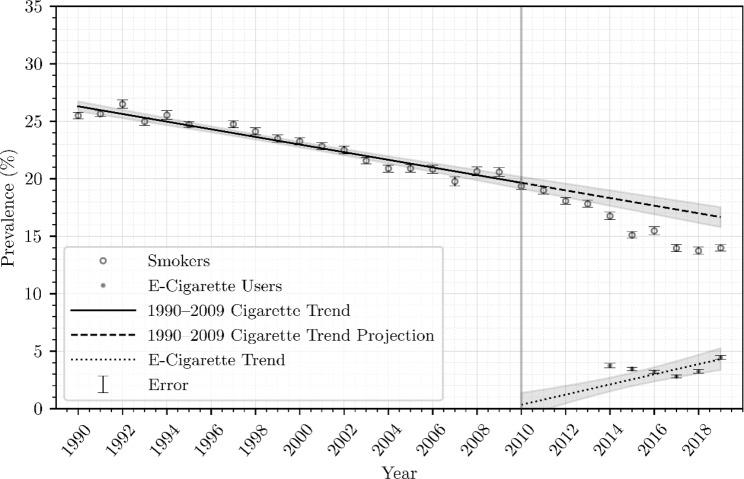
Annual estimates of smoking and e-cigarette use in US adults varying in age, race/ethnicity, and sex were derived from the National Health Interview Survey. Regression models were fitted to smoking prevalence trends before e-cigarettes became widely available (1999-2009) and trends were extrapolated to 2019 (counterfactual model). Smoking prevalence discrepancies, defined as the difference between projected and actual smoking prevalence from 2010 to 2019, were calculated, to evaluate whether actual smoking prevalence differed from those expected from counterfactual projections. The correlation between smoking discrepancies and e-cigarette use prevalence was investigated.
RESULTS
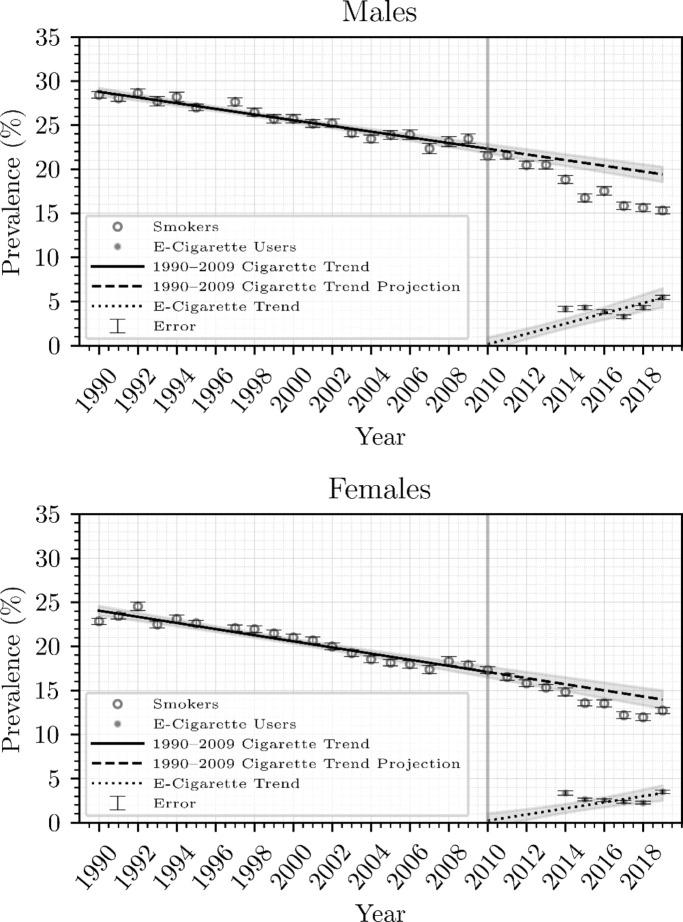
Actual overall smoking prevalence from 2010 to 2019 was significantly lower than counterfactual predictions. The discrepancy was significantly larger as e-cigarette use prevalence increased. In subgroup analyses, discrepancies in smoking prevalence were more pronounced for cohorts with greater e-cigarette use prevalence, namely adults ages 18-34, adult males, and non-Hispanic White adults.
CONCLUSION
Population-level data suggest that smoking prevalence has dropped faster than expected, in ways correlated with increased e-cigarette use. This population movement has potential public health implications.
背景
研究表明,一些美国成年吸烟者正在从吸烟转向电子烟使用。通过评估香烟和电子烟流行率的趋势,全国代表性数据可能反映出吸烟方式的这种变化。本研究的目的是评估自电子烟问世以来,吸烟流行率是否以及在多大程度上与预期有所不同。
方法
从全国健康访谈调查中得出了年龄、种族/民族和性别各异的美国成年人吸烟和电子烟使用的年度估计值。对电子烟广泛使用之前(1999-2009 年)的吸烟流行率趋势进行了回归模型拟合,并将趋势外推到 2019 年(虚拟模型)。计算了吸烟流行率差异,定义为 2010 年至 2019 年期间实际吸烟流行率与预测吸烟流行率之间的差异,以评估实际吸烟流行率是否与虚拟预测值存在差异。还调查了吸烟差异与电子烟使用流行率之间的相关性。
结果
2010 年至 2019 年期间,实际总体吸烟流行率明显低于虚拟预测值。随着电子烟使用流行率的增加,差异显著增大。在亚组分析中,电子烟使用流行率较高的队列(即 18-34 岁成年人、成年男性和非西班牙裔白人成年人)的吸烟流行率差异更为明显。
结论
人群水平数据表明,吸烟流行率的下降速度快于预期,这与电子烟使用的增加有关。这种人群流动可能对公共卫生产生影响。


 Zotero 插件