
瘢痕疙瘩中高mA修饰条件下的mA甲基化mRNA模式及Wnt信号通路的激活
The mA-methylated mRNA pattern and the activation of the Wnt signaling pathway under the hyper-mA-modifying condition in the keloid.
作者信息
Lin Can-Xiang, Chen Zhi-Jing, Peng Qi-Lin, Xiang Ke-Rong, Xiao Du-Qing, Chen Ruo-Xi, Cui Taixing, Huang Yue-Sheng, Liu Hong-Wei
机构信息
Key Laboratory of Regenerative Medicine, Ministry of Education, Department of Plastic Surgery, The First Affiliated Hospital of Jinan University, Guangzhou, China.
The Research Center of Medicine, Sun Yat-Sen Memorial Hospital, Sun Yat-Sen University, Guangzhou, China.
出版信息
Front Cell Dev Biol. 2022 Oct 3;10:947337. doi: 10.3389/fcell.2022.947337. eCollection 2022.
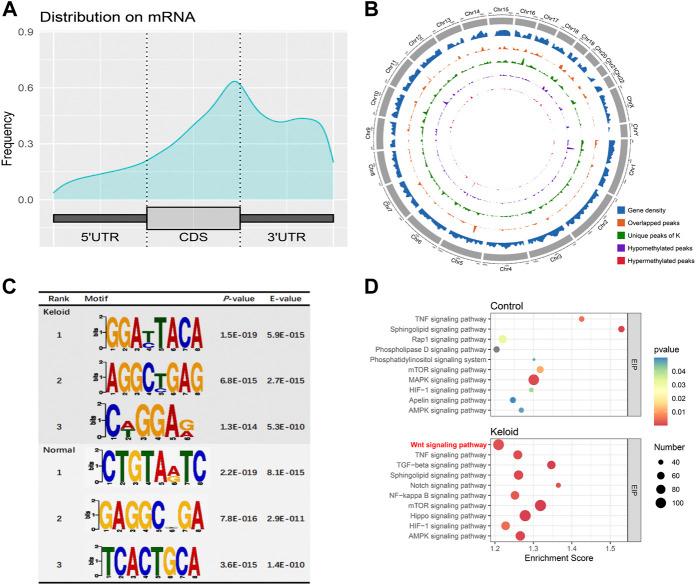
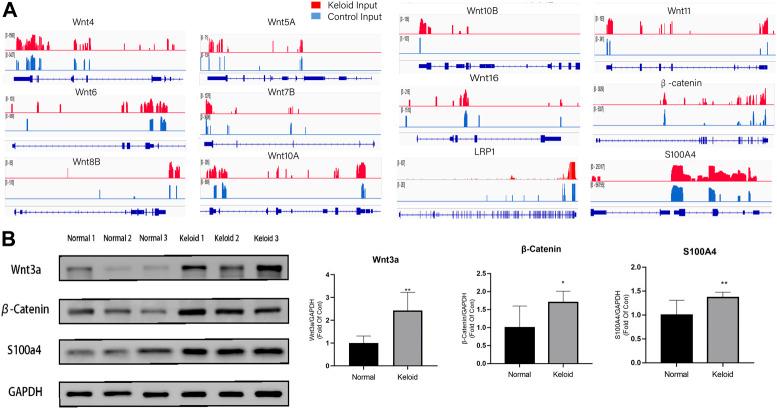
The present study was carried out to investigate the global mA-modified RNA pattern and possible mechanisms underlying the pathogenesis of keloid. In total, 14 normal skin and 14 keloid tissue samples were first collected on clinics. Then, three samples from each group were randomly selected to be verified with the Western blotting to determine the level of methyltransferase and demethylase. The total RNA of all samples in each group was isolated and subjected to the analysis of MeRIP sequencing and RNA sequencing. Using software of MeTDiff and count, the mA peaks and differentially expressed genes (DEGs) were determined within the fold change >2 and value < 0.05. The top 10 pathways of mA-modified genes in each group and the differentially expressed genes were enriched by the Kyoto Encyclopedia of Genes and Genomes signaling pathways. Finally, the closely associated pathway was determined using the Western blotting and immunofluorescence staining. There was a higher protein level of WTAP and Mettl3 in the keloid than in the normal tissue. In the keloid samples, 21,020 unique mA peaks with 6,573 unique mA-associated genetic transcripts appeared. In the normal tissue, 4,028 unique mA peaks with 779 mA-associated modified genes appeared. In the RNA sequencing, there were 847 genes significantly changed between these groups, transcriptionally. The genes with mA-methylated modification and the upregulated differentially expressed genes between two tissues were both mainly related to the Wnt signaling pathway. Moreover, the hyper-mA-modified Wnt/-catenin pathway in keloid was verified with Western blotting. From the immunofluorescence staining results, we found that the accumulated fibroblasts were under a hyper-mA condition in the keloid, and the Wnt/-Catenin signaling pathway was mainly activated in the fibroblasts. The fibroblasts in the keloid were under a cellular hyper-mA-methylated condition, and the hyper-mA-modified highly expressed Wnt/-catenin pathway in the dermal fibroblasts might promote the pathogenesis of keloid.
本研究旨在探讨瘢痕疙瘩发病机制背后的整体 mA 修饰 RNA 模式及可能机制。总共首先在临床上收集了 14 例正常皮肤和 14 例瘢痕疙瘩组织样本。然后,从每组中随机选取 3 个样本用蛋白质免疫印迹法进行验证,以确定甲基转移酶和去甲基酶的水平。分离每组所有样本的总 RNA,并进行 MeRIP 测序和 RNA 测序分析。使用 MeTDiff 和 count 软件,在变化倍数>2 且 P 值<0.05 的条件下确定 mA 峰和差异表达基因(DEG)。每组中 mA 修饰基因的前 10 条通路以及差异表达基因通过京都基因与基因组百科全书信号通路进行富集。最后,使用蛋白质免疫印迹法和免疫荧光染色确定密切相关的通路。瘢痕疙瘩中 WTAP 和 Mettl3 的蛋白质水平高于正常组织。在瘢痕疙瘩样本中,出现了 21020 个独特的 mA 峰以及 6573 个与 mA 相关的独特基因转录本。在正常组织中,出现了 4028 个独特的 mA 峰以及 779 个与 mA 相关的修饰基因。在 RNA 测序中,两组之间有 847 个基因在转录水平上发生了显著变化。两个组织之间具有 mA 甲基化修饰的基因以及上调的差异表达基因均主要与 Wnt 信号通路相关。此外,通过蛋白质免疫印迹法验证了瘢痕疙瘩中 Wnt/β-连环蛋白通路的 mA 修饰过度。从免疫荧光染色结果来看,我们发现在瘢痕疙瘩中积累的成纤维细胞处于 mA 修饰过度的状态,并且 Wnt/β-连环蛋白信号通路主要在成纤维细胞中被激活。瘢痕疙瘩中的成纤维细胞处于细胞 mA 甲基化修饰过度的状态,并且真皮成纤维细胞中 mA 修饰过度且高度表达的 Wnt/β-连环蛋白通路可能促进瘢痕疙瘩的发病机制。



 Zotero 插件