
2013-2018 年使用韩国国家健康保险服务数据库的老年人无牙颌发病率。
Incidence of edentulism among older adults using the Korean National Health Insurance Service database, 2013-2018.
机构信息
Department of Preventive Dentistry, School of Dentistry, Kyungpook National University, Daegu, Korea.
Department of Dental Hygiene, Kyungpook National University, Sangju, Korea.
出版信息
Epidemiol Health. 2022;44:e2022091. doi: 10.4178/epih.e2022091. Epub 2022 Oct 17.
OBJECTIVES
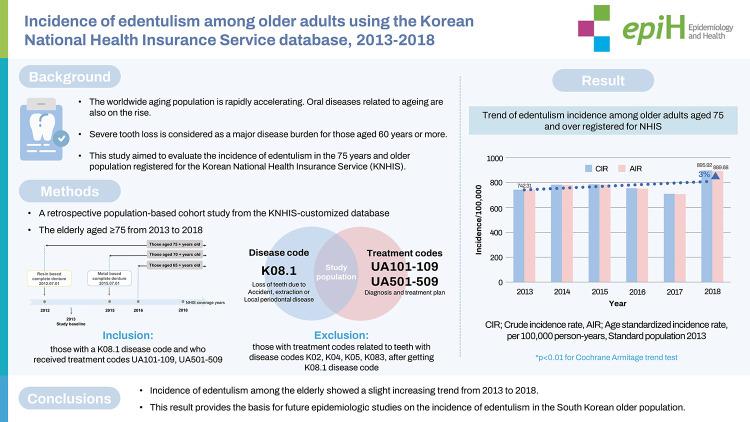
Population aging is rapidly accelerating worldwide. Oral diseases related to aging are also on the rise. This study examined trends in the incidence of edentulism among the older Korean population using data from the Korean National Health Insurance Service (KNHIS).
METHODS
Data on older adults, aged ≥75 years of age, were obtained from the KNHIS for the period 2013-2018. Edentulism was defined as a treatment history of complete dentures in the KNHIS database. The exclusion criteria consisted of both disease codes and treatment codes related to conservative dental treatment, including periodontal and extraction treatment afterward. Crude incidence rates (CIRs) and age-standardized incidence rates (AIRs) with 95% confidence intervals were calculated and reported per 100,000 person-years by the direct method. Trends were tested by Cochrane Armitage models.
RESULTS
Statistically significant increasing trends in both CIRs and AIRs were found among the older Korean population registered in the KNHIS (CIRs, 707.92 to 895.92; AIRs, 705.11 to 889.68; p<0.01). The incidence tended to increase in both genders (p<0.01). Both CIRs and AIRs in specific regions also showed slight but significant annual increases except for Jeju Island (p<0.01 or <0.05). The incidence showed increasing trends (p<0.01) in all income quintiles apart from the highest quintile. The edentulism incidence was highest in the lowest income group (the first quintile).
CONCLUSIONS
Our data showed that the incidence of edentulism among the elderly showed an increasing trend from 2013 to 2018. This result provides a basis for future epidemiological studies on the incidence of edentulism in the older Korean population.
目的
全球人口老龄化正迅速加速。与衰老相关的口腔疾病也在上升。本研究使用韩国国民健康保险服务(KNHIS)的数据,检查了韩国老年人口中无牙颌发病率的趋势。
方法
从 KNHIS 获得了 2013 年至 2018 年期间年龄≥75 岁的老年人数据。在 KNHIS 数据库中,无牙颌被定义为全口义齿治疗史。排除标准包括与保守牙科治疗相关的疾病代码和治疗代码,包括牙周和拔牙治疗后。以直接法计算每 100,000 人年的粗发病率(CIR)和年龄标准化发病率(AIR),并报告 95%置信区间。采用 Cochrane-Armitage 模型检验趋势。
结果
在 KNHIS 登记的韩国老年人中,CIR 和 AIR 均呈统计学显著上升趋势(CIRs,707.92 至 895.92;AIRs,705.11 至 889.68;p<0.01)。发病率在两性中均呈上升趋势(p<0.01)。除济州岛外(p<0.01 或 <0.05),所有地区的 CIR 和 AIR 均呈轻微但有统计学意义的逐年上升趋势。除最高五分位数外,所有收入五分位数的发病率均呈上升趋势(p<0.01)。无牙颌发病率最高的是收入最低的群体(第一五分位数)。
结论
我们的数据表明,2013 年至 2018 年期间,老年人无牙颌发病率呈上升趋势。这一结果为未来研究韩国老年人口无牙颌发病率的流行病学研究提供了依据。

 Zotero 插件