
2021年1月至3月新冠疫情期间美国成年人中种族/民族与社会经济因素和疫苗接种之间的关联。
Associations of race/ethnicity and socioeconomic factors with vaccination among US adults during the COVID-19 pandemic, January to March 2021.
作者信息
Kim Daniel
机构信息
School of Community Health and Behavioral Sciences & School of Public Policy and Urban Affairs, Northeastern University, 360 Huntington Avenue, 413 International Village, Boston, MA 02115, United States.
出版信息
Prev Med Rep. 2023 Feb;31:102021. doi: 10.1016/j.pmedr.2022.102021. Epub 2022 Oct 13.
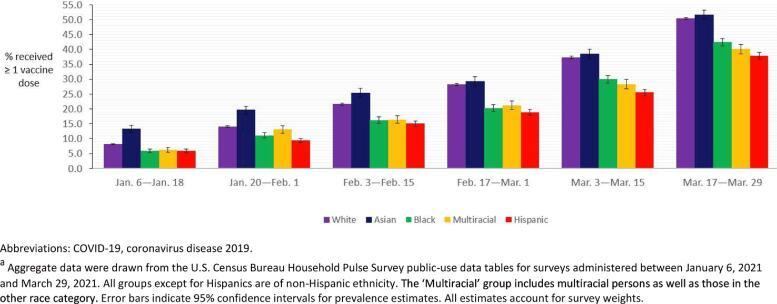
To date, there has been limited data available to understand the associations between race/ethnicity and socioeconomic and related characteristics with novel coronavirus disease (COVID-19) vaccination in the United States. I leveraged the large, nationally-representative cross-sectional surveys of the U.S. Household Pulse Survey between January and March 2021 with relatively complete race/ethnicity and socioeconomic data to examine national trends in levels of COVID-19 vaccine initiation and intention in adults aged 18-85 years. I further estimated the multivariable associations between race/ethnicity, education, income, and financial hardship with the adjusted prevalence odds ratios of: 1) receipt of ≥1 COVID-19 vaccine dose; and 2) among those unvaccinated, the definite intention to receive a vaccine. I observed persistent disparities in vaccine initiation for non-Hispanic Blacks, Hispanics, and non-Hispanic multiracial/other race persons, and vaccine intention for Blacks and multiracial/other race persons, compared to non-Hispanic Whites and Asians. In late March 2021, the prevalence estimates of Hispanics and Blacks receiving a vaccine were 12-percentage points and 8-percentage points lower than for Whites, respectively. Education and income exhibited dose-response relationships with vaccine initiation ( for trend ≤0.01 and <0.001, respectively). Substantial financial hardship was linked to 35-44% lower adjusted odds of vaccination (<.001). In this large, nationally-representative study, I found persistent racial/ethnic and socioeconomic disparities in vaccine initiation and intention, more than three months after COVID-19 vaccines first became available. Addressing these persistent racial/ethnic and socioeconomic inequities in vaccination is essential to mitigate the pandemic's higher risks of infection and adverse health outcomes in Hispanic, Black, and socioeconomically-disadvantaged communities.
迄今为止,在美国,关于种族/民族、社会经济及相关特征与新型冠状病毒肺炎(COVID-19)疫苗接种之间的关联,可用数据有限。我利用了2021年1月至3月期间美国家庭脉搏调查的大规模、具有全国代表性的横断面调查数据,这些数据包含相对完整的种族/民族和社会经济信息,以研究18至85岁成年人中COVID-19疫苗接种起始率和接种意愿的全国趋势。我进一步估计了种族/民族、教育程度、收入和经济困难与以下调整患病率比值比之间的多变量关联:1)接种≥1剂COVID-19疫苗;2)在未接种疫苗者中,明确的接种疫苗意愿。与非西班牙裔白人及亚裔相比,我观察到非西班牙裔黑人、西班牙裔以及非西班牙裔多种族/其他种族人群在疫苗接种起始率方面存在持续差异,而黑人和多种族/其他种族人群在疫苗接种意愿方面存在差异。2021年3月下旬,西班牙裔和黑人接种疫苗的患病率估计分别比白人低12个百分点和8个百分点。教育程度和收入与疫苗接种起始率呈现剂量反应关系(趋势P值分别≤0.01和<0.001)。严重的经济困难与接种疫苗的调整后几率降低35%-44%相关(P<0.001)。在这项大规模、具有全国代表性的研究中,我发现,在COVID-19疫苗首次可用三个多月后,疫苗接种起始率和接种意愿方面存在持续的种族/民族和社会经济差异。解决疫苗接种中这些持续存在的种族/民族和社会经济不平等问题,对于减轻西班牙裔、黑人以及社会经济弱势社区在疫情中更高的感染风险和不良健康后果至关重要。
 Zotero 插件