
早期 PEG-天冬酰胺酶停药对年轻 ALL 患者的影响:CALGB 10403 研究的事后分析。
The impact of early PEG-asparaginase discontinuation in young adults with ALL: a post hoc analysis of the CALGB 10403 study.
机构信息
Department of Hematology and Hematopoietic Cell Transplantation, City of Hope National Medical Center, Duarte, CA.
Alliance Statistics and Data Center, Mayo Clinic, Rochester, MN.
出版信息
Blood Adv. 2023 Jan 24;7(2):196-204. doi: 10.1182/bloodadvances.2022007791.
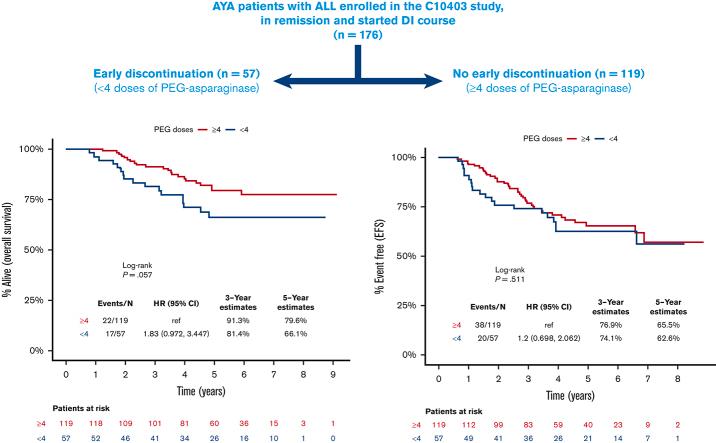
Asparaginase is a key component of pediatric-inspired regimens in young adults with acute lymphoblastic leukemia (ALL). Truncation of asparaginase therapy is linked to inferior outcomes in children with ALL. However, a similar correlation in adults is lacking. Here, we studied the prevalence and risk factors associated with pegylated (PEG)-asparaginase discontinuation in young adults with ALL treated on the US intergroup Cancer and Leukemia Group B (CALGB) 10403 study and examined the prognostic impact of early discontinuation (ED) (defined as <4 of 5 or 6 planned doses) on survival outcomes. The analysis included 176 patients who achieved complete remission and initiated the delayed intensification (DI) cycle. The median number of PEG-asparaginase doses administered before DI was 5 (range, 1-6), with 57 (32%) patients with ED. The ED patients were older (median, 26 vs 23 years; P = .023). Survival was apparently lower for ED patients compared with those receiving ≥4 doses, but this finding was not statistically significant (hazard ratio [HR], 1.82; 95% confidence interval [CI], 0.97-3.43; P = .06), with corresponding 5-year overall survival (OS) rates of 66% and 80%, respectively. In patients with standard-risk ALL, the ED of PEG-asparaginase adversely influenced OS (HR, 2.3; 95% CI, 1.02-5.22; P = .04) with a trend toward inferior event-free survival (EFS) (HR, 1.84; 95% CI, 0.92-3.67; P = .08). In contrast, there was no impact of early PEG-asparaginase discontinuation on OS (P = .64) or EFS (P = .32) in patients with high-risk disease based on the presence of high-risk cytogenetics, Ph-like genotype, and/or high white blood cell count at presentation. In conclusion, early PEG-asparaginase discontinuation is common in young adults with ALL and may adversely impact survival of patients with standard-risk ALL.
门冬酰胺酶是儿童急性淋巴细胞白血病(ALL)方案中的关键组成部分。在 ALL 患儿中,门冬酰胺酶治疗的截断与较差的结果有关。然而,成人中缺乏类似的相关性。在这里,我们研究了在美国癌症和白血病组 B(CALGB)10403 研究中接受治疗的年轻 ALL 成人中聚乙二醇(PEG)-门冬酰胺酶停药的流行率和相关因素,并检查了早期停药(ED)(定义为<4 次)对生存结果的预后影响计划剂量中的 5 次或 6 次)。该分析包括 176 名达到完全缓解并开始延迟强化(DI)周期的患者。在开始 DI 之前,PEG-门冬酰胺酶的中位数剂量为 5(范围 1-6),57 名(32%)患者出现 ED。ED 患者年龄较大(中位数 26 岁比 23 岁;P=0.023)。与接受≥4 次剂量的患者相比,ED 患者的生存率显然较低,但这一发现无统计学意义(风险比 [HR],1.82;95%置信区间 [CI],0.97-3.43;P=0.06),相应的 5 年总生存率(OS)分别为 66%和 80%。在标准风险 ALL 患者中,PEG-门冬酰胺酶的 ED 对 OS 产生不利影响(HR,2.3;95%CI,1.02-5.22;P=0.04),EFS 呈下降趋势(HR,1.84;95%CI,0.92-3.67;P=0.08)。相比之下,在基于高风险细胞遗传学、Ph 样基因型和/或高白细胞计数的高危疾病患者中,早期 PEG-门冬酰胺酶停药对 OS(P=0.64)或 EFS(P=0.32)无影响。总之,年轻 ALL 成人中早期 PEG-门冬酰胺酶停药很常见,可能对标准风险 ALL 患者的生存产生不利影响。



 Zotero 插件