
饮食类黄酮的摄入量与丹麦饮食、癌症和健康队列中的缺血性心脏病发病风险。
Intake of dietary flavonoids and incidence of ischemic heart disease in the Danish Diet, Cancer, and Health cohort.
机构信息
School of Biomedical Sciences, University of Western Australia, Royal Perth Hospital, Perth, WA, Australia.
Nutrition & Health Innovation Research Institute, School of Medical and Health Sciences, Edith Cowan University, Perth, WA, Australia.
出版信息
Eur J Clin Nutr. 2023 Feb;77(2):270-277. doi: 10.1038/s41430-022-01226-y. Epub 2022 Oct 25.
BACKGROUND/OBJECTIVES: Few studies have investigated the association between dietary flavonoid intake, including all major subclasses, and the long-term risk of ischemic heart disease (IHD). We examined whether dietary flavonoid intake associated with IHD incidence, assessing the possible modifying role of sex and smoking, in participants from the Danish Diet, Cancer, and Health study.
SUBJECTS/METHODS: In a cohort study design, 54,496 adults (46.8% male), aged 50-64 years, without a history of IHD, were followed for up to 23 years. Habitual dietary flavonoid intake was estimated from food frequency questionnaires using Phenol-Explorer. Incident cases of IHD were identified within Danish nationwide health registries. Restricted cubic splines in Cox proportional hazards models were used to examine associations between flavonoid intake and IHD risk.
RESULTS
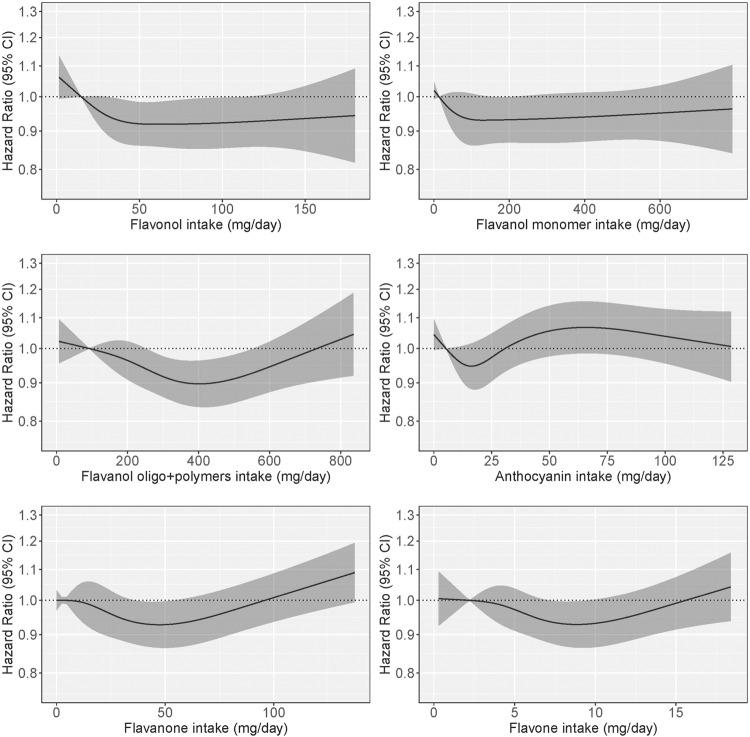
During follow-up, 5560 IHD events were recorded. No overall association was seen between total flavonoid intake, nor any subclass, and IHD, following adjustment for demographics, lifestyle, and dietary confounders. Stratified by sex and smoking status, higher intakes of specific subclasses associated with lower IHD risk among ever-smokers [Q5 vs. Q1 flavonols HR (95% CI): 0.90 (0.82, 0.99); flavanol oligo+polymers: 0.88 (0.80, 0.97)], but not among never-smokers, nor either sex specifically.
CONCLUSIONS
While we did not find clear evidence that higher habitual dietary flavonoid intake was associated with lower IHD risk, these results do not exclude the possibility that certain subclasses may have a protective role in prevention of IHD among population sub-groups; this was evident among smokers, who are at a higher risk of atherosclerosis.
背景/目的:很少有研究调查膳食类黄酮(包括所有主要亚类)摄入量与缺血性心脏病(IHD)长期风险之间的关系。我们研究了膳食类黄酮摄入量与 IHD 发病率之间的相关性,评估了性别和吸烟的可能修饰作用,研究对象来自丹麦饮食、癌症和健康研究。
方法
在一项队列研究设计中,54496 名年龄在 50-64 岁、无 IHD 病史的成年人(46.8%为男性)接受了长达 23 年的随访。使用 Phenol-Explorer 从食物频率问卷中估计习惯性饮食类黄酮摄入量。通过丹麦全国健康登记处确定 IHD 事件。Cox 比例风险模型中的限制三次样条用于检验类黄酮摄入量与 IHD 风险之间的关系。
结果
随访期间,记录了 5560 例 IHD 事件。在调整人口统计学、生活方式和饮食混杂因素后,总类黄酮摄入量或任何亚类与 IHD 之间均未见总体相关性。按性别和吸烟状况分层,特定亚类的较高摄入量与吸烟者的 IHD 风险降低相关[五分位数 (Q5) 与一分位数 (Q1) 类黄酮醇 HR(95%CI):0.90(0.82,0.99);黄烷醇寡聚物+聚合物:0.88(0.80,0.97)],但在不吸烟者中,或特定性别中均未观察到这种相关性。
结论
虽然我们没有明确证据表明习惯性较高的膳食类黄酮摄入量与较低的 IHD 风险相关,但这些结果并不能排除某些亚类在人群亚组预防 IHD 方面可能具有保护作用的可能性;这在吸烟者中更为明显,他们患动脉粥样硬化的风险更高。

 Zotero 插件