
氧化平衡评分与内脏脂肪指数与缺血性心脏病风险的关联:NHANES 2005-2018 年的横断面研究。
Associations of oxidative balance score and visceral adiposity index with risk of ischaemic heart disease: a cross-sectional study of NHANES, 2005-2018.
机构信息
Department of Cardiology, The First Affiliated Hospital of Jinan University, Guangzhou, Guangdong, China.
Department of Cardiology, The First Affiliated Hospital of Jinan University, Guangzhou, Guangdong, China
出版信息
BMJ Open. 2023 Jul 14;13(7):e072334. doi: 10.1136/bmjopen-2023-072334.
OBJECTIVE
Evidence on the association of oxidative balance score (OBS) and visceral adiposity index (VAI) with risk of ischaemic heart disease (IHD) is limited. We aimed to explore the association of OBS and VAI with risk of IHD, and then examined their potential interactive effects.
DESIGN
A cross-sectional study.
SETTING
The National Health and Nutrition Examination Survey.
PARTICIPANTS
A total of 27 867 individuals aged more than 20 years were included in this study.
PRIMARY AND SECONDARY OUTCOME MEASURES
Multivariable logistic regression analyses were used to estimate ORs and 95% CIs for the associations of OBS and VAI with risk of IHD, including coronary heart disease (CHD), heart attack and angina pectoris.
RESULTS
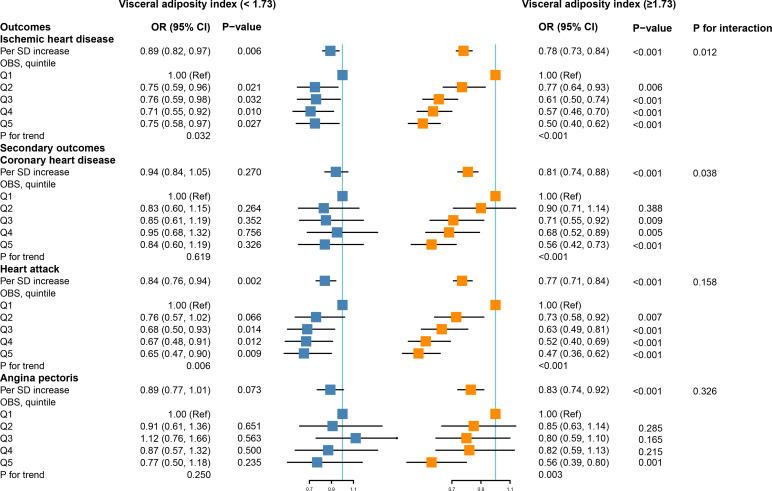
Compared with those in the first quintile, participants with highest quintile of OBS had decreased risk of IHD (OR: 0.59, 95% CI: 0.50, 0.69), CHD (OR: 0.65, 95% CI: 0.52, 0.80), heart attack (OR: 0.53, 95% CI: 0.43, 0.66) and angina pectoris (OR: 0.63, 95% CI: 0.48, 0.82); meanwhile, those with highest quintile of VAI had increased risk of IHD (OR: 1.46, 95% CI: 1.22, 1.74), CHD (OR: 1.34, 95% CI: 1.07, 1.67), heart attack (OR: 1.55, 95% CI: 1.24, 1.94) and angina pectoris (OR: 1.40, 95% CI: 1.04, 1.87). Furthermore, we observed a stronger association between OBS and risk of IHD among participants with VAI ≥1.73 (OR: 0.50, 95% CI: 0.40, 0.62).
CONCLUSION
Our study found the negative association between OBS and risk of IHD, and positive association between VAI and risk of IHD. In addition, we found the interactive effects between VAI and OBS on the risk of IHD, underlining the importance of OBS in IHD prevention among participants with high VAI level.
目的
关于氧化平衡评分(OBS)和内脏脂肪指数(VAI)与缺血性心脏病(IHD)风险之间的关联,证据有限。本研究旨在探讨 OBS 和 VAI 与 IHD 风险的关系,并进一步研究它们潜在的交互作用。
设计
横断面研究。
地点
国家健康与营养调查。
参与者
本研究共纳入 27867 名年龄大于 20 岁的个体。
主要和次要结局测量
采用多变量逻辑回归分析估计 OBS 和 VAI 与 IHD(包括冠心病(CHD)、心脏病发作和心绞痛)风险的比值比(OR)和 95%置信区间(CI)。
结果
与 OBS 评分最低五分位组相比,OBS 评分最高五分位组的 IHD(OR:0.59,95%CI:0.50,0.69)、CHD(OR:0.65,95%CI:0.52,0.80)、心脏病发作(OR:0.53,95%CI:0.43,0.66)和心绞痛(OR:0.63,95%CI:0.48,0.82)风险降低;而 VAI 评分最高五分位组的 IHD(OR:1.46,95%CI:1.22,1.74)、CHD(OR:1.34,95%CI:1.07,1.67)、心脏病发作(OR:1.55,95%CI:1.24,1.94)和心绞痛(OR:1.40,95%CI:1.04,1.87)风险增加。此外,我们发现 OBS 与 VAI≥1.73 患者的 IHD 风险之间存在更强的关联(OR:0.50,95%CI:0.40,0.62)。
结论
本研究发现 OBS 与 IHD 风险呈负相关,VAI 与 IHD 风险呈正相关。此外,我们发现 VAI 和 OBS 之间存在交互作用,这强调了 OBS 在 VAI 水平较高的患者中预防 IHD 的重要性。
 Zotero 插件