
内脏脂肪指数与空腹血糖呈正相关:来自 2017-2020 年国家健康和营养检查调查的横断面研究。
Visceral adiposity index is positively associated with fasting plasma glucose: a cross-sectional study from National Health and Nutrition Examination Survey 2017-2020.
机构信息
Department of Cardiology, Zhongda Hospital, School of Medicine, Southeast University, Nanjing, 210009, Jiangsu, China.
出版信息
BMC Public Health. 2023 Feb 11;23(1):313. doi: 10.1186/s12889-023-15231-8.
BACKGROUND
Visceral adiposity index (VAI) has been recognized as a reliable indicator for visceral adiposity. However, it remains largely unexplored on its association with fasting plasma glucose (FPG). The current study aims to explore the association between VAI and FPG using a representative dataset.
METHODS
A cross-sectional study was carried out based on the dataset from National Health and Nutrition Examination Survey (NHANES) 2017-2020. Univariate and Multiple linear regression analysis were performed to explore the relationship between VAI and FPG. Generalized additive model (GAM) and smooth curve fitting analysis were performed to explore the nonlinear relationship between VAI and FPG. Receiver operating characteristic (ROC) analysis was used to evaluate the predictive value of VAI for FPG elevation.
RESULTS
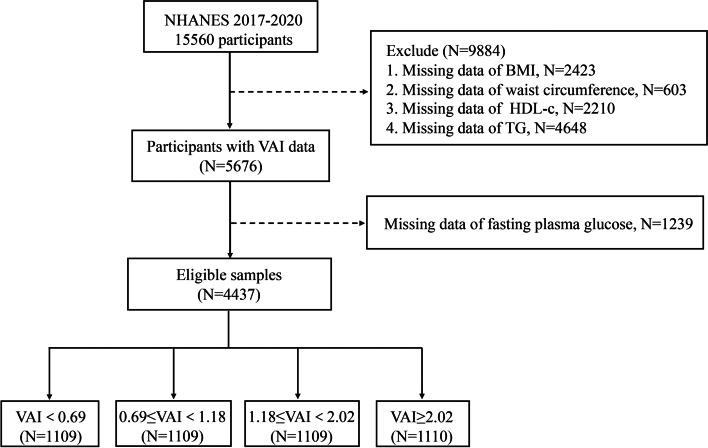
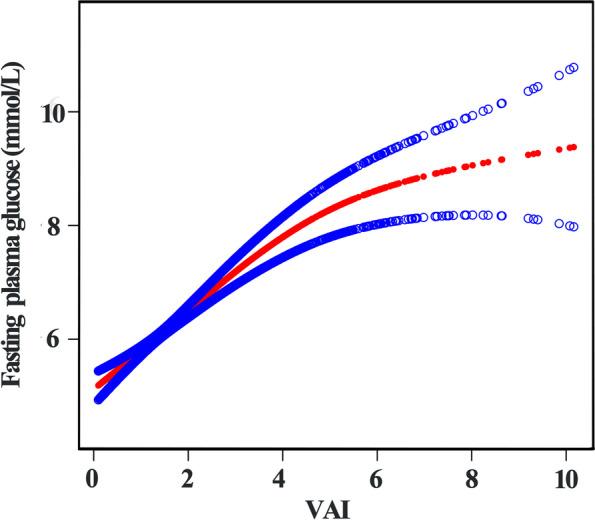
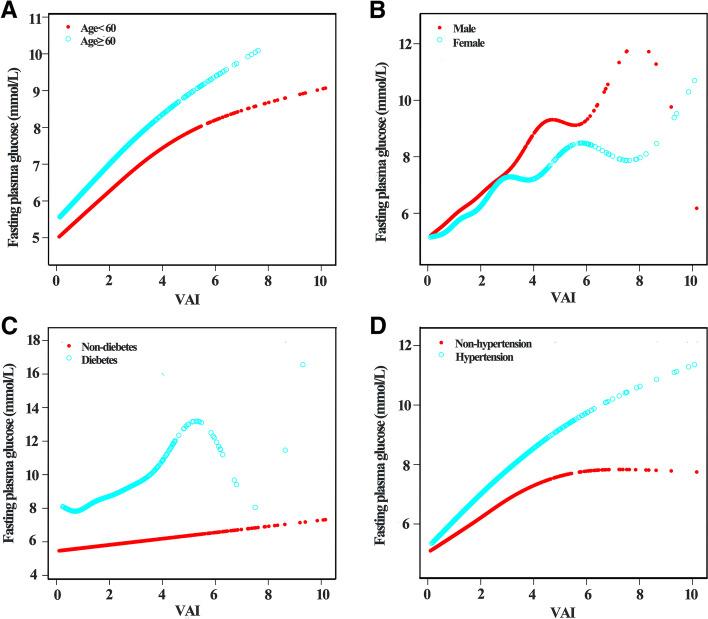
A total of 4437 participants with complete data were finally included in the research. Individuals were divided into 4 quartiles according to the calculated VAI value: Q1 (VAI<0.69), Q2 (0.69 ≤ VAI < 1.18), Q3 (1.18 ≤ VAI < 2.02) and Q4 (VAI ≥ 2.02). FPG significantly increased with the increasing VAI quartile. Multiple linear regression analysis showed VAI was independently positively associated with FPG after adjusting confounding factors. As a continuous variable, an increase of one unit in VAI was correlated with 0.52 mmol/L (95% CI: 0.41-0.63, p < 0.0001) higher FPG level. As a categorical variable, 4th VAI quartile group was related to 0.71 mmol/L (95% CI: 0.47-0.95, p < 0.001) higher FPG level compared with 1st VAI group. GAM and smooth curve fitting analysis identified the non-linear relationship between VAI and FPG, and 4.02 was identified as the inflection point using two-piecewise linear regression. The positive association between VAI and FPG existed when VAI was lower (β = 0.73, p < 0.0001) and higher than 4.02 (β = 0.23, p = 0.0063). ROC analysis indicated VAI has a good predictive value for FPG elevation (AUC = 0.7169, 95% CI: 0.6948-0.7389), and the best threshold of VAI was 1.4315.
CONCLUSION
VAI was an independently risk indicator for FPG, and VAI was nonlinearly positively associated with FPG. VAI had a good predictive value for elevated FPG. VAI might become a useful indicator for risk assessment and treatment of hyperglycemia in clinical practice.
背景
内脏脂肪指数(VAI)已被认为是内脏脂肪的可靠指标。然而,其与空腹血糖(FPG)的关系仍在很大程度上尚未得到探索。本研究旨在使用代表性数据集探讨 VAI 与 FPG 之间的关系。
方法
基于 2017-2020 年全国健康与营养调查(NHANES)的数据进行横断面研究。使用单变量和多元线性回归分析来探讨 VAI 与 FPG 之间的关系。使用广义加性模型(GAM)和平滑曲线拟合分析来探讨 VAI 与 FPG 之间的非线性关系。使用接收者操作特征(ROC)分析来评估 VAI 预测 FPG 升高的价值。
结果
最终共有 4437 名数据完整的参与者被纳入研究。根据计算的 VAI 值将个体分为 4 个四分位数:Q1(VAI<0.69)、Q2(0.69≤VAI<1.18)、Q3(1.18≤VAI<2.02)和 Q4(VAI≥2.02)。FPG 随 VAI 四分位数的增加而显著升高。多元线性回归分析表明,在调整混杂因素后,VAI 与 FPG 呈独立正相关。作为一个连续变量,VAI 增加 1 个单位与 FPG 水平升高 0.52mmol/L(95%CI:0.41-0.63,p<0.0001)相关。作为一个分类变量,与第 1 个 VAI 四分位数组相比,第 4 个 VAI 四分位数组的 FPG 水平升高 0.71mmol/L(95%CI:0.47-0.95,p<0.001)。GAM 和平滑曲线拟合分析确定了 VAI 与 FPG 之间的非线性关系,并使用两段线性回归确定了 4.02 为拐点。当 VAI 较低(β=0.73,p<0.0001)和高于 4.02 时(β=0.23,p=0.0063),VAI 与 FPG 之间存在正相关关系。ROC 分析表明,VAI 对 FPG 升高具有良好的预测价值(AUC=0.7169,95%CI:0.6948-0.7389),VAI 的最佳阈值为 1.4315。
结论
VAI 是 FPG 的独立危险因素,且与 FPG 呈非线性正相关。VAI 对升高的 FPG 具有良好的预测价值。VAI 可能成为临床实践中评估和治疗高血糖的有用指标。

 Zotero 插件