
MXenes 在生物传感应用中的新进展。
New Horizons for MXenes in Biosensing Applications.
机构信息
Department of Materials Genome Institute, Shanghai University, Shanghai 200444, China.
Qing Wei Chang College, Shanghai University, Shanghai 200444, China.
出版信息
Biosensors (Basel). 2022 Oct 2;12(10):820. doi: 10.3390/bios12100820.
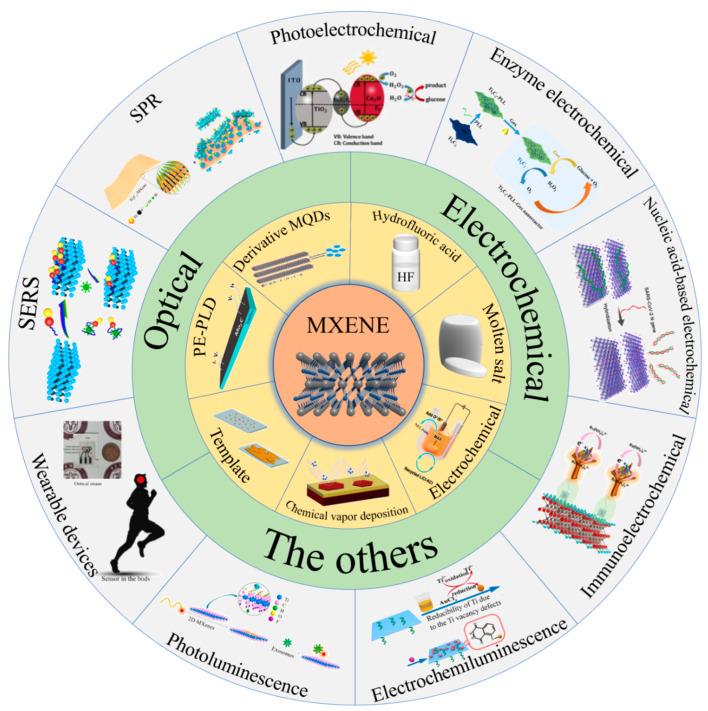
Over the last few decades, biosensors have made significant advances in detecting non-invasive biomarkers of disease-related body fluid substances with high sensitivity, high accuracy, low cost and ease in operation. Among various two-dimensional (2D) materials, MXenes have attracted widespread interest due to their unique surface properties, as well as mechanical, optical, electrical and biocompatible properties, and have been applied in various fields, particularly in the preparation of biosensors, which play a critical role. Here, we systematically introduce the application of MXenes in electrochemical, optical and other bioanalytical methods in recent years. Finally, we summarise and discuss problems in the field of biosensing and possible future directions of MXenes. We hope to provide an outlook on MXenes applications in biosensing and to stimulate broader interests and research in MXenes across different disciplines.
在过去几十年中,生物传感器在检测与疾病相关的体液物质的非侵入性生物标志物方面取得了重大进展,具有高灵敏度、高准确性、低成本和易于操作等优点。在各种二维(2D)材料中,由于其独特的表面特性以及机械、光学、电学和生物相容性,MXenes 引起了广泛的关注,并已应用于各个领域,特别是在生物传感器的制备中发挥了关键作用。在这里,我们系统地介绍了近年来 MXenes 在电化学、光学和其他生物分析方法中的应用。最后,我们总结和讨论了生物传感领域的问题以及 MXenes 的可能未来发展方向。我们希望为 MXenes 在生物传感中的应用提供一个展望,并激发不同学科对 MXenes 的更广泛兴趣和研究。






 Zotero 插件