
为什么 Ala-His-His 肽是从阿尔茨海默病相关 Aβ肽中去除和还原沉默铜离子的合适支架。
Why the Ala-His-His Peptide Is an Appropriate Scaffold to Remove and Redox Silence Copper Ions from the Alzheimer's-Related Aβ Peptide.
机构信息
LCC-CNRS, Université de Toulouse, CNRS, 31077 Toulouse, France.
Laboratory of Biometals and Biological Chemistry, Institut de Chimie (UMR 7177), Université de Strasbourg-CNRS, 4 rue Blaise Pascal, 67000 Strasbourg, France.
出版信息
Biomolecules. 2022 Sep 20;12(10):1327. doi: 10.3390/biom12101327.
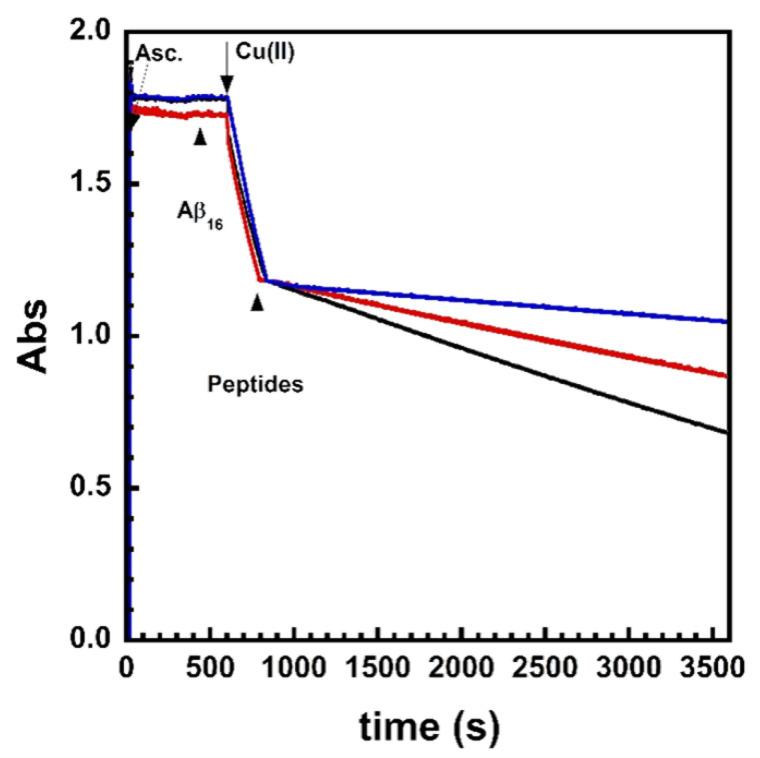
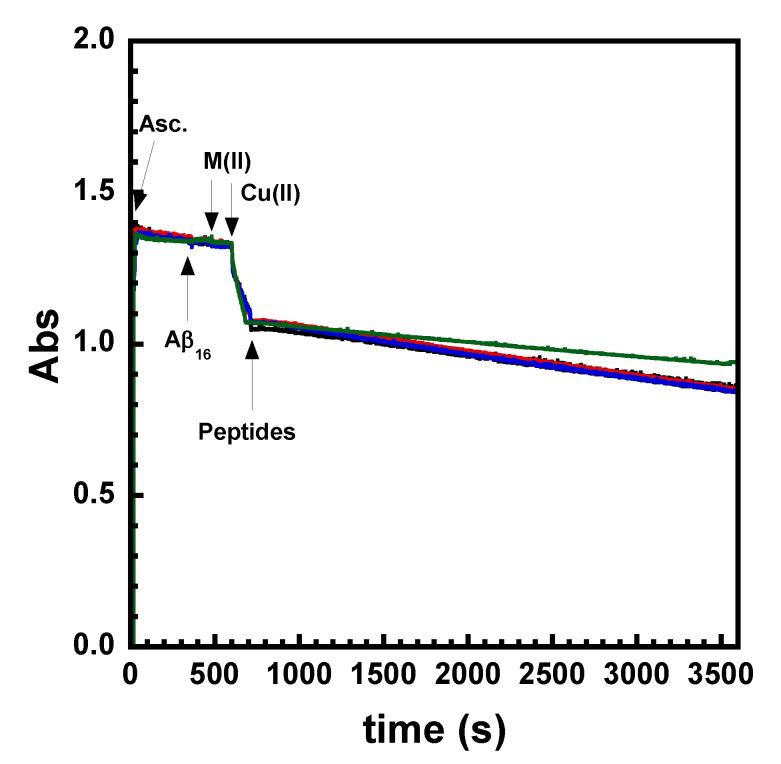
The progressive, neurodegenerative Alzheimer's disease (AD) is the most widespread dementia. Due to the ageing of the population and the current lack of molecules able to prevent or stop the disease, AD will be even more impactful for society in the future. AD is a multifactorial disease, and, among other factors, metal ions have been regarded as potential therapeutic targets. This is the case for the redox-competent Cu ions involved in the production of reactive oxygen species (ROS) when bound to the Alzheimer-related Aβ peptide, a process that contributes to the overall oxidative stress and inflammation observed in AD. Here, we made use of peptide ligands to stop the Cu(Aβ)-induced ROS production and we showed why the AHH sequence is fully appropriate, while the two parents, AH and AAH, are not. The AHH peptide keeps its beneficial ability against Cu(Aβ)-induced ROS, even in the presence of Zn-competing ions and other biologically relevant ions. The detailed kinetic mechanism by which AHH could exert its action against Cu(Aβ)-induced ROS is also proposed.
进行性神经退行性阿尔茨海默病(AD)是最常见的痴呆症。由于人口老龄化和目前缺乏能够预防或阻止这种疾病的分子,AD 在未来将对社会产生更大的影响。AD 是一种多因素疾病,除其他因素外,金属离子被认为是潜在的治疗靶点。与阿尔茨海默病相关的 Aβ肽结合的氧化还原能力的 Cu 离子就是这种情况,当与阿尔茨海默病相关的 Aβ肽结合时,Cu 离子会产生活性氧(ROS),这一过程导致了 AD 中观察到的总体氧化应激和炎症。在这里,我们利用肽配体来阻止 Cu(Aβ)诱导的 ROS 产生,并展示了为什么 AHH 序列是完全合适的,而其两个亲本 AH 和 AAH 则不合适。AHH 肽保留了其对 Cu(Aβ)诱导的 ROS 的有益能力,即使在存在 Zn 竞争离子和其他与生物学相关的离子的情况下也是如此。还提出了 AHH 对抗 Cu(Aβ)诱导的 ROS 发挥作用的详细动力学机制。




 Zotero 插件