
时型与社会时差对后备军官训练团体能训练中的表现和损伤的影响。
Chronotype and Social Jetlag Influence Performance and Injury during Reserve Officers' Training Corps Physical Training.
机构信息
Department of Kinesiology and Nutrition Sciences, University of Nevada Las Vegas, 4505 S. Maryland Pkwy, Las Vegas, NV 89154, USA.
出版信息
Int J Environ Res Public Health. 2022 Oct 21;19(20):13644. doi: 10.3390/ijerph192013644.
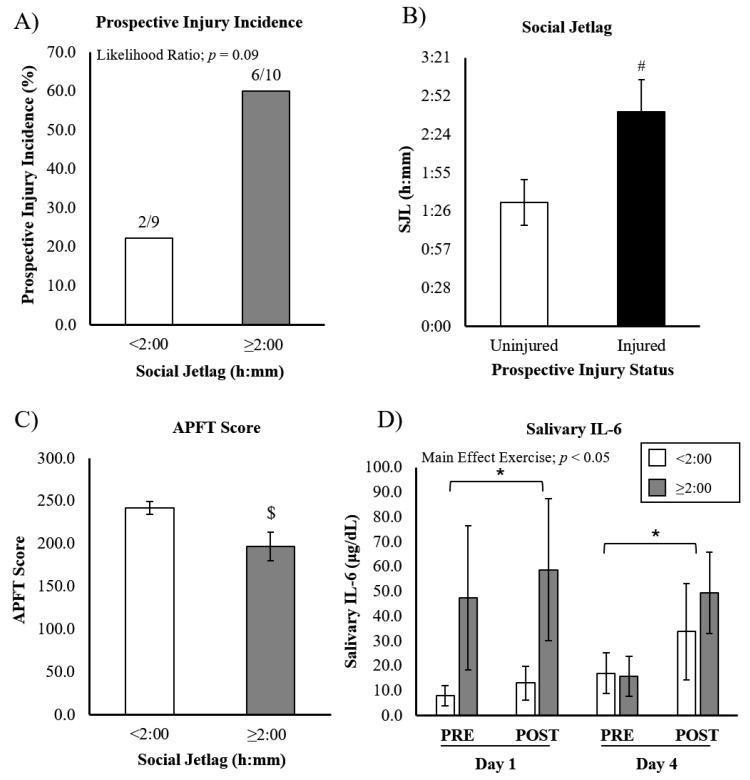
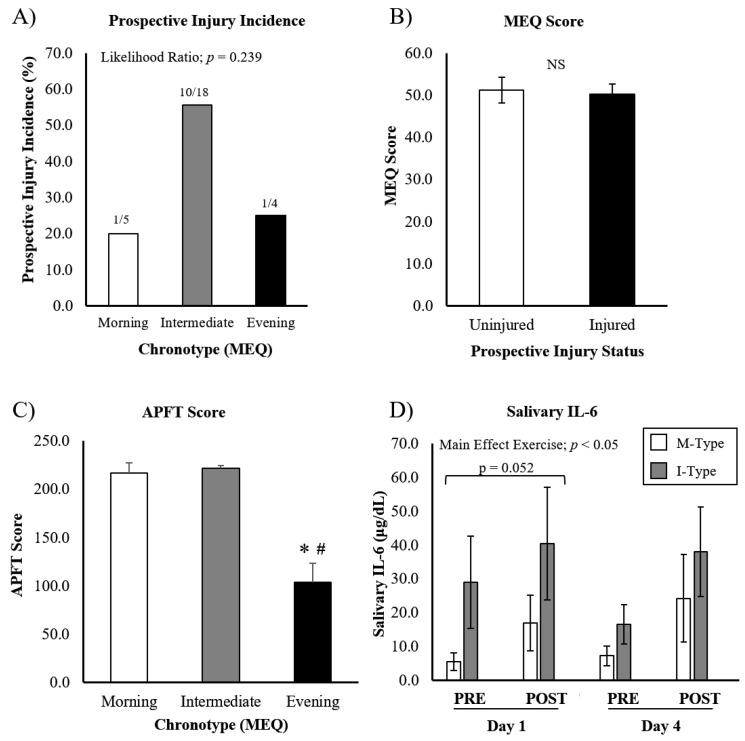
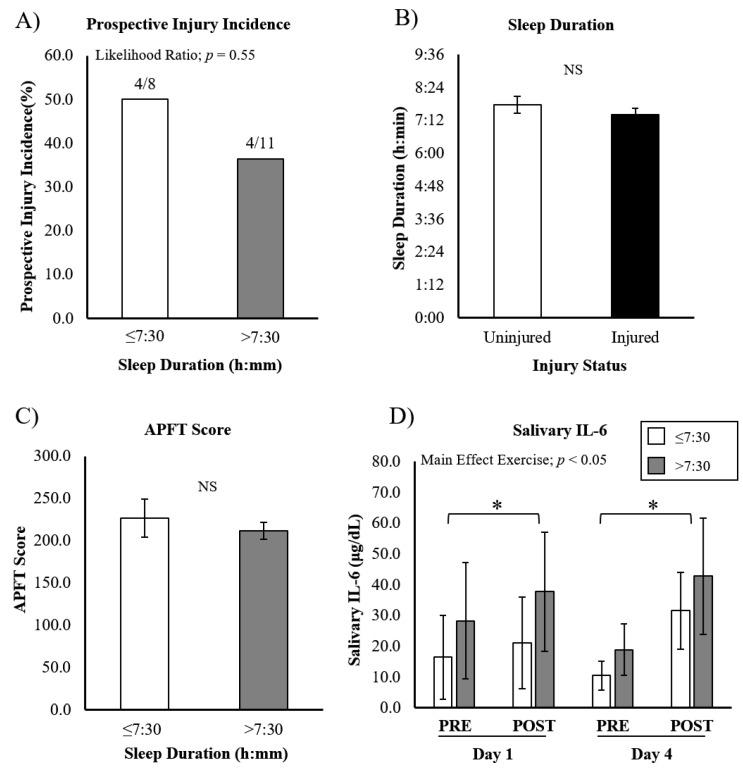
Sleep and circadian rhythms are critically important for optimal physical performance and maintaining health during training. Chronotype and altered sleep may modulate the response to exercise training, especially when performed at specific times/days, which may contribute to musculoskeletal injury. The purpose of this study was to determine if cadet characteristics (chronotype, sleep duration, and social jetlag) were associated with injury incidence and inflammation during physical training. Reserve Officers' Training Corps (ROTC) cadets ( = 42) completed the Morningness/Eveningness Questionnaire to determine chronotype, and 1-week sleep logs to determine sleep duration and social jetlag. Salivary IL-6 was measured before and after the first and fourth exercise sessions during training. Prospective injury incidence was monitored over 14 weeks of training, and Army Physical Fitness Test scores were recorded at the conclusion. Chronotype, sleep duration, and social jetlag were assessed as independent factors impacting IL-6, injury incidence, and APFT scores using ANOVAs, chi-squared tests, and the -test where appropriate, with significance accepted at < 0.05. Evening chronotypes performed worse on the APFT (evening = 103.8 ± 59.8 vs. intermediate = 221.9 ± 40.3 vs. morning = 216.6 ± 43.6; < 0.05), with no difference in injury incidence. Sleep duration did not significantly impact APFT score or injury incidence. Social jetlag was significantly higher in injured vs. uninjured cadets (2:40 ± 1:03 vs. 1:32 ± 55, < 0.05). Exercise increased salivary IL-6, with no significant effects of chronotype, sleep duration, or social jetlag. Evening chronotypes and cadets with social jetlag display hampered performance during morning APFT. Social jetlag may be a behavioral biomarker for musculoskeletal injury risk, which requires further investigation.
睡眠和昼夜节律对最佳身体表现和训练期间的健康维护至关重要。时型和睡眠改变可能会调节对运动训练的反应,尤其是在特定时间/天进行时,这可能导致肌肉骨骼损伤。本研究旨在确定学员特征(时型、睡眠时间和社交时差)是否与体能训练期间的损伤发生率和炎症有关。后备军官训练团(ROTC)学员(=42)完成了Morningness/Eveningness Questionnaire 以确定时型,并用 1 周的睡眠日志来确定睡眠时间和社交时差。在训练期间的第 1 次和第 4 次运动课程前后测量唾液白细胞介素 6(IL-6)。在 14 周的训练期间,前瞻性监测损伤发生率,并在训练结束时记录陆军体能测试(APFT)成绩。使用方差分析、卡方检验和适当的 t 检验,将时型、睡眠时间和社交时差评估为影响 IL-6、损伤发生率和 APFT 评分的独立因素,接受显著性水平为 0.05。夜间型在 APFT 中表现较差(夜间=103.8±59.8 与中间型=221.9±40.3 与早晨型=216.6±43.6;0.05),而损伤发生率没有差异。睡眠时间对 APFT 评分或损伤发生率没有显著影响。受伤学员的社交时差明显高于未受伤学员(2:40±1:03 与 1:32±55;0.05)。运动增加了唾液白细胞介素 6,但时型、睡眠时间或社交时差没有显著影响。夜间型和社交时差较大的学员在早晨的 APFT 中表现较差。社交时差可能是肌肉骨骼损伤风险的行为生物标志物,需要进一步研究。
 Zotero 插件