
社会时差会影响运动的总量,削弱身体对自愿性运动训练的生理和代谢适应。
Social jet lag impairs exercise volume and attenuates physiological and metabolic adaptations to voluntary exercise training.
机构信息
Department of Kinesiology and Nutrition Sciences, School of Integrated Health Sciences, University of Nevada, Las Vegas, Nevada, United States.
Department of Psychology, Psychological and Brain Sciences and Interdisciplinary Neuroscience Programs, University of Nevada, Las Vegas, Nevada, United States.
出版信息
J Appl Physiol (1985). 2024 Apr 1;136(4):996-1006. doi: 10.1152/japplphysiol.00632.2023. Epub 2024 Mar 7.
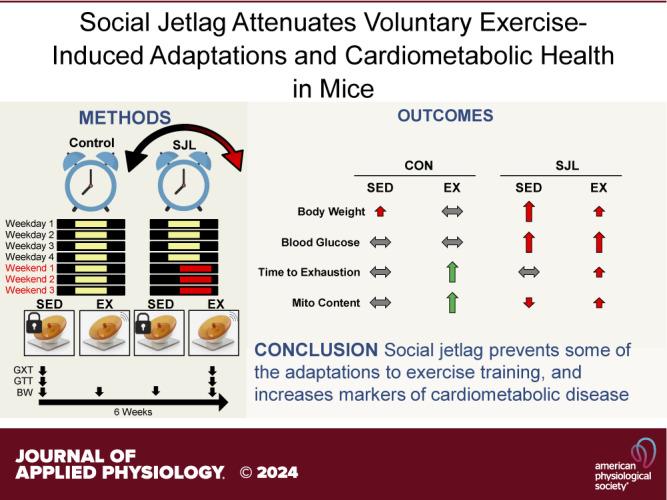
Social jet lag (SJL) is a misalignment between sleep and wake times on workdays and free days. SJL leads to chronic circadian rhythm disruption and may affect nearly 70% of the general population, leading to increased risk for cardiometabolic diseases. This study investigated the effects of SJL on metabolic health, exercise performance, and exercise-induced skeletal muscle adaptations in mice. Ten-week-old C57BL/6J mice ( = 40) were allocated to four groups: control sedentary (CON-SED), control exercise (CON-EX), social jet lag sedentary (SJL-SED), and social jet lag exercise (SJL-EX). CON mice were housed under a 12:12-h light-dark cycle. SJL was simulated by implementing a 4-h phase delay for 3 days to simulate "weekends," followed by a 4-h phase advance back to "weekdays," for 6 wk. EX mice had free access to a running wheel. Graded exercise tests (GXTs) and glucose tolerance tests (GTTs) were performed at baseline and after intervention to monitor the effects of exercise and social jet lag on cardiorespiratory and metabolic health, respectively. SJL led to alterations in activity and running patterns and clock gene expression in skeletal muscle and decreased average running distance ( < 0.05). SJL-SED mice gained significantly more weight compared with CON-SED and SJL-EX mice ( < 0.01). SJL impaired fasting blood glucose and glucose tolerance compared with CON mice ( < 0.05), which was partially restored by exercise in SJL-EX mice. SJL also blunted improvements in exercise performance and mitochondrial content in the quadriceps. These data suggest that SJL blunted some cardiometabolic adaptations to exercise and that proper circadian hygiene is necessary for maintaining health and performance. In mice, disrupting circadian rhythms with social jet lag for 6 wk caused significant weight gain, higher fasting blood glucose, and impaired glucose tolerance compared with control. Voluntary exercise in mice experiencing social jet lag prevented weight gain, though the mice still experienced increased fasting blood glucose and impaired exercise performance compared with trained mice not experiencing social jet lag. Social jet lag seems to be a potent circadian rhythm disruptor that impacts exercise-induced training adaptations.
社会时差(SJL)是工作日和休息日睡眠和清醒时间的不匹配。SJL 导致慢性昼夜节律紊乱,可能影响近 70%的普通人群,增加患心血管代谢疾病的风险。本研究探讨了 SJL 对代谢健康、运动表现和运动诱导的骨骼肌适应的影响。将 10 周龄 C57BL/6J 小鼠(n=40)分为四组:对照组安静(CON-SED)、对照组运动(CON-EX)、社会时差安静(SJL-SED)和社会时差运动(SJL-EX)。CON 组小鼠在 12:12 光照-黑暗循环中饲养。通过实施 3 天的 4 小时相位延迟来模拟“周末”,然后再进行 4 小时的相位提前回到“工作日”,共 6 周,模拟 SJL。EX 组小鼠可以自由使用跑轮。在基线和干预后进行递增运动试验(GXT)和葡萄糖耐量试验(GTT),分别监测运动和社会时差对心肺和代谢健康的影响。SJL 导致骨骼肌活动和跑步模式以及时钟基因表达发生变化,平均跑步距离减少(<0.05)。与 CON-SED 和 SJL-EX 相比,SJL-SED 组小鼠体重显著增加(<0.01)。与 CON 相比,SJL 使空腹血糖和葡萄糖耐量受损(<0.05),SJL-EX 组运动部分恢复。SJL 还削弱了运动表现和股四头肌中线粒体含量的改善。这些数据表明,SJL 削弱了一些对运动的心血管代谢适应,适当的昼夜节律卫生对于维持健康和表现是必要的。在小鼠中,6 周的社会时差扰乱昼夜节律会导致体重显著增加、空腹血糖升高和葡萄糖耐量受损,与对照组相比。在经历社会时差的小鼠中进行自愿运动可防止体重增加,但与未经历社会时差的训练有素的小鼠相比,这些小鼠的空腹血糖仍然升高,运动表现受损。社会时差似乎是一种强大的昼夜节律破坏者,会影响运动诱导的训练适应。
 Zotero 插件