
基于分子动力学模型的 LSD1/CoREST 潜在抑制剂的抗增殖作用,用于治疗 SH-SY5Y 神经母细胞瘤癌细胞系。
Anti-Proliferative Effect of Potential LSD1/CoREST Inhibitors Based on Molecular Dynamics Model for Treatment of SH-SY5Y Neuroblastoma Cancer Cell Line.
机构信息
Hamdi Mango Research Center for Scientific Research, The University of Jordan, Amman 11942, Jordan.
Department of Pharmacy, Faculty of Health Science, American University of Madaba, P.O. Box 2882, Amman 11821, Jordan.
出版信息
Asian Pac J Cancer Prev. 2022 Oct 1;23(10):3533-3540. doi: 10.31557/APJCP.2022.23.10.3533.
BACKGROUND
Lysine-specific demethylase is a demethylase enzyme that can remove methyl groups from histones H3K4me1/2 and H3K9me1/2. It is expressed in many cancers, where it impedes differentiation and contributes to cancer cell proliferation, cell metastasis and invasiveness, and is associated with inferior prognosis. LSD1 is associated with its corepressor protein CoREST, and utilizes tetrahydrofolate as a cofactor to accept CH2 from the demethylation process. The fact that the cofactor is best bound to the active site inspired us to explore its interactions to LSD1/CoREST enzyme complex utilizing molecular dynamics simulation, which aids designing novel and potent inhibitors.
OBJECTIVE
In this study we minted to identify a new potential LSD1/CoREST inhibitors and test the potency and the safety of such inhibitors against human neuroblastoma and fibroblast cells lines.
METHODS
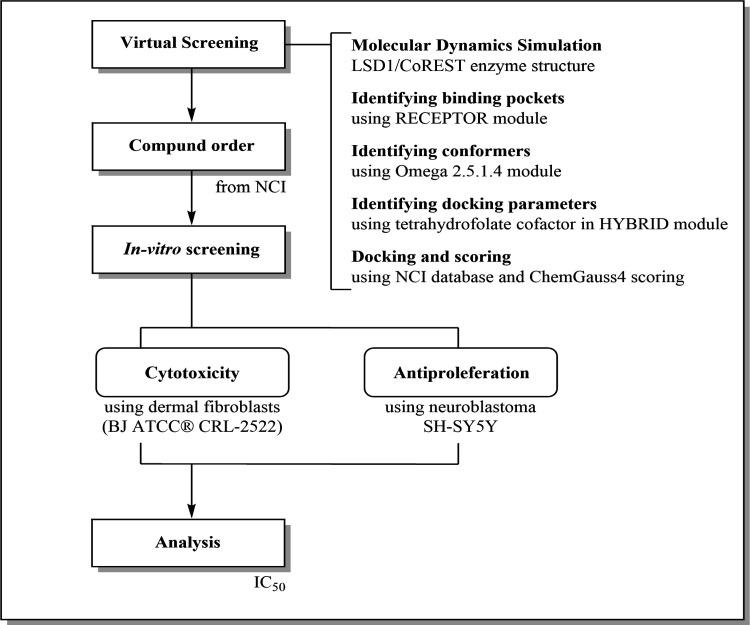
We have implemented a previously derived model from the molecular dynamics simulation study and the key contacts to the active site in a subsequent structure based drug design and in-silico screening, which revealed a number of potential inhibitors toward LSD1/CoREST complex. The anti-proliferative activities of the identified compounds will be tested against neuroblastoma SH-SY5Y cancer cell line which known to highly express LSD1/CoREST complex.
RESULTS
In-silico mining on National Cancer Institute (NCI) database identified 55 promising and structurally diverse inhibitors. Applying the abovementioned molecular modeling procedure yielded four compounds of LSD1/CoREST inhibiters with IC50 < 2µM. The four lead compounds were tested against SH-SY5Y neuroblastoma cell line that known to express high level of LSD1 and illustrated a potent activity with an IC50 ranging from 0.195 to 1.52µM. To estimate the toxicity of the selective leads, they were tested against normal fibroblast cells and scored a relatively high IC50 ranging from 0.303 to ≥ 100µM.
CONCLUSION
Our model revealed promising inhibitors that can be used in treating cancers that overexpress the LSD1 enzyme such as the SH-SY5Y neuroblastoma.
背景
赖氨酸特异性脱甲基酶是一种可以从组蛋白 H3K4me1/2 和 H3K9me1/2 上去除甲基基团的脱甲基酶。它在许多癌症中表达,抑制分化并促进癌细胞增殖、细胞转移和侵袭,并与预后不良相关。LSD1 与它的核心抑制蛋白 CoREST 相关,利用四氢叶酸作为辅助因子从去甲基化过程中接受 CH2。事实上,辅助因子与活性位点的最佳结合激发了我们利用分子动力学模拟探索其与 LSD1/CoREST 酶复合物的相互作用,从而有助于设计新型有效的抑制剂。
目的
在这项研究中,我们旨在鉴定一种新的潜在 LSD1/CoREST 抑制剂,并测试其对人神经母细胞瘤和成纤维细胞系的效力和安全性。
方法
我们已经实施了先前从分子动力学模拟研究中得出的模型,并在随后的基于结构的药物设计和计算机筛选中利用关键的活性位点接触,这揭示了针对 LSD1/CoREST 复合物的一些潜在抑制剂。所鉴定化合物的抗增殖活性将针对已知高度表达 LSD1/CoREST 复合物的神经母细胞瘤 SH-SY5Y 癌细胞系进行测试。
结果
对国家癌症研究所(NCI)数据库的计算机挖掘鉴定了 55 种有前途且结构多样的抑制剂。应用上述分子建模程序得到了四种 LSD1/CoREST 抑制剂,其 IC50<2µM。四种先导化合物针对已知高表达 LSD1 的 SH-SY5Y 神经母细胞瘤系进行了测试,表现出有效的活性,IC50 范围为 0.195 至 1.52µM。为了估计选择性先导化合物的毒性,它们在正常成纤维细胞系中进行了测试,其 IC50 范围为 0.303 至≥100µM。
结论
我们的模型揭示了有前途的抑制剂,可用于治疗过度表达 LSD1 酶的癌症,如 SH-SY5Y 神经母细胞瘤。

 Zotero 插件