
精液微生物培养:洗还是不洗?
Ejaculate for Microbiological Culture: To Wash or Not To Wash?
机构信息
Institute of Medical Microbiology, University Hospital Münster, Münster, Germany.
出版信息
Microbiol Spectr. 2022 Dec 21;10(6):e0326922. doi: 10.1128/spectrum.03269-22. Epub 2022 Nov 2.
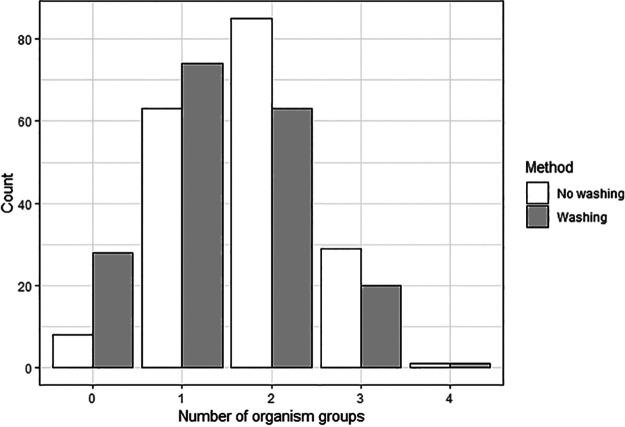
Bacteria can be associated with male infertility. Antibacterial substances (e.g., zinc-containing proteins, antimicrobial peptides) in ejaculates might impair the growth of bacteria in culture. We therefore wanted to test if removing antibacterial substances by washing the ejaculate could improve the detection of bacteria in culture. All ejaculates from patients ≥18 years old, which were obtained for routine diagnostics to assess male infertility were included in this study (no exclusion criteria were applied). Test samples were diluted with 2 mL sterile 0.45% saline, vortexed, and centrifuged (5 min; 7.5 × ). After the removal of 2 mL of the supernatant and resuspension, 10 μL of the pellet was used for aerobic and anaerobic culture. Control samples were cultured identically but without washing. Species identification was done with matrix-assisted laser desorption ionization-time of flight mass spectrometry. A total of 186 samples were included. The data set was stratified into five groups (Gram-negative rods [GNR], anaerobes [AN], spp. [EC], coagulase-negative staphylococci [CNS], and viridans streptococci [VS]). Compared to the control arm, the test arm revealed significant lower proportions for CNS (59.1% versus 44.6%, < 0.01) and VS (53.8% versus 41.9%, = 0.03). Similarly, slightly lower proportions of GNR (16.1% versus 15.1%, = 0.89), AN (19.9% versus 17.2%, = 0.5), and EC (25.3% versus 23.1%, = 0.63) were observed. The medians of CFU were lower in test samples compared to the control samples (6.5 × 10 versus 2.5 × 10, < 0.01) for any bacterial growth. Lower colony counts were also observed for individual bacterial groups. In conclusion, preculture washing of ejaculates results in a decrease in total bacteria count and culture-positive samples. This study compares two methods for processing ejaculate samples from men undergoing investigations for infertility. The method of sample washing and centrifugation was compared to the standard method of direct inoculation and culture. The study hypothesis was that preprocessing of samples may increase bacterial yield by removing bactericidal substances from semen. However, we found that washing ejaculate samples before microbiological culture did not improve the detection of bacteria and led to a reduction in colony counts.
细菌可能与男性不育有关。精液中的抗菌物质(如含锌蛋白、抗菌肽)可能会损害培养物中细菌的生长。因此,我们想测试通过洗涤精液去除抗菌物质是否可以提高培养物中细菌的检测率。
本研究纳入了所有年龄≥ 18 岁的因男性不育接受常规诊断评估而获得的精液样本(无排除标准)。测试样本用 2 mL 无菌 0.45%生理盐水稀释,涡旋,离心(5 分钟;7.5×)。去除 2 mL 上清液并重新悬浮后,使用 10 μL 沉淀进行需氧和厌氧培养。对照样本以相同方式培养,但不进行洗涤。通过基质辅助激光解吸电离飞行时间质谱进行种属鉴定。共纳入 186 个样本。数据集分为五组(革兰氏阴性杆菌[GNR]、厌氧菌[AN]、 spp.[EC]、凝固酶阴性葡萄球菌[CNS]和草绿色链球菌[VS])。与对照臂相比,测试臂 CNS(59.1%比 44.6%,<0.01)和 VS(53.8%比 41.9%,=0.03)的比例显著较低。同样,GNR(16.1%比 15.1%,=0.89)、AN(19.9%比 17.2%,=0.5)和 EC(25.3%比 23.1%,=0.63)的比例也略低。与对照样本相比,测试样本中的 CFU 中位数较低(任何细菌生长时为 6.5×10 比 2.5×10,<0.01)。个别细菌群的菌落计数也较低。
总之,精液的预培养洗涤导致总细菌计数和培养阳性样本减少。本研究比较了两种处理男性不育症患者精液样本的方法。将洗涤和离心的样本处理方法与直接接种和培养的标准方法进行了比较。研究假设是预处理样品可以通过去除精液中的杀菌物质来提高细菌产量。然而,我们发现,在微生物培养之前洗涤精液样本并没有提高细菌的检测率,反而导致菌落计数减少。
 Zotero 插件