
2018 年至 2020 年期间,来自共同生活的狗和人类的 中存在黏菌素耐药基因的共享。
colistin resistance gene sharing between from cohabiting dogs and humans, Lisbon, Portugal, 2018 to 2020.
机构信息
Associate Laboratory for Animal and Veterinary Sciences (AL4AnimalS), Lisbon, Portugal.
Centre for Interdisciplinary Research in Animal Health (CIISA), Faculty of Veterinary Medicine, University of Lisbon, Lisbon, Portugal.
出版信息
Euro Surveill. 2022 Nov;27(44). doi: 10.2807/1560-7917.ES.2022.27.44.2101144.
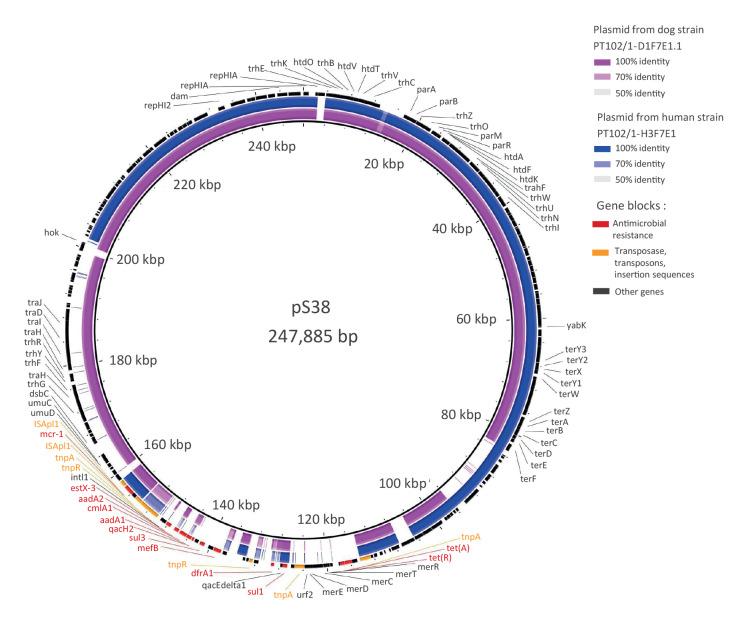
BackgroundThe emergence of colistin resistance is a One Health antimicrobial resistance challenge worldwide. The close contact between companion animals and humans creates opportunities for transmission and dissemination of colistin-resistant bacteria.AimTo detect potential animal reservoirs of colistin-resistant and investigate the possible sharing of these bacteria between dogs, cats and their cohabiting humans in the community in Lisbon, Portugal.MethodsA prospective longitudinal study was performed from 2018 to 2020. Faecal samples from dogs and cats either healthy or diagnosed with a skin and soft tissue or urinary tract infection, and their cohabiting humans were screened for the presence of colistin-resistant . All isolates were tested by broth microdilution against colistin and 12 other antimicrobials. Colistin-resistant isolates were screened for 30 resistance genes, including plasmid-mediated colistin resistance genes ( to ), and typed by multilocus sequence typing. Genetic relatedness between animal and human isolates was analysed by whole genome sequencing.ResultsColistin-resistant strains harbouring the gene were recovered from faecal samples of companion animals (8/102; 7.8%) and humans (4/125; 3.2%). No difference between control and infection group was detected. Indistinguishable multidrug-resistant . ST744 strains harbouring the gene were found in humans and their dogs in two households.ConclusionsThe identification of identical . strains containing the plasmid-mediated gene in companion animals and humans in daily close contact is of concern. These results demonstrate the importance of the animal-human unit as possible disseminators of clinically important resistance genes in the community setting.
背景
黏菌素耐药性的出现是全球范围内的一个涉及人类健康的抗生素耐药性挑战。伴侣动物与人类的密切接触为耐药菌的传播和扩散创造了机会。
目的
检测潜在的动物黏菌素耐药菌储主,并调查葡萄牙里斯本社区中狗、猫及其共同居住的人类之间这些细菌的可能共享情况。
方法
进行了一项从 2018 年到 2020 年的前瞻性纵向研究。筛选了健康的狗和猫的粪便样本,或患有皮肤和软组织或尿路感染的狗和猫的粪便样本,以及他们共同居住的人类的粪便样本,以检测是否存在黏菌素耐药菌。所有分离株均通过肉汤微量稀释法对黏菌素和 12 种其他抗菌药物进行了检测。对黏菌素耐药分离株进行了 30 种耐药基因的筛选,包括质粒介导的黏菌素耐药基因(至),并通过多位点序列分型进行了分型。通过全基因组测序分析动物和人类分离株之间的遗传相关性。
结果
从伴侣动物(8/102;7.8%)和人类(4/125;3.2%)的粪便样本中回收了携带基因的黏菌素耐药菌菌株。在对照组和感染组之间未检测到差异。发现了携带基因的多药耐药 菌株。ST744 型,在两个家庭中,人类及其狗均携带该基因。
结论
在日常密切接触的伴侣动物和人类中,发现了携带质粒介导基因的相同黏菌素耐药菌菌株令人担忧。这些结果表明,动物-人类单元作为社区环境中临床重要耐药基因的可能传播者的重要性。


 Zotero 插件