
产碳青霉烯酶肠杆菌科菌株导致伴侣动物感染—葡萄牙。
Carbapenemase-producing Enterobacterales strains causing infections in companion animals-Portugal.
机构信息
CIISA-Centre for Interdisciplinary Research in Animal Health, Faculty of Veterinary Medicine, University of Lisbon, Lisbon, Portugal.
AL4AnimalS-Associate Laboratory for Animal and Veterinary Sciences, Vila Real, Portugal.
出版信息
Microbiol Spectr. 2024 Apr 2;12(4):e0341623. doi: 10.1128/spectrum.03416-23. Epub 2024 Mar 6.
UNLABELLED
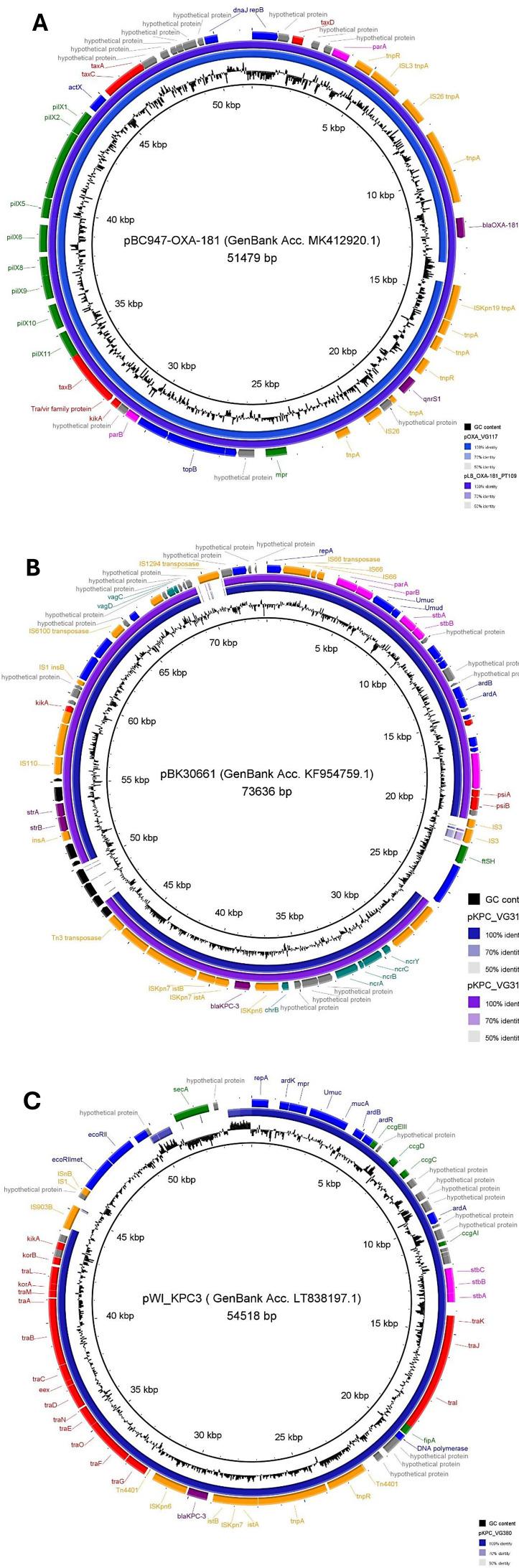
An increase in carbapenem-resistant human nosocomial strains is occurring in Europe, namely with the and genes. We determined the prevalence of carbapenemase-producing Enterobacterales clinical strains in companion animals in Portugal and characterized their mobile genetic elements. Susceptibility data of a consecutive collection of 977 Enterobacterales clinical strains from a Portuguese private veterinary diagnostic laboratory were evaluated (January-December 2020). Additional phenotypical and genotypical assays were performed in a subset of 261 strains with a resistant phenotype. Whole-genome sequencing was performed for carbapenemase-producing strains. The frequency of carbapenemase-producing Enterobacterales clinical strains in companion animals in Portugal was 0.51% ( = 5/977). Thus, five strains were characterized: (i) one OXA-181-producing ST273, (ii) two KPC-3-producing ST147; (iii) one KPC-3-producing ST392; and (iv) one OXA-48-producing ST127. The gene was located on transposon Tn on IncFIA type plasmid for the ST147 strains and on a IncN-type plasmid for the ST392 strain, while gene was located on an IncX3 plasmid. All assembled plasmids and plasmid-encoded transposons harboring carbapenemase genes were homologous to those previously described in the human healthcare. No plasmid replicons were detected on the OXA-48-producing ST127. The dissemination of carbapenem resistance is occurring horizontally plasmid spreading from the human high burden carbapenem resistance setting to the companion animal sector. Furthermore, companion animals may act as reservoirs of carbapenem resistance. Implementation of carbapenemase detection methods in routine clinical veterinary microbiology is urgently needed.
IMPORTANCE
This is the first study on the prevalence of carbapenemase-producing Enterobacterales (CPE) clinical strains from companion animals in Portugal. Despite the generally low prevalence of CPE in companion animals, it is imperative for veterinary diagnostic laboratories to employ diagnostic methods for carbapenemase detection. The resemblance found in the mobile genetic elements transporting carbapenemase genes between veterinary medicine and human medicine implies a potential circulation within a One Health framework.
未加标签
欧洲耐碳青霉烯类人源医院分离株数量不断增加,主要为 和 基因。本研究旨在调查葡萄牙伴侣动物中产碳青霉烯酶肠杆菌科(Enterobacterales)临床分离株的流行情况,并对其移动遗传元件进行特征分析。我们评估了葡萄牙一家私人兽医诊断实验室连续收集的 977 株肠杆菌科临床分离株的药敏数据(2020 年 1 月至 12 月)。对具有耐药表型的 261 株菌株进行了额外的表型和基因型检测。对产碳青霉烯酶的菌株进行了全基因组测序。葡萄牙伴侣动物中产碳青霉烯酶肠杆菌科临床分离株的频率为 0.51%(=5/977)。共鉴定了 5 株产碳青霉烯酶的菌株:(i)1 株产 OXA-181 的 ST273;(ii)2 株产 KPC-3 的 ST147;(iii)1 株产 KPC-3 的 ST392;(iv)1 株产 OXA-48 的 ST127。 基因位于 ST147 株的转座子 Tn 上,位于 IncFIA 型质粒上,而 基因位于 IncN 型质粒上; 基因位于 IncX3 质粒上。所有组装的质粒和携带碳青霉烯酶基因的质粒转座子与先前在人类医疗保健中描述的质粒同源。在产 OXA-48 的 ST127 中未检测到质粒复制子。碳青霉烯耐药性的传播是通过质粒的水平传播,从人类高碳青霉烯耐药负担环境传播到伴侣动物领域。此外,伴侣动物可能是碳青霉烯耐药性的储存库。迫切需要在常规兽医临床微生物学中实施碳青霉烯酶检测方法。
意义
这是葡萄牙首次研究伴侣动物中产碳青霉烯酶肠杆菌科(CPE)临床分离株的流行情况。尽管伴侣动物中 CPE 的总体流行率较低,但兽医诊断实验室必须采用碳青霉烯酶检测诊断方法。兽医和人类医学中携带碳青霉烯酶基因的移动遗传元件的相似性表明,在一个统一的健康框架内存在潜在的循环。

 Zotero 插件