
不孕不育及生育护理指标:一项系统性综述
Indicators of infertility and fertility care: a systematic scoping review.
作者信息
Nabhan Ashraf, Salama Mohamed, Elsayed Mortada, Nawara Maii, Kamel Menna, Abuelnaga Yasmeen, Ghonim Mohanad, Elshafeey Farida, Abdelhadi Rana, Gebril Sara, Mahdy Shahd, Sarhan Dana, Mburu Gitau, Kiarie James
机构信息
Department of Obstetrics and Gynecology, Faculty of Medicine, Ain Shams University, Cairo, Egypt.
Egyptian Center for Evidence Based Medicine, Cairo, Egypt.
出版信息
Hum Reprod Open. 2022 Oct 13;2022(4):hoac047. doi: 10.1093/hropen/hoac047. eCollection 2022.
STUDY QUESTION
What is the scope of literature regarding infertility and fertility care indicators in terms of types and dimensions of these indicators?
SUMMARY ANSWER
Most available infertility and fertility care indicators are outcomes indicators of effectiveness and efficiency dimensions.
WHAT IS KNOWN ALREADY
The use of appropriate, relevant and valid indicators of infertility and fertility care is critical for monitoring access, equity and utilization.
STUDY DESIGN SIZE DURATION
A systematic scoping review was conducted. We searched MEDLINE, Pubmed, JSTOR, CINAHL, Web of Science and Scopus electronic databases from inception to May 2022 without imposing language or date restrictions. We searched gray literature and online libraries of relevant organizations. We hand-searched the list of relevant references.
PARTICIPANTS/MATERIALS SETTING METHODS: This scoping systematic review followed the framework of Arksey and O'Malley and the Joanna Briggs Institute guidelines. Records identified by the search were independently screened and data were extracted. We performed conceptual synthesis by grouping the reported indicators by typology and dimensions. Structured tabulation and graphical synthesis were used along with narrative commentary.
MAIN RESULTS AND THE ROLE OF CHANCE
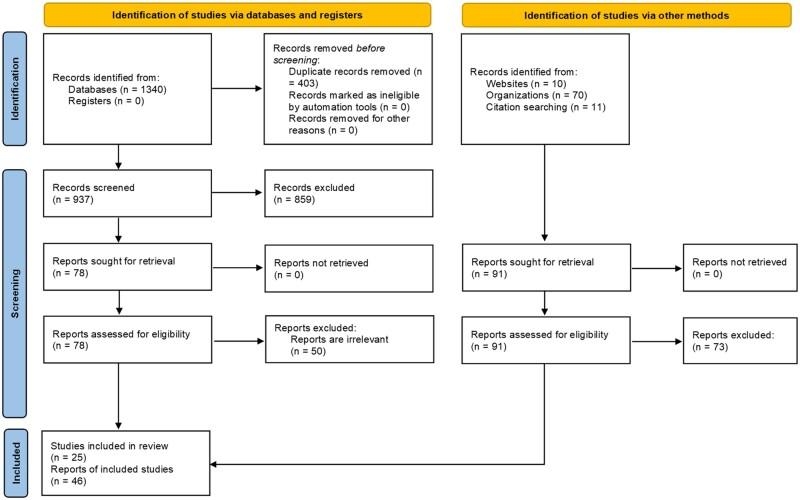
We included 46 reports from 88 countries. The reporting of infertility and fertility care indicators was voluntary in 63 countries (72%) and compulsory in 25 countries (28%). Reporting for cycles or deliveries was based on individual cycles in 56 countries (64%) and on cumulative cycles in 32 countries (36%). Most indicators were utilized as outcome indicators with fewer being process indicators or structural indicators. For the dimension of indicators, most indicators were utilized as effectiveness and efficiency indicators with fewer utilized as indicators of safety, patient-centeredness, equity and timeliness.
LIMITATIONS REASONS FOR CAUTION
Most indicators fall into the domain of assisted reproductive technology and are reported by fertility clinics. Indicators of safety, patient-centeredness, equity and timeliness as well as non-clinical indicators are almost invisible.
WIDER IMPLICATIONS OF THE FINDINGS
A wide range of indicators of infertility and fertility care exist in literature. Most indicators were effectiveness and efficiency indicators, while indicators of safety, patient-centeredness, equity and timeliness remain almost invisible. The scope of the current indicators indicates a predominant focus on clinical metrics, with substantial invisibility of non-clinical indicators and indicators outside the ART domain. These gaps need to be considered in further work of identifying a core set of indicators.
STUDY FUNDING/COMPETING INTERESTS: This work received funding from the UNDP-UNFPA-UNICEF-WHO-World Bank Special Programme of Research, Development and Research Training in Human Reproduction (HRP), a cosponsored program executed by the World Health Organization (WHO). The authors had no competing interests.
TRIAL REGISTRATION NUMBER
Open Science Framework vsu42.
研究问题
关于不孕症和生育护理指标的文献在这些指标的类型和维度方面的范围是什么?
简要回答
大多数现有的不孕症和生育护理指标是有效性和效率维度的结果指标。
已知信息
使用适当、相关且有效的不孕症和生育护理指标对于监测可及性、公平性和利用率至关重要。
研究设计、规模、持续时间:进行了一项系统的范围综述。我们检索了MEDLINE、PubMed、JSTOR、CINAHL、科学网和Scopus电子数据库,从数据库建立至2022年5月,不设语言或日期限制。我们检索了灰色文献和相关组织的在线图书馆。我们手动检索了相关参考文献列表。
参与者/材料、环境、方法:本范围系统综述遵循了阿克西和奥马利的框架以及乔安娜·布里格斯研究所的指南。对检索到的记录进行独立筛选并提取数据。我们通过按类型和维度对报告的指标进行分组来进行概念综合。使用结构化表格和图形综合以及叙述性评论。
主要结果及机遇的作用
我们纳入了来自88个国家的46份报告。在63个国家(72%),不孕症和生育护理指标的报告是自愿的,在25个国家(28%)是强制性的。56个国家(64%)基于单个周期报告周期或分娩情况,32个国家(36%)基于累积周期报告。大多数指标被用作结果指标,用作过程指标或结构指标的较少。对于指标维度,大多数指标被用作有效性和效率指标,用作安全性、以患者为中心、公平性和及时性指标的较少。
局限性、谨慎的理由:大多数指标属于辅助生殖技术领域,由生育诊所报告。安全性、以患者为中心、公平性和及时性指标以及非临床指标几乎未被提及。
研究结果的更广泛影响
文献中存在各种各样的不孕症和生育护理指标。大多数指标是有效性和效率指标,而安全性、以患者为中心、公平性和及时性指标几乎未被提及。当前指标的范围表明主要关注临床指标,非临床指标和辅助生殖技术领域之外的指标基本未被提及。在确定核心指标集的进一步工作中需要考虑这些差距。
研究资金/利益冲突:这项工作得到了联合国开发计划署 - 联合国人口基金 - 联合国儿童基金会 - 世界卫生组织 - 世界银行人类生殖特别研究、发展和研究培训计划(HRP)的资助,这是一项由世界卫生组织(WHO)共同赞助的计划。作者没有利益冲突。
试验注册号
开放科学框架vsu42

 Zotero 插件