
美国痴呆症患病率不平等趋势。
Trends in inequalities in the prevalence of dementia in the United States.
机构信息
Economics, Sociology, and Statistics Department, RAND Corporation, Santa Monica, CA 90401.
National Bureau of Economic Research, Cambridge, MA 02138.
出版信息
Proc Natl Acad Sci U S A. 2022 Nov 16;119(46):e2212205119. doi: 10.1073/pnas.2212205119. Epub 2022 Nov 7.
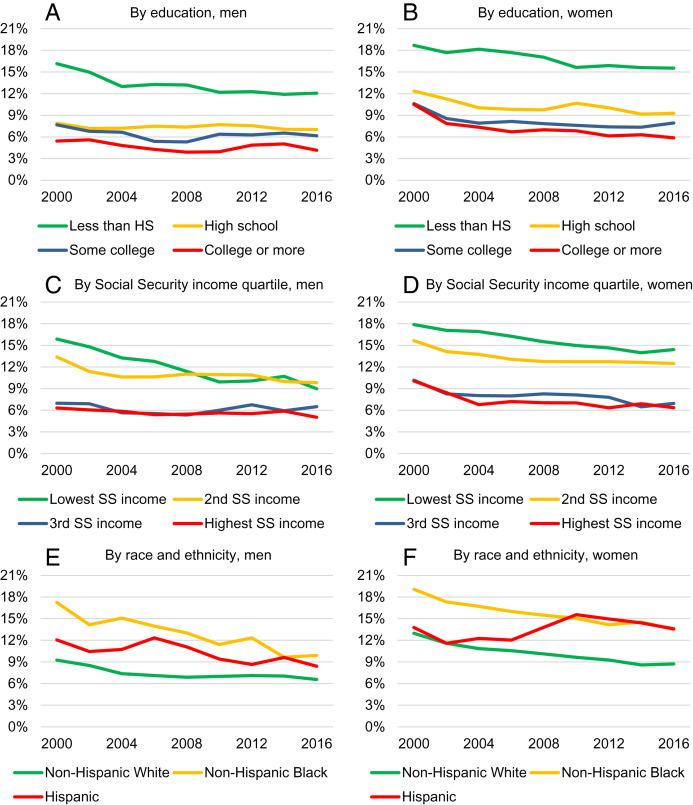
This paper presents estimates of the prevalence of dementia in the United States from 2000 to 2016 by age, sex, race and ethnicity, education, and a measure of lifetime earnings, using data on 21,442 individuals aged 65 y and older and 97,629 person-year observations from a nationally representative survey, the Health and Retirement Study (HRS). The survey includes a range of cognitive tests, and a subsample underwent clinical assessment for dementia. We developed a longitudinal, latent-variable model of cognitive status, which we estimated using the Markov Chain Monte Carlo method. This model provides more accurate estimates of dementia prevalence in population subgroups than do previously used methods on the HRS. The age-adjusted prevalence of dementia decreased from 12.2% in 2000 (95% CI, 11.7 to 12.7%) to 8.5% in 2016 (7.9 to 9.1%) in the 65+ population, a statistically significant decline of 3.7 percentage points or 30.1%. Females are more likely to live with dementia, but the sex difference has narrowed. In the male subsample, we found a reduction in inequalities across education, earnings, and racial and ethnic groups; among females, those inequalities also declined, but less strongly. We observed a substantial increase in the level of education between 2000 and 2016 in the sample. This compositional change can explain, in a statistical sense, about 40% of the reduction in dementia prevalence among men and 20% among women, whereas compositional changes in the older population by age, race and ethnicity, and cardiovascular risk factors mattered less.
本文利用美国具有全国代表性的调查(健康与退休研究)中 21442 名年龄在 65 岁及以上的个体和 97629 人年的观察资料,按年龄、性别、种族和民族、教育程度以及终生收入衡量标准,估算了 2000 年至 2016 年美国痴呆症的流行率。该调查包括一系列认知测试,其中一部分参与者接受了痴呆症的临床评估。我们开发了一个认知状态的纵向潜在变量模型,使用马尔可夫链蒙特卡罗方法对其进行了估计。与之前在 HRS 上使用的方法相比,该模型为人口亚组的痴呆症流行率提供了更准确的估计。经过年龄调整后,65 岁及以上人群的痴呆症流行率从 2000 年的 12.2%(95%置信区间:11.7%至 12.7%)降至 2016 年的 8.5%(7.9%至 9.1%),统计学上显著下降了 3.7 个百分点,即 30.1%。女性更有可能患有痴呆症,但性别差异正在缩小。在男性亚组中,我们发现教育程度、收入以及种族和民族群体之间的不平等现象有所减少;在女性中,这些不平等现象也有所减少,但程度较轻。我们发现,在样本中,2000 年至 2016 年期间,受教育程度有了实质性提高。从统计学意义上讲,这种构成变化可以解释男性痴呆症流行率降低的 40%左右,女性降低的 20%左右,而年龄、种族和民族以及心血管风险因素方面的老年人口构成变化则不太重要。

 Zotero 插件