
侧向流检测(LFA)在 COVID-19 相关肺曲霉病(CAPA)诊断中的应用:一项单中心经验。
Lateral flow assay (LFA) in the diagnosis of COVID-19-associated pulmonary aspergillosis (CAPA): a single-center experience.
机构信息
Department of Hematology, Istanbul Training and Research Hospital, University of Health Sciences, Org. Nafiz GURMAN Cad. 34098, Fatih, Istanbul, Turkey.
Department of Anesthesiology and Reanimation, Istanbul Training and Research Hospital, University of Health Sciences, Istanbul, Turkey.
出版信息
BMC Infect Dis. 2022 Nov 8;22(1):822. doi: 10.1186/s12879-022-07828-y.
BACKGROUND
Invasive pulmonary aspergillosis (IPA) is seen during coronavirus-2019 (COVID-19), has been reported in different incidences, and is defined as COVID-19-associated pulmonary aspergillosis (CAPA). Detection of galactomannan antigen is an important diagnostic step in diagnosing IPA. Enzyme-linked immunoassay (ELISA) is the most frequently used method, and lateral flow assay (LFA) is increasingly used with high sensitivity and specificity for rapid diagnosis. The present study aimed to compare the sensitivity of LFA and ELISA in the diagnosis of CAPA in COVID-19 patients followed in our hospital's ICU for pandemic (ICU-P).
METHODS
This study included patients with a diagnosis of COVID-19 cases confirmed by polymerase chain reaction and were followed up in ICU-P between August 2021 and February 2022 with acute respiratory failure. The diagnosis of CAPA was based on the European Confederation of Medical Mycology (ECMM) and the International Society for Human and Animal Mycology 2020 (ECMM/ ISHAM) guideline. Galactomannan levels were determined using LFA and ELISA in serum samples taken simultaneously from the patients.
RESULTS
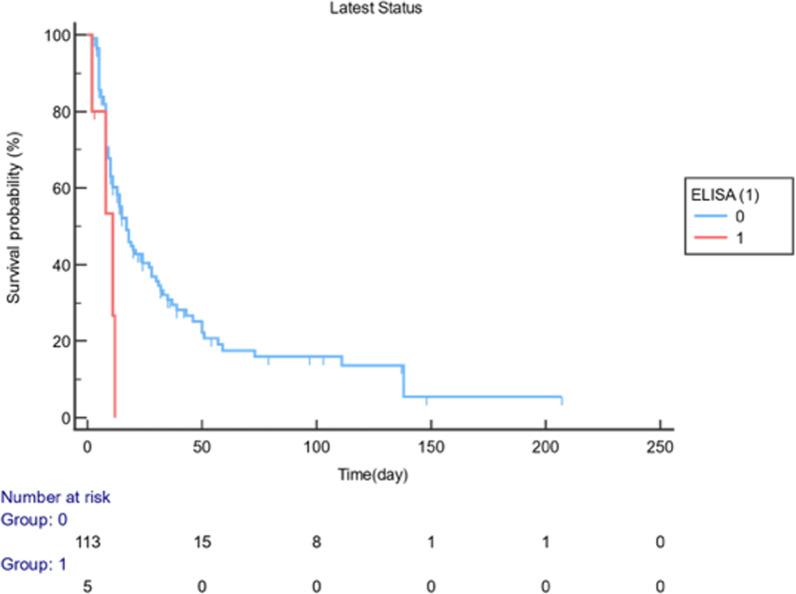
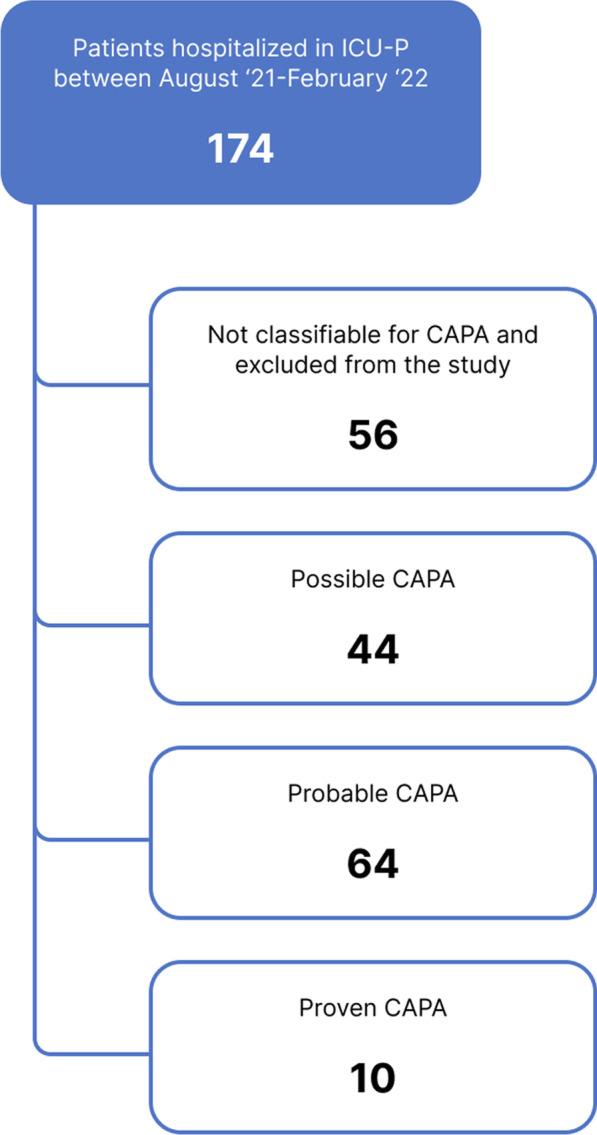
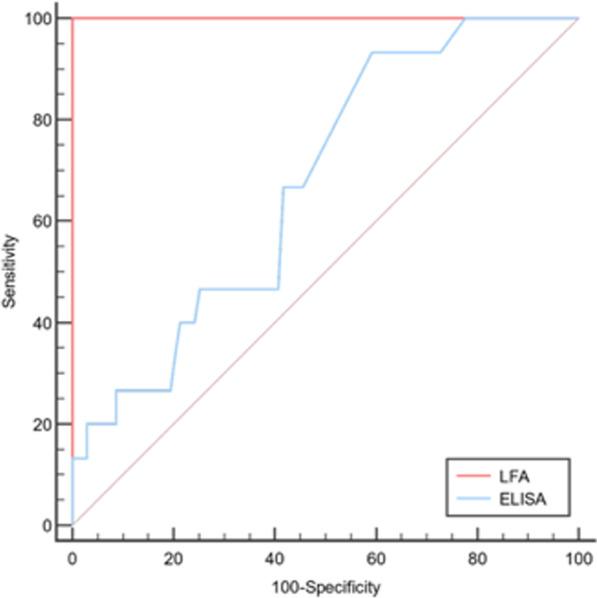
Out of the 174 patients followed in the ICU-P, 56 did not meet any criteria for CAPA and were excluded from the analysis. The rate of patients diagnosed with proven CAPA was 5.7% (10 patients). A statistically significant result was obtained with LFA for the cut-off value of 0.5 ODI in the diagnosis of CAPA (p < 0.001). The same significant statistical relationship was found for the cut-off value of 1.0 ODI for the ELISA (p < 0.01). The sensitivity of LFA was 80% (95% CI: 0.55-1.05, p < 0.05), specificity 94% (95% CI: 0.89-0.98, p < 0.05); PPV 53% (95% CI: 0.28-0.79, p > 0.05) and NPV was 98% (95% CI: 0.95-1.01, p < 0.05). The risk of death was 1.66 (HR: 1.66, 95% CI: 1.02-2.86, p < 0.05) times higher in patients with an LFA result of ≥ 0.5 ODI than those with < 0.5 (p < 0.05).
CONCLUSIONS
It is reckoned that LFA can be used in future clinical practice, particularly given its effectiveness in patients with hematological malignancies and accuracy in diagnosing CAPA.
背景
侵袭性肺曲霉病(IPA)见于新型冠状病毒-2019(COVID-19)患者,其发病率不同,被定义为 COVID-19 相关肺曲霉病(CAPA)。半乳甘露聚糖抗原检测是诊断 IPA 的重要诊断步骤。酶联免疫吸附试验(ELISA)是最常用的方法,而侧向流动检测(LFA)因其具有高灵敏度和特异性,可用于快速诊断而越来越多地被应用。本研究旨在比较 LFA 和 ELISA 在诊断我院 ICU 内因大流行而收治的 COVID-19 患者(ICU-P)中 CAPA 的敏感性。
方法
本研究纳入了通过聚合酶链反应确诊的 COVID-19 病例,并于 2021 年 8 月至 2022 年 2 月期间在 ICU-P 中因急性呼吸衰竭而接受随访。CAPA 的诊断基于欧洲医学真菌联合会(ECMM)和国际人类与动物真菌学会 2020 年(ECMM/ISHAM)指南。同时从患者身上采集血清样本,使用 LFA 和 ELISA 检测半乳甘露聚糖水平。
结果
在 ICU-P 中接受随访的 174 例患者中,有 56 例不符合任何 CAPA 标准,被排除在分析之外。确诊为确诊 CAPA 的患者比例为 5.7%(10 例)。LFA 检测的截止值为 0.5 ODI 时,对 CAPA 的诊断具有统计学显著意义(p<0.001)。ELISA 的截止值为 1.0 ODI 时,也有相同的显著统计学关系(p<0.01)。LFA 的灵敏度为 80%(95%CI:0.55-1.05,p<0.05),特异性为 94%(95%CI:0.89-0.98,p<0.05);阳性预测值为 53%(95%CI:0.28-0.79,p>0.05),阴性预测值为 98%(95%CI:0.95-1.01,p<0.05)。LFA 检测结果≥0.5 ODI 的患者死亡风险是 LFA 检测结果<0.5 ODI 的患者的 1.66 倍(HR:1.66,95%CI:1.02-2.86,p<0.05)。
结论
LFA 可用于未来的临床实践,特别是鉴于其在血液恶性肿瘤患者中的有效性和对 CAPA 的诊断准确性。

 Zotero 插件