
46,XY DSD 患者中的 FGF9 变体提示二聚化在性别决定中的作用。
FGF9 variant in 46,XY DSD patient suggests a role for dimerization in sex determination.
机构信息
Hudson Institute of Medical Research, Monash Medical Centre, Melbourne, Australia.
Department of Molecular & Translational Science, Monash University, Melbourne, Australia.
出版信息
Clin Genet. 2023 Mar;103(3):277-287. doi: 10.1111/cge.14261. Epub 2022 Nov 28.
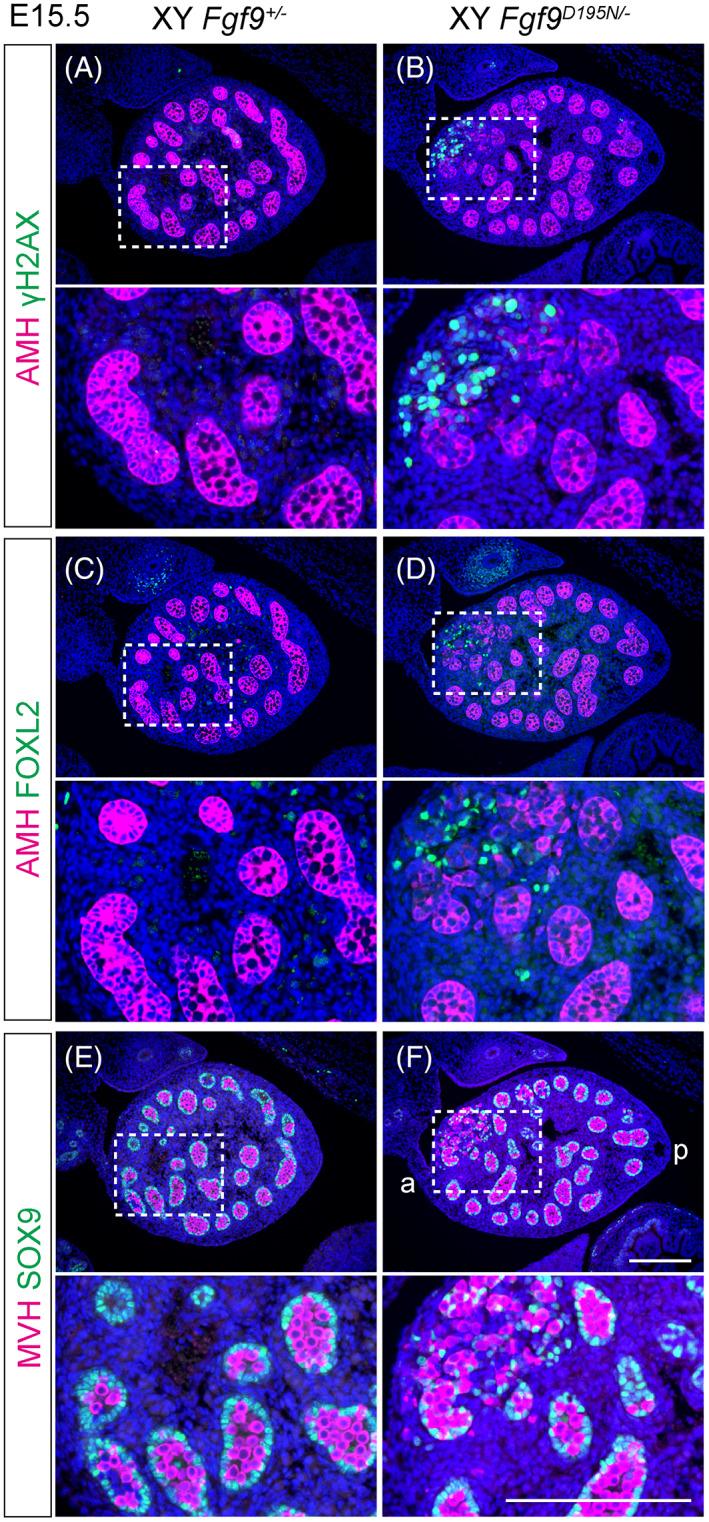
46,XY gonadal dysgenesis (GD) is a Disorder/Difference of Sex Development (DSD) that can present with phenotypes ranging from ambiguous genitalia to complete male-to-female sex reversal. Around 50% of 46,XY DSD cases receive a molecular diagnosis. In mice, Fibroblast growth factor 9 (FGF9) is an important component of the male sex-determining pathway. Two FGF9 variants reported to date disrupt testis development in mice, but not in humans. Here, we describe a female patient with 46,XY GD harbouring the rare FGF9 variant (missense mutation), NM_002010.2:c.583G > A;p.(Asp195Asn) (D195N). By biochemical and cell-based approaches, the D195N variant disrupts FGF9 protein homodimerisation and FGF9-heparin-binding, and reduces both Sertoli cell proliferation and Wnt4 repression. XY Fgf9 foetal mice show a transient disruption of testicular cord development, while XY Fgf9 foetal mice show partial male-to-female gonadal sex reversal. In the general population, the D195N variant occurs at an allele frequency of 2.4 × 10 , suggesting an oligogenic basis for the patient's DSD. Exome analysis of the patient reveals several known and novel variants in genes expressed in human foetal Sertoli cells at the time of sex determination. Taken together, our results indicate that disruption of FGF9 homodimerization impairs testis determination in mice and, potentially, also in humans in combination with other variants.
46,XY 性腺发育不全(GD)是一种性别发育障碍(DSD),其表型可从生殖器模糊到完全男性到女性的性反转。大约 50%的 46,XY DSD 病例可获得分子诊断。在小鼠中,成纤维细胞生长因子 9(FGF9)是男性性别决定途径的重要组成部分。迄今为止报道的两种 FGF9 变体在小鼠中破坏睾丸发育,但在人类中没有。在这里,我们描述了一名 46,XY GD 女性患者,携带罕见的 FGF9 变体(错义突变),NM_002010.2:c.583G>A;p.(Asp195Asn)(D195N)。通过生化和基于细胞的方法,D195N 变体破坏了 FGF9 蛋白同源二聚体化和 FGF9-肝素结合,并降低了支持细胞的增殖和 Wnt4 的抑制。XY Fgf9 胎儿小鼠显示睾丸索发育的短暂中断,而 XY Fgf9 胎儿小鼠显示部分男性到女性性腺性别反转。在普通人群中,D195N 变体的等位基因频率为 2.4×10,提示该患者的 DSD 具有寡基因基础。对患者的外显子组分析显示,在性别决定时表达的人类胎儿支持细胞中存在几个已知和新的变体基因。总之,我们的结果表明,FGF9 同源二聚体化的破坏会损害小鼠的睾丸决定,并且在与其他变体结合时,也可能会损害人类的睾丸决定。


 Zotero 插件