
用于泌尿生殖系统肿瘤光热治疗的透明质酸修饰的金@二氧化硅@金纳米颗粒
Hyaluronic Acid Modified Au@SiO@Au Nanoparticles for Photothermal Therapy of Genitourinary Tumors.
作者信息
Wang Ruizhi, Du Nan, Jin Liang, Chen Wufei, Ma Zhuangxuan, Zhang Tianyu, Xu Jie, Zhang Wei, Wang Xiaolin, Li Ming
机构信息
Department of Radiology, Huadong Hospital, Fudan University, Shanghai 200040, China.
Department of Interventional Radiology, Zhongshan Hospital, Fudan University, Shanghai 200032, China.
出版信息
Polymers (Basel). 2022 Nov 7;14(21):4772. doi: 10.3390/polym14214772.
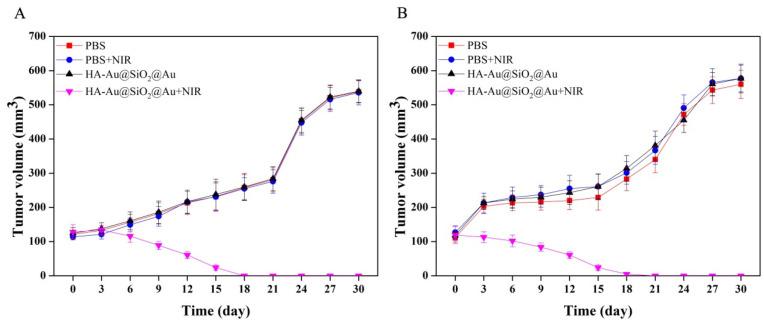
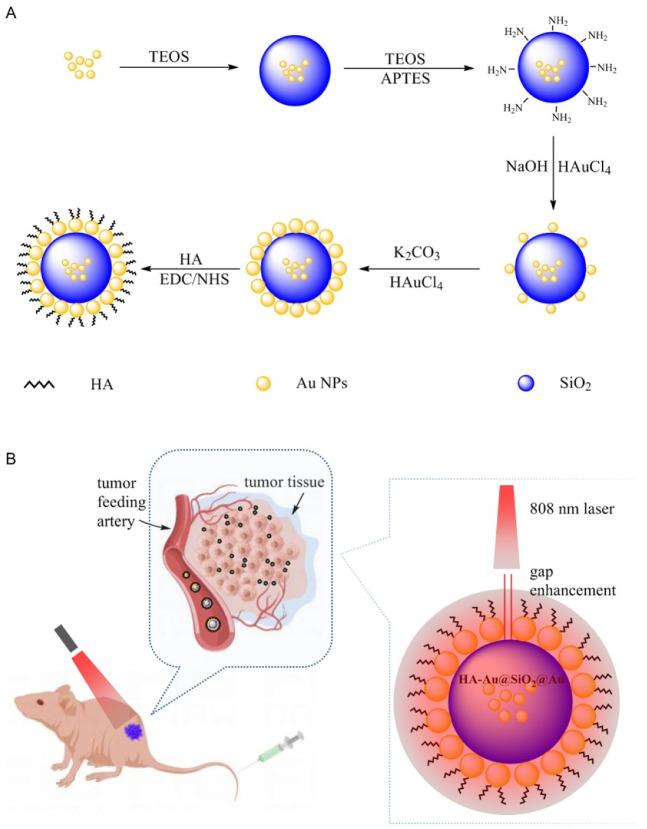
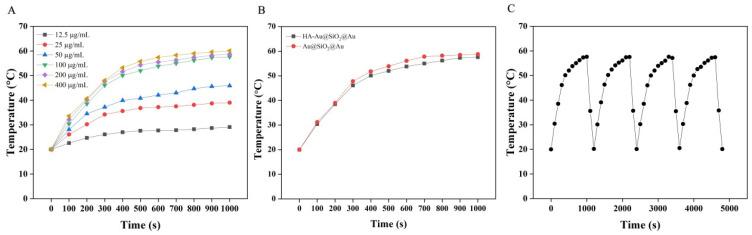
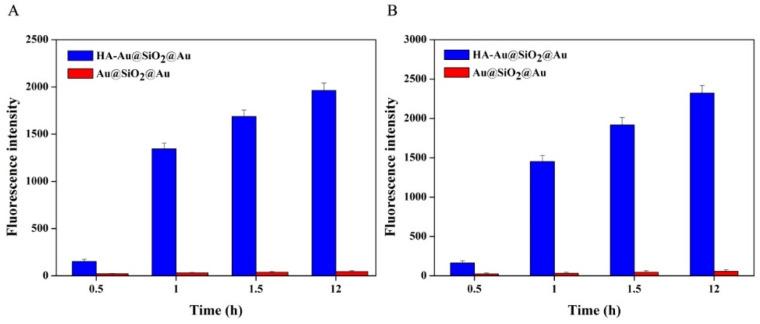
Bladder cancer and prostate cancer are the most common malignant tumors of the genitourinary system. Conventional strategies still face great challenges of high recurrence rate and severe trauma. Therefore, minimally invasive photothermal therapy (PTT) has been extensively explored to address these challenges. Herein, fluorescent Au nanoparticles (NPs) were first prepared using glutathione as template, which were then capped with SiO shell to improve the biocompatibility. Next, Au nanoclusters were deposited on the NPs surface to obtain Au@SiO@Au NPs for photothermal conversion. The gaps between Au nanoparticles on their surface could enhance their photothermal conversion efficiency. Finally, hyaluronic acid (HA), which targets cancer cells overexpressing CD44 receptors, was attached on the NPs surface via 1-(3-dimethylaminopropyl)-3-ethylcarbodiimide hydrochloride (EDC) chemistry to improve the accumulation of NPs in tumor tissues. Photothermal experiments showed that NPs with an average size of 37.5 nm have a high photothermal conversion efficiency (47.6%) and excellent photostability, thus exhibiting potential application as a PTT agent. The temperature of the NPs (100 μg·mL) could rapidly increase to 38.5 °C within 200 s and reach the peak of 57.6 °C with the laser power density of 1.5 W·cm and irradiation time of 600 s. In vivo and in vitro PTT experiments showed that the NPs have high biocompatibility and excellent targeted photothermal ablation capability of cancer cells. Both bladder and prostate tumors disappeared at 15 and 18 d post-treatment with HA-Au@SiO@Au NPs, respectively, and did not recur. In summary, HA-Au@SiO@Au NPs can be used a powerful PTT agent for minimally invasive treatment of genitourinary tumors.
膀胱癌和前列腺癌是泌尿生殖系统最常见的恶性肿瘤。传统治疗策略仍面临高复发率和严重创伤等巨大挑战。因此,人们广泛探索了微创光热疗法(PTT)来应对这些挑战。在此,首先以谷胱甘肽为模板制备了荧光金纳米颗粒(NPs),然后用SiO壳层进行包覆以提高生物相容性。接下来,将金纳米团簇沉积在NPs表面以获得用于光热转换的Au@SiO@Au NPs。其表面金纳米颗粒之间的间隙可提高它们的光热转换效率。最后,通过1-(3-二甲基氨基丙基)-3-乙基碳二亚胺盐酸盐(EDC)化学方法将靶向过表达CD44受体癌细胞的透明质酸(HA)连接到NPs表面,以提高NPs在肿瘤组织中的蓄积。光热实验表明,平均尺寸为37.5 nm的NPs具有高光热转换效率(47.6%)和优异的光稳定性,因此展现出作为PTT剂的潜在应用价值。在激光功率密度为1.5 W·cm且照射时间为600 s的条件下,NPs(100 μg·mL)的温度可在200 s内迅速升至38.5 °C,并达到57.6 °C的峰值。体内和体外PTT实验表明,NPs具有高生物相容性和优异的靶向癌细胞光热消融能力。分别用HA-Au@SiO@Au NPs治疗后,膀胱肿瘤和前列腺肿瘤在第15天和第18天均消失且未复发。综上所述,HA-Au@SiO@Au NPs可作为一种强大的PTT剂用于泌尿生殖系统肿瘤的微创治疗。


 Zotero 插件