
45 个结核病高负担国家中 COVID-19 相关干扰对年龄和性别相关的结核病诊断的影响的不平等。
Inequalities in the impact of COVID-19-associated disruptions on tuberculosis diagnosis by age and sex in 45 high TB burden countries.
机构信息
TB Modelling Group, TB Centre and Centre for Mathematical Modelling of Infectious Diseases, Department of Infectious Disease Epidemiology, Faculty of Epidemiology and Population Health, London School of Hygiene & Tropical Medicine, London, UK.
Malawi-Liverpool-Wellcome Programme, Blantyre, Malawi.
出版信息
BMC Med. 2022 Nov 14;20(1):432. doi: 10.1186/s12916-022-02624-6.
BACKGROUND
Tuberculosis remains a major public health priority and is the second leading cause of mortality from infectious disease worldwide. TB case detection rates are unacceptably low for men, the elderly and children. Disruptions in TB services due to the COVID-19 pandemic may have exacerbated these and other inequalities.
METHODS
We modelled trends in age- and sex- disaggregated case notifications for all forms of new and relapse TB reported to the World Health Organization for 45 high TB, TB/HIV and MDR-TB burden countries from 2013 to 2019. We compared trend predicted notifications to observed notifications in 2020 to estimate the number of people with TB likely to have missed or delayed diagnosis. We estimated the risk ratio (RR) of missed or delayed TB diagnosis for children (aged < 15 years) or the elderly (aged ≥ 65 years) compared to adults (aged 15-64 years) and women compared to men (both aged ≥ 15 years) using a random-effects meta-analysis.
RESULTS
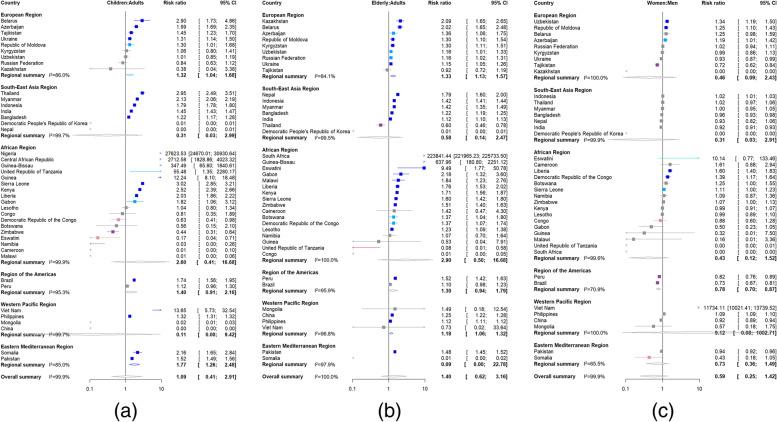
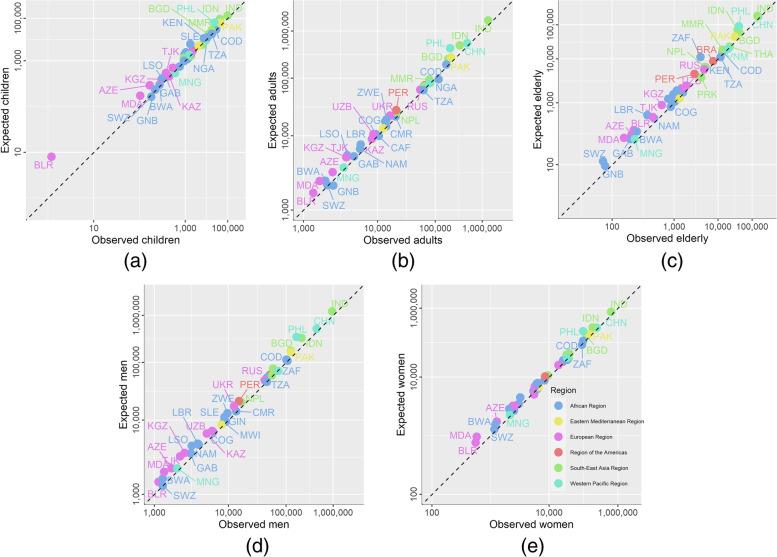
An estimated 195,449 children (95% confidence interval, CI: 189,673-201,562, 37.8% of an expected 517,168), 1,126,133 adults (CI: 1,107,146-1,145,704, 21.8% of an expected 5,170,592) and 235,402 elderly (CI: 228,108-243,202, 28.5% of an expected 826,563) had a missed or delayed TB diagnosis in 2020. This included 511,546 women (CI: 499,623-523,869, 22.7%, of an expected 2,250,097) and 863,916 men (CI: 847,591-880,515, 23.0% of an expected 3,763,363). There was no evidence globally that the risk of having TB diagnosis missed or delayed was different for children and adults (RR: 1.09, CI: 0.41-2.91), the elderly and adults (RR: 1.40, CI: 0.62-3.16) or men and women (RR: 0.59, CI: 0.25-1.42). However, there was evidence of disparities in risk by age and/or sex in some WHO regions and in most countries.
CONCLUSIONS
There is no evidence at an aggregate global level of any difference by age or sex in the risk of disruption to TB diagnosis as a result of the COVID-19 pandemic. However, in many countries, disruptions in TB services have been greater for some groups than others. It is important to recognise these context-specific inequalities when prioritising key populations for catch-up campaigns.
背景
结核病仍然是一个主要的公共卫生重点,是全球传染病死亡的第二大原因。男性、老年人和儿童的结核病检出率低得令人无法接受。由于 COVID-19 大流行,结核病服务中断可能加剧了这些和其他不平等现象。
方法
我们对 2013 年至 2019 年向世界卫生组织报告的 45 个高结核病、结核病/艾滋病毒和耐多药结核病负担国家的所有新发病例和复发结核病的年龄和性别分类病例通知趋势进行了建模。我们将预测的趋势通知与 2020 年的实际通知进行了比较,以估计可能错过或延迟诊断的结核病患者人数。我们使用随机效应荟萃分析估计了儿童(<15 岁)或老年人(≥65 岁)与成年人(15-64 岁)和女性与男性(均≥15 岁)相比,错过或延迟结核病诊断的风险比(RR)。
结果
据估计,2020 年有 195449 名儿童(95%置信区间,CI:189673-201562,占预计的 517168 名儿童的 37.8%)、1126133 名成年人(CI:1107146-1145704,占预计的 5170592 名成年人的 21.8%)和 235402 名老年人(CI:228108-243202,占预计的 826563 名老年人的 28.5%)错过了或延迟了结核病诊断。这包括 511546 名女性(CI:499623-523869,占预计的 2250097 名女性的 22.7%)和 863916 名男性(CI:847591-880515,占预计的 3763363 名男性的 23.0%)。全球范围内没有证据表明,儿童和成年人(RR:1.09,CI:0.41-2.91)、老年人和成年人(RR:1.40,CI:0.62-3.16)或男性和女性(RR:0.59,CI:0.25-1.42)的结核病诊断风险存在差异。然而,在一些世卫组织区域和大多数国家,确实存在按年龄和/或性别划分的风险差异的证据。
结论
在全球范围内,没有证据表明由于 COVID-19 大流行,结核病诊断中断的风险因年龄或性别而有所不同。然而,在许多国家,结核病服务的中断对某些群体的影响大于其他群体。在为追赶活动确定重点人群时,必须认识到这些具体国情的不平等现象。
 Zotero 插件