
2020 - 2021年新冠疫情对结核病诊断的全球、区域和国家层面影响
Global-, Regional-, and National-Level Impacts of the COVID-19 Pandemic on Tuberculosis Diagnoses, 2020-2021.
作者信息
Ledesma Jorge R, Basting Ann, Chu Huong T, Ma Jianing, Zhang Meixin, Vongpradith Avina, Novotney Amanda, Dalos Jeremy, Zheng Peng, Murray Christopher J L, Kyu Hmwe H
机构信息
Institute for Health Metrics and Evaluation, University of Washington, 3980 15th Ave. NE, Seattle, WA 98195, USA.
Department of Epidemiology, Brown University School of Public Health, 121 S Main St, Providence, RI 02912, USA.
出版信息
Microorganisms. 2023 Aug 30;11(9):2191. doi: 10.3390/microorganisms11092191.
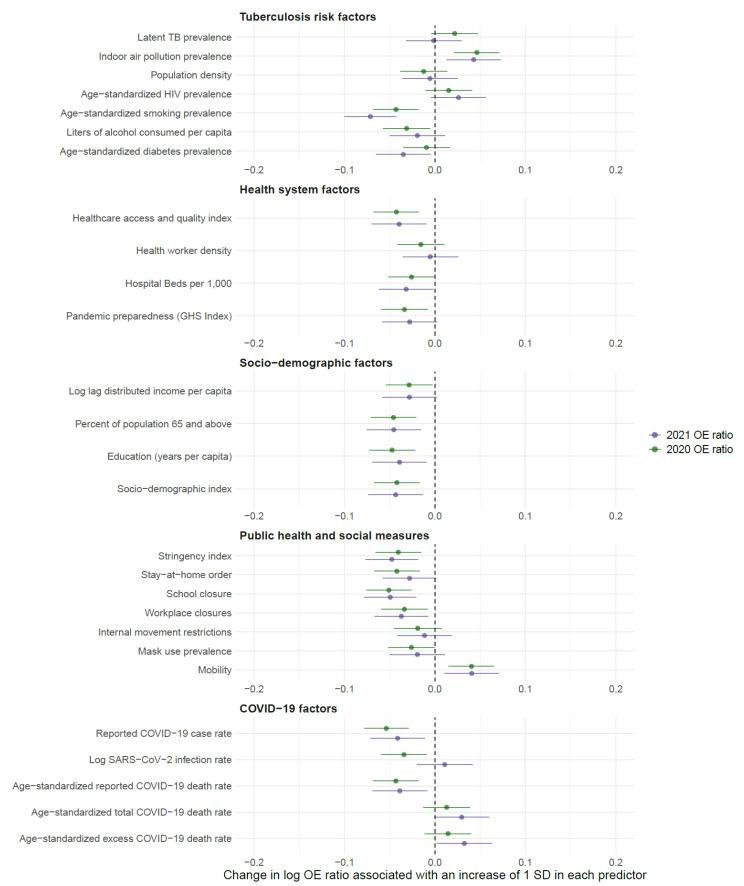
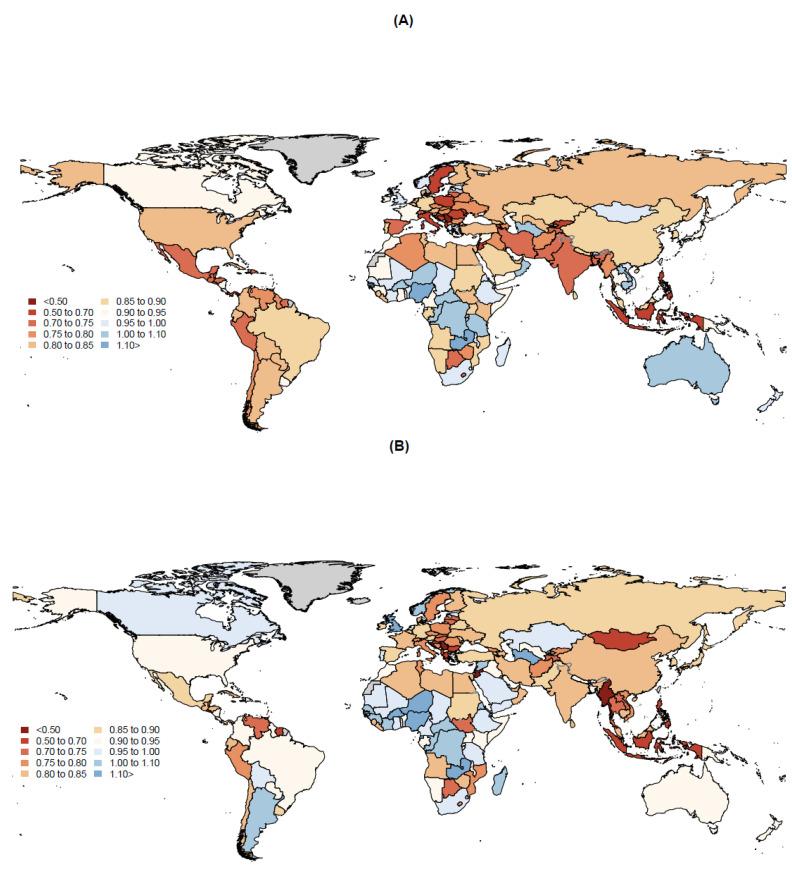
Evaluating cross-country variability on the impact of the COVID-19 pandemic on tuberculosis (TB) may provide urgent inputs to control programs as countries recover from the pandemic. We compared expected TB notifications, modeled using trends in annual TB notifications from 2013-2019, with observed TB notifications to compute the observed to expected (OE) ratios for 170 countries. We applied the least absolute shrinkage and selection operator (LASSO) method to identify the covariates, out of 27 pandemic- and tuberculosis-relevant variables, that had the strongest explanatory power for log OE ratios. The COVID-19 pandemic was associated with a 1.55 million (95% CI: 1.26-1.85, 21.0% [17.5-24.6%]) decrease in TB diagnoses in 2020 and a 1.28 million (0.90-1.76, 16.6% [12.1-21.2%]) decrease in 2021 at a global level. India, Indonesia, the Philippines, and China contributed the most to the global declines for both years, while sub-Saharan Africa achieved pre-pandemic levels by 2021 (OE ratio = 1.02 [0.99-1.05]). Age-stratified analyses revealed that the ≥ 65-year-old age group experienced greater relative declines in TB diagnoses compared with the under 65-year-old age group in 2020 (RR = 0.88 [0.81-0.96]) and 2021 (RR = 0.88 [0.79-0.98]) globally. Covariates found to be associated with all-age OE ratios in 2020 were age-standardized smoking prevalence in 2019 (β = 0.973 [0.957-990]), school closures (β = 0.988 [0.977-0.998]), stay-at-home orders (β = 0.993 [0.985-1.00]), SARS-CoV-2 infection rate (β = 0.991 [0.987-0.996]), and proportion of population ≥65 years (β = 0.971 [0.944-0.999]). Further research is needed to clarify the extent to which the observed declines in TB diagnoses were attributable to disruptions in health services, decreases in TB transmission, and COVID-19 mortality among TB patients.
评估新冠疫情对结核病影响的跨国差异,可为各国从疫情中恢复后的防控计划提供紧急参考依据。我们使用2013 - 2019年结核病年度通报趋势建立模型,将预期结核病通报数与实际观察到的通报数进行比较,计算了170个国家的观察值与预期值(OE)比率。我们应用最小绝对收缩和选择算子(LASSO)方法,从27个与疫情和结核病相关的变量中识别出对对数OE比率具有最强解释力的协变量。在全球层面,2020年新冠疫情导致结核病诊断数减少155万例(95%可信区间:126 - 185万例,21.0%[17.5 - 24.6%]),2021年减少128万例(90 - 176万例,16.6%[12.1 - 21.2%])。印度、印度尼西亚、菲律宾和中国在这两年的全球下降中贡献最大,而撒哈拉以南非洲到2021年达到了疫情前水平(OE比率 = 1.02[0.99 - 1.05])。年龄分层分析显示,在全球范围内,2020年(相对风险 = 0.88[0.81 - 0.96])和2021年(相对风险 = 0.88[0.79 - 0.98]),65岁及以上年龄组的结核病诊断相对下降幅度大于65岁以下年龄组。2020年发现与全年龄OE比率相关的协变量包括2019年年龄标准化吸烟率(β = 0.973[0.957 - 0.990])、学校关闭(β = 0.988[0.977 - 0.998])、居家令(β = 0.993[0.985 - 1.00])、SARS-CoV-2感染率(β = 0.991[0.987 - 0.996])以及65岁及以上人口比例(β = 0.971[0.944 - 0.999])。需要进一步研究以明确观察到的结核病诊断下降在多大程度上归因于卫生服务中断、结核病传播减少以及结核病患者中的新冠死亡情况。

 Zotero 插件