
通过基于基因型的接触者追踪结合公共卫生防控措施减少结核病传播:台湾地区COVID-19大流行期间的案例研究
Reducing tuberculosis transmission by genotype-based contact tracing coupled with public health containment measures: a case study during the COVID-19 pandemic in Taiwan.
作者信息
Chien Yuan-Shan, Lai Chao-Chih, Hsu Chen-Yang, Hsieh Yu-Chu, Lin Shin-Yi, Wang Hsiao Chi, Chen Hung-Pin, Chen Tony Hsiu-His, Luh Dih-Ling, Yeh Yen-Po
机构信息
Department of Public Health, Chung Shan Medical University, Taichung City, Taiwan.
Changhua Public Health Bureau, Changhua, Taiwan.
出版信息
Microbiol Spectr. 2025 Mar 26;13(5):e0212524. doi: 10.1128/spectrum.02125-24.
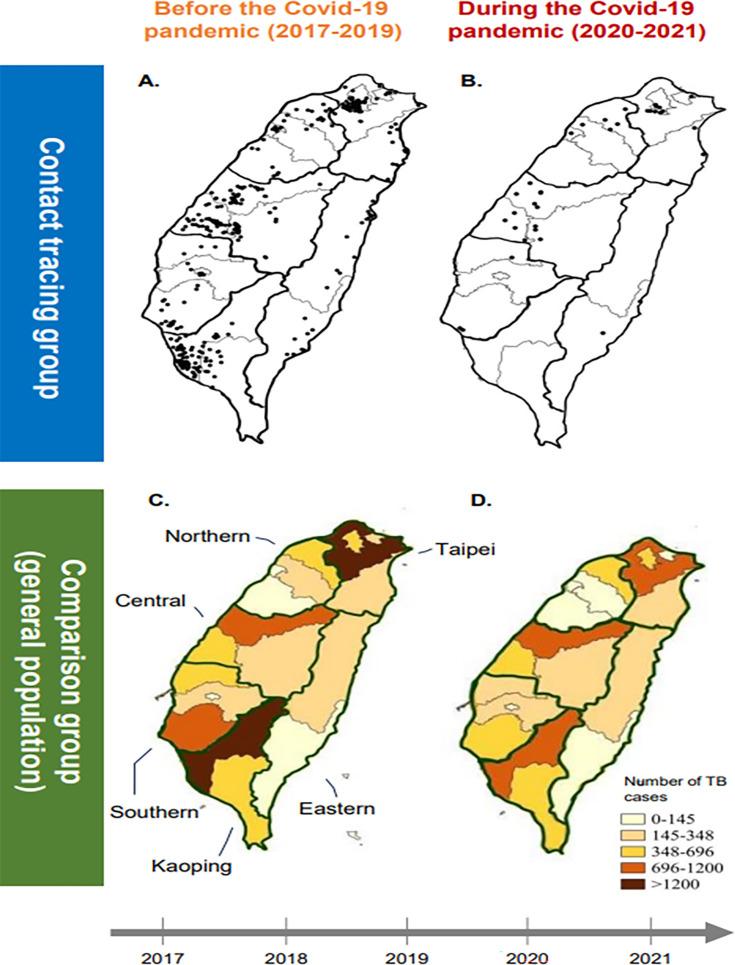
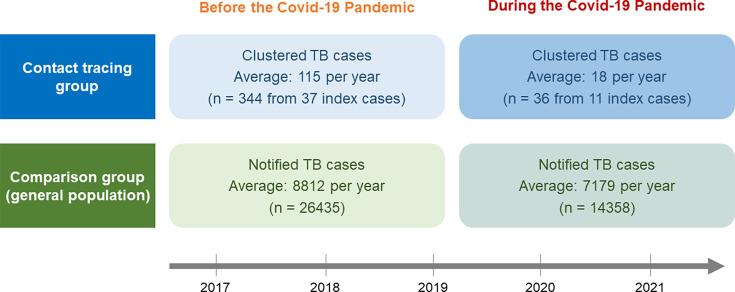
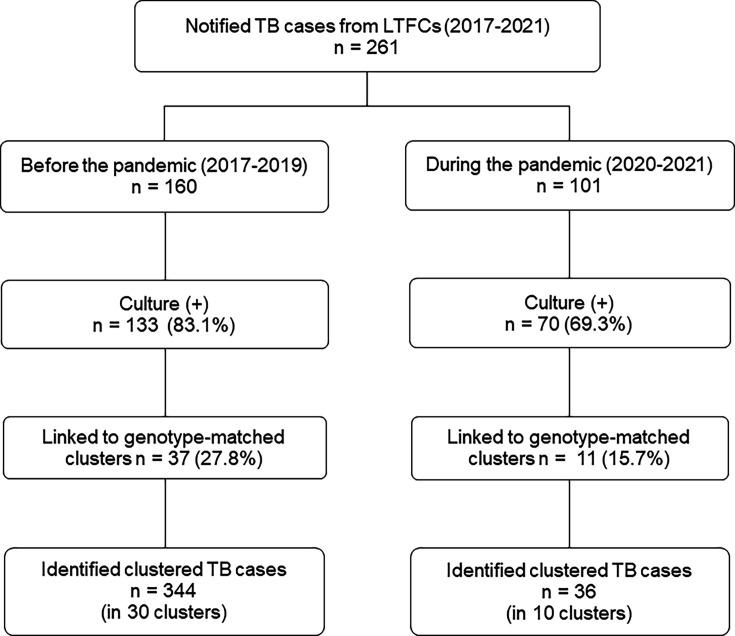
This study aimed to estimate the effectiveness of genotype-based contact tracing coupled with public health and social containment measures (PHSMs) in reducing tuberculosis (TB) transmission during the COVID-19 pandemic. Patients suspicious of recent TB infection from index cases were traced by genotyping method between 2017 and 2021. To make allowance for TB cases attributed to reactivation, TB cases identified from the genotype-based contact tracing group were compared to those from the underlying population via the notifiable nationwide system without genotyping. The relative changes (ratios) in TB cases before and during the pandemic between the two groups were leveraged to estimate the effectiveness of PHSMs following genotype-based contact tracing, taking into account demographic features and geographic variation, with a multivariable Poisson regression model. Before the pandemic, we identified 42 of 133 (31.6%) sputum culture-positive index (SCI) patients via 344 genotype-matched clustered TB cases. During the pandemic, 11 of 70 (15.7%) SCI patients were linked to 36 clustered cases. The annual average of TB-clustered patients for the genotype-based contact tracing group decreased by 84.3%, whereas the corresponding figure for the comparator decreased by 18.5%. The adjusted relative risk of 0.19 (95% CI 0.14-0.28) gave an 81% TB transmission reduction after controlling for extraneous factors. Genotype-based contact tracing coupled with PHSMs significantly reduced TB transmission. Our findings from the pandemic period demonstrate that a molecular epidemiological approach with public health containment measures will enable a moderate-burden TB country to reach the WHO End TB targets by 2035.IMPORTANCEThe extent to which COVID-19 public health and social measures reduced tuberculosis transmission remains unclear. We elucidated the recent tuberculosis infection with a novel genotype-based contact tracing from 2017 to 2021. These patients were recruited as the contact tracing group in contrast to the comparison group of tuberculosis cases from the general population via the notifiable nationwide system without genotyping. The relative changes in tuberculosis cases before and during the pandemic between the contact tracing group and the comparison group were used to estimate the effectiveness of reducing tuberculosis transmission. We found a significant 81% reduction in tuberculosis transmission during the first 2 years of the pandemic. This finding demonstrates that a molecular epidemiological approach with public health containment measures will enable a moderate-burden tuberculosis country to reach the End TB targets by 2035.
本研究旨在评估基于基因型的接触者追踪结合公共卫生和社会防控措施(PHSMs)在新冠疫情期间减少结核病(TB)传播的效果。2017年至2021年期间,通过基因分型方法对疑似由索引病例近期感染结核病的患者进行追踪。为了考虑因复发导致的结核病病例,将基于基因型的接触者追踪组中识别出的结核病病例与通过全国法定报告系统识别出的未进行基因分型的潜在人群中的病例进行比较。利用多变量泊松回归模型,在考虑人口统计学特征和地理差异的情况下,比较两组在疫情前和疫情期间结核病病例的相对变化(比率),以评估基于基因型的接触者追踪后PHSMs的效果。在疫情前,我们通过344例基因匹配的聚集性结核病病例识别出133例痰培养阳性索引(SCI)患者中的42例(31.6%)。在疫情期间,70例SCI患者中的11例(15.7%)与36例聚集性病例相关联。基于基因型的接触者追踪组中结核病聚集性患者的年平均数量下降了84.3%,而对照组的相应数字下降了18.5%。调整后的相对风险为0.19(95%CI 0.14 - 0.28),在控制了外部因素后,结核病传播减少了81%。基于基因型的接触者追踪结合PHSMs显著减少了结核病传播。我们在疫情期间的研究结果表明,采用分子流行病学方法并结合公共卫生防控措施将使一个结核病负担中等的国家能够在2035年实现世界卫生组织的终结结核病目标。
重要性
新冠疫情的公共卫生和社会措施在多大程度上减少了结核病传播仍不清楚。我们通过一种新型的基于基因型的接触者追踪方法,对2017年至2021年期间的近期结核病感染情况进行了阐明。这些患者被招募为接触者追踪组,与之形成对比的是通过全国法定报告系统从普通人群中选取的未进行基因分型的结核病病例对照组。利用接触者追踪组和对照组在疫情前和疫情期间结核病病例的相对变化来评估减少结核病传播的效果。我们发现,在疫情的头两年,结核病传播显著减少了81%。这一发现表明,采用分子流行病学方法并结合公共卫生防控措施将使一个结核病负担中等的国家能够在2035年实现终结结核病目标。
 Zotero 插件