
基于飞行时间正电子发射断层扫描(TOF PET)数据的HYPR4D核方法,并进行了包括图像衍生输入函数在内的验证。
HYPR4D kernel method on TOF PET data with validations including image-derived input function.
作者信息
Cheng Ju-Chieh Kevin, Bevington Connor W J, Sossi Vesna
机构信息
Pacific Parkinson's Research Centre, University of British Columbia, Vancouver, BC, Canada.
Department of Physics and Astronomy, University of British Columbia, Vancouver, BC, Canada.
出版信息
EJNMMI Phys. 2022 Nov 17;9(1):78. doi: 10.1186/s40658-022-00507-6.
BACKGROUND
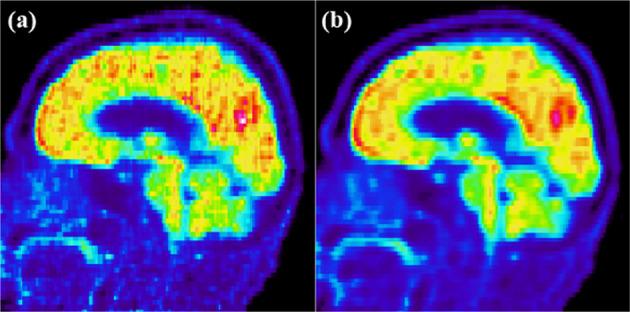
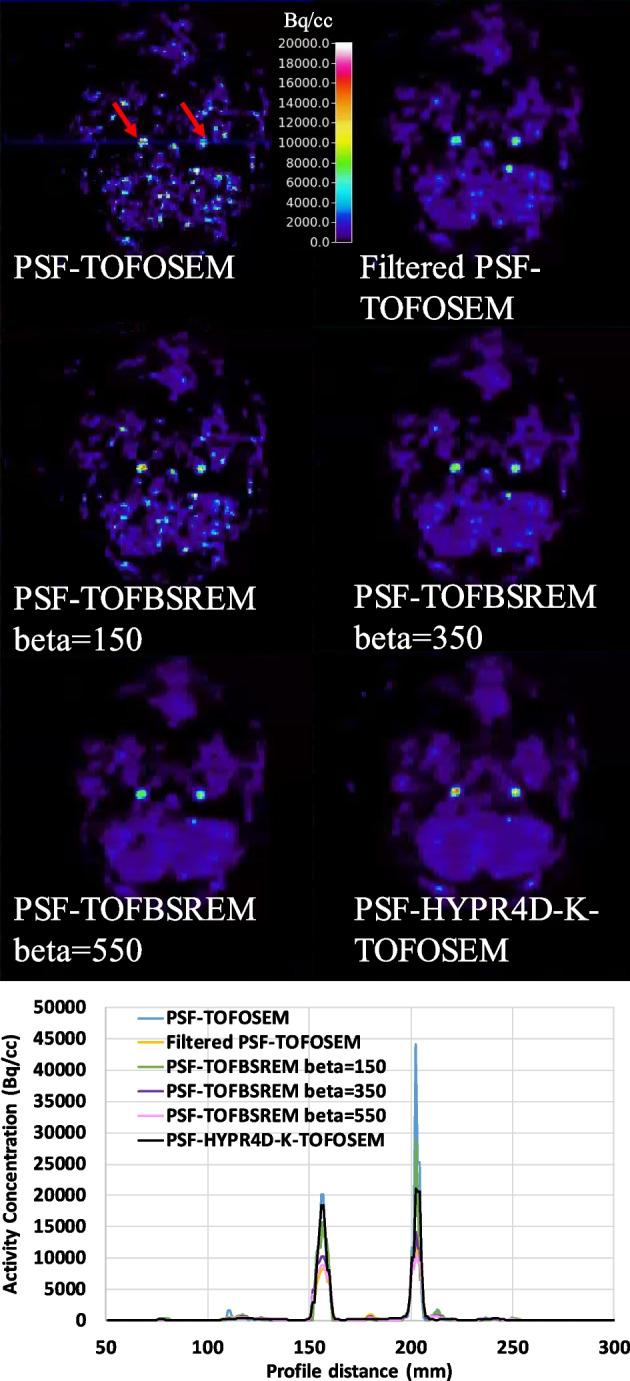
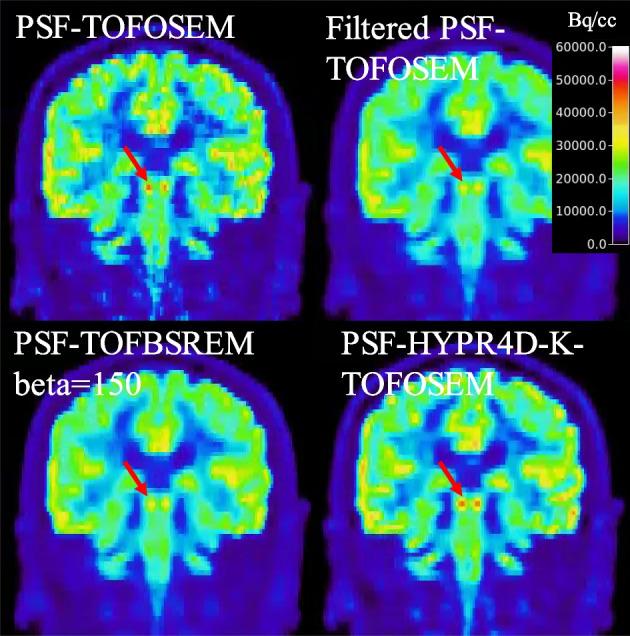
Positron emission tomography (PET) images are typically noisy especially in dynamic imaging where the PET data are divided into a number of short temporal frames often with a low number of counts. As a result, image features such as contrast and time-activity curves are highly variable. Noise reduction in PET is thus essential. Typical noise reduction methods tend to not preserve image features/patterns (e.g. contrast and size dependent) accurately. In this work, we report the first application of our HYPR4D kernel method on time-of-flight (TOF) PET data (i.e. PSF-HYPR4D-K-TOFOSEM). The proposed HYPR4D kernel method makes use of the mean 4D high frequency features and inconsistent noise patterns over OSEM subsets as well as the low noise property of the early reconstruction updates to achieve prior-free de-noising. The method was implemented and tested on the GE SIGNA PET/MR and was compared to the TOF reconstructions with PSF resolution modeling available on the system, namely PSF-TOFOSEM with and without standard post filter and PSF-TOFBSREM (TOF Q.Clear) with various beta values (regularization strengths).
RESULTS
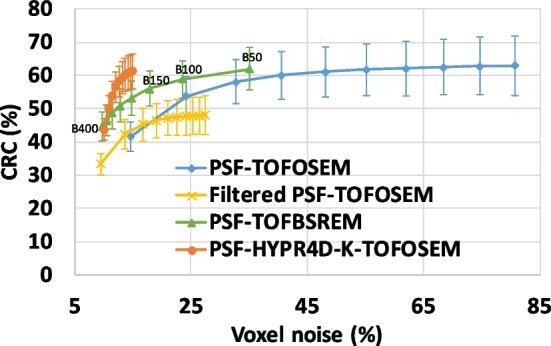
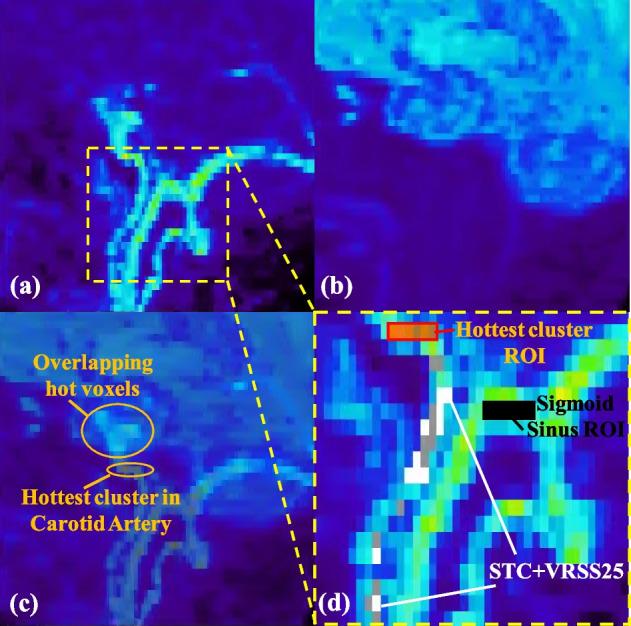
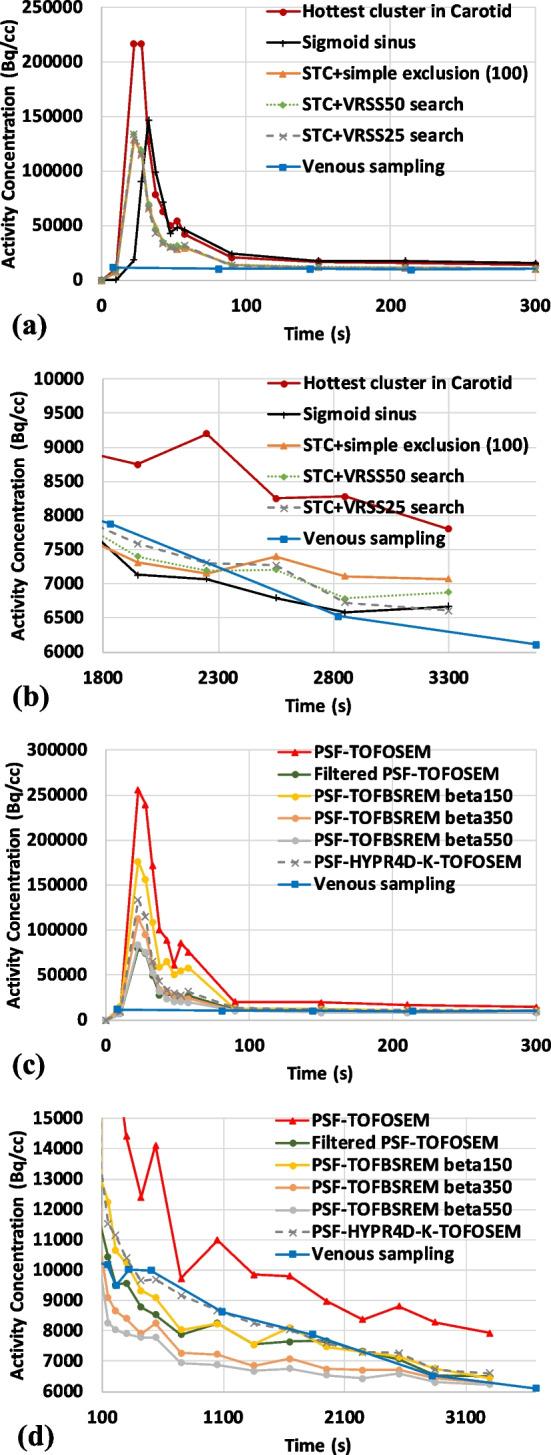
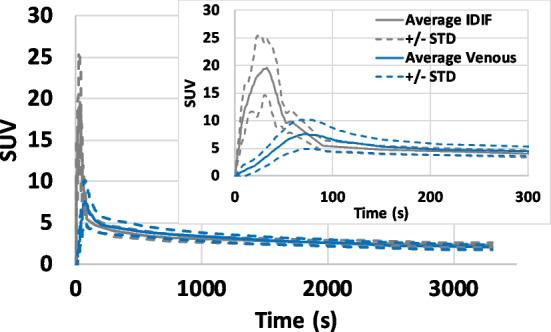
Results from experimental contrast phantom and human subject data with various PET tracers showed that the proposed method provides more robust and accurate image features compared to other regularization methods. The preservation of contrast for the PSF-HYPR4D-K-TOFOSEM was observed to be better and less dependent on the contrast and size of the target structures as compared to TOF Q.Clear and PSF-TOFOSEM with filter. At the same contrast level, PSF-HYPR4D-K-TOFOSEM achieved better 4D noise suppression than other methods (e.g. >2 times lower noise than TOF Q.Clear at the highest contrast). We also present a novel voxel search method to obtain an image-derived input function (IDIF) and demonstrate that the obtained IDIF is the most quantitative w.r.t. the measured blood samples when the acquired data are reconstructed with PSF-HYPR4D-K-TOFOSEM.
CONCLUSIONS
The overall results support superior performance of the PSF-HYPR4D-K-TOFOSEM for TOF PET data and demonstrate that the proposed method is likely suitable for all imaging tasks including the generation of IDIF without requiring any prior information as well as further improving the effective sensitivity of the imaging system.
背景
正电子发射断层扫描(PET)图像通常有噪声,尤其是在动态成像中,PET数据被分成多个短时间帧,计数往往较少。因此,诸如对比度和时间-活性曲线等图像特征高度可变。所以PET中的降噪至关重要。典型的降噪方法往往不能准确保留图像特征/模式(例如对比度和尺寸依赖性)。在这项工作中,我们报告了我们的HYPR4D内核方法在飞行时间(TOF)PET数据上的首次应用(即PSF-HYPR4D-K-TOFOSEM)。所提出的HYPR4D内核方法利用4D高频特征的均值以及OSEM子集中不一致的噪声模式,以及早期重建更新的低噪声特性来实现无先验去噪。该方法在GE SIGNA PET/MR上实现并进行了测试,并与系统上可用的具有PSF分辨率建模的TOF重建进行了比较,即带和不带标准后置滤波器的PSF-TOFOSEM以及具有各种β值(正则化强度)的PSF-TOFBSREM(TOF Q.Clear)。
结果
来自实验性对比体模和使用各种PET示踪剂的人体受试者数据的结果表明,与其他正则化方法相比,所提出的方法提供了更稳健和准确的图像特征。与TOF Q.Clear和带滤波器的PSF-TOFOSEM相比,观察到PSF-HYPR4D-K-TOFOSEM对对比度的保留更好,并且对目标结构的对比度和尺寸依赖性更小。在相同的对比度水平下,PSF-HYPR4D-K-TOFOSEM比其他方法实现了更好的4D噪声抑制(例如在最高对比度下噪声比TOF Q.Clear低2倍以上)。我们还提出了一种新颖的体素搜索方法来获得图像衍生输入函数(IDIF),并证明当使用PSF-HYPR4D-K-TOFOSEM重建采集的数据时,所获得的IDIF在测量血样方面是最定量的。
结论
总体结果支持PSF-HYPR4D-K-TOFOSEM在TOF PET数据方面的卓越性能,并表明所提出的方法可能适用于所有成像任务,包括生成IDIF,无需任何先验信息,以及进一步提高成像系统的有效灵敏度。

 Zotero 插件