
用于人类正电子发射断层扫描(PET)研究的图像衍生输入函数应用的最新进展:新希望还是旧幻想?
An update on the use of image-derived input functions for human PET studies: new hopes or old illusions?
作者信息
Volpi Tommaso, Maccioni Lucia, Colpo Maria, Debiasi Giulia, Capotosti Amedeo, Ciceri Tommaso, Carson Richard E, DeLorenzo Christine, Hahn Andreas, Knudsen Gitte Moos, Lammertsma Adriaan A, Price Julie C, Sossi Vesna, Wang Guobao, Zanotti-Fregonara Paolo, Bertoldo Alessandra, Veronese Mattia
机构信息
Department of Radiology and Biomedical Imaging, Yale University, 801 Howard Avenue, PO Box 208048, New Haven, CT, 06520-8048, USA.
Department of Information Engineering, University of Padova, Padua, Italy.
出版信息
EJNMMI Res. 2023 Nov 10;13(1):97. doi: 10.1186/s13550-023-01050-w.
BACKGROUND
The need for arterial blood data in quantitative PET research limits the wider usability of this imaging method in clinical research settings. Image-derived input function (IDIF) approaches have been proposed as a cost-effective and non-invasive alternative to gold-standard arterial sampling. However, this approach comes with its own limitations-partial volume effects and radiometabolite correction among the most important-and varying rates of success, and the use of IDIF for brain PET has been particularly troublesome.
MAIN BODY
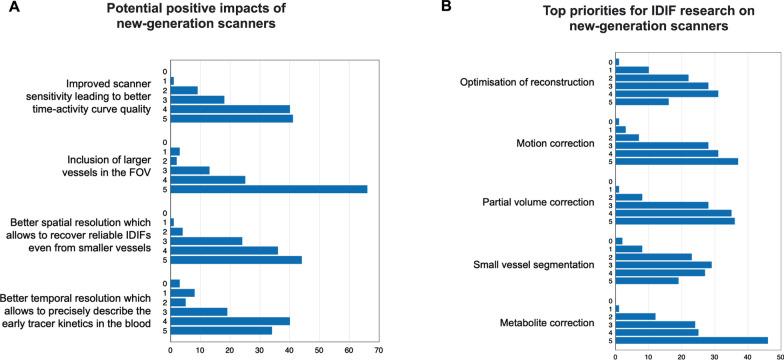
This paper summarizes the limitations of IDIF methods for quantitative PET imaging and discusses some of the advances that may make IDIF extraction more reliable. The introduction of automated pipelines (both commercial and open-source) for clinical PET scanners is discussed as a way to improve the reliability of IDIF approaches and their utility for quantitative purposes. Survey data gathered from the PET community are then presented to understand whether the field's opinion of the usefulness and validity of IDIF is improving. Finally, as the introduction of next-generation PET scanners with long axial fields of view, ultra-high sensitivity, and improved spatial and temporal resolution, has also brought IDIF methods back into the spotlight, a discussion of the possibilities offered by these state-of-the-art scanners-inclusion of large vessels, less partial volume in small vessels, better description of the full IDIF kinetics, whole-body modeling of radiometabolite production-is included, providing a pathway for future use of IDIF.
CONCLUSION
Improvements in PET scanner technology and software for automated IDIF extraction may allow to solve some of the major limitations associated with IDIF, such as partial volume effects and poor temporal sampling, with the exciting potential for accurate estimation of single kinetic rates. Nevertheless, until individualized radiometabolite correction can be performed effectively, IDIF approaches remain confined at best to a few tracers.
背景
定量PET研究中对动脉血数据的需求限制了这种成像方法在临床研究环境中的更广泛应用。图像衍生输入函数(IDIF)方法已被提出作为金标准动脉采样的一种经济高效且非侵入性的替代方法。然而,这种方法有其自身的局限性——部分容积效应和放射性代谢物校正最为重要——以及成功率各不相同,并且将IDIF用于脑PET一直特别麻烦。
主体
本文总结了IDIF方法在定量PET成像中的局限性,并讨论了一些可能使IDIF提取更可靠的进展。讨论了为临床PET扫描仪引入自动化流程(商业和开源的),以此作为提高IDIF方法可靠性及其定量用途的一种方式。然后展示了从PET领域收集的调查数据,以了解该领域对IDIF的有用性和有效性的看法是否正在改善。最后,随着具有长轴向视野、超高灵敏度以及改进的空间和时间分辨率的下一代PET扫描仪的推出,也使IDIF方法重新受到关注,文中讨论了这些最先进扫描仪提供的可能性——纳入大血管、小血管中部分容积较小、更好地描述完整IDIF动力学、放射性代谢物产生的全身建模——为IDIF的未来应用提供了一条途径。
结论
PET扫描仪技术和用于自动IDIF提取的软件的改进可能有助于解决与IDIF相关的一些主要局限性,例如部分容积效应和时间采样不佳,并具有准确估计单一动力学速率的令人兴奋的潜力。然而,在能够有效进行个体化放射性代谢物校正之前,IDIF方法充其量仍仅限于少数示踪剂。


 Zotero 插件