
1990 年至 2019 年中国老年人中 HIV 或艾滋病死亡率的模式:年龄-时期-队列分析。
Patterns of HIV or AIDS Mortality Among Older People From 1990 to 2019 in China: Age-Period-Cohort Analysis.
机构信息
School of Public Health, Southwest Medical University, Luzhou, China.
Department of Health Management Center & Institute of Health Management, Sichuan Provincial People's Hospital, University of Electronic Science and Technology of China, Chengdu, China.
出版信息
JMIR Public Health Surveill. 2022 Nov 17;8(11):e35785. doi: 10.2196/35785.
BACKGROUND
With the increasing effectiveness of antiretroviral therapy and shifting demographics, the problem of older people with HIV or AIDS is increasingly grim in China, and neglecting infection among them may cause more serious social problems, exacerbate the difficulty of controlling HIV or AIDS transmission, and increase the risk of death.
OBJECTIVE
We investigated the variations in the trends of Chinese mortality by age, period, and cohort, from 1990 to 2019, to reveal the relationship between age, period, cohort, and HIV burden, as well as providing guidance for resource allocation to prevent HIV-related deaths in vulnerable target populations.
METHODS
We extracted the HIV or AIDS mortality data from the Global Burden of Disease. The joinpoint regression model was applied to detect changes in HIV or AIDS trends. The age-period-cohort model was used to explore the age, period, and cohort effects.
RESULTS
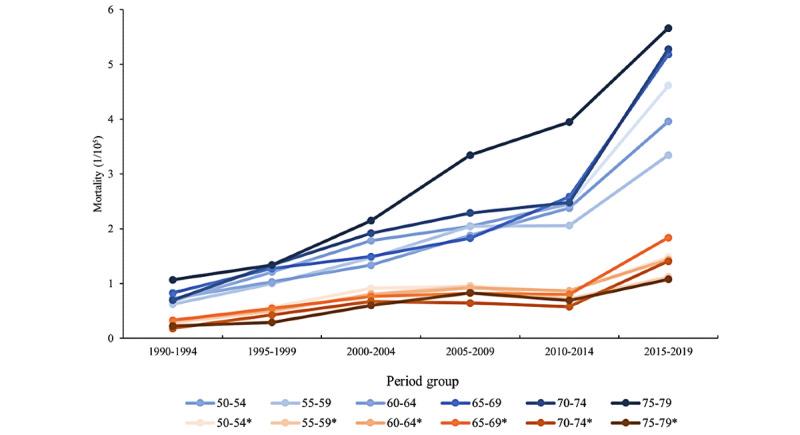
The trends in age-standardized mortality rates in HIV or AIDS were increased in both genders, from 0.50 to 4.54/105 individuals for males, and from 0.19 to 1.43/105 individuals for females. Joinpoint regression model showed the average annual percentage change of age-standardized mortality rates was 7.0 for male and 6.4 for female individuals, showing an increasing trend. The age effect of male HIV or AIDS mortality showed a net increase of 0.59 (-0.21 to 0.38) from the ages 50-79 years. There is a gradual upward trend in the change in risk of death from HIV or AIDS for the period effect among the older population, lowest at ages 50-54 years (-0.80 for male and -0.78 for female individuals) and highest at ages 75-79 years (0.86 for male and 0.69 for female individuals). The variation of cohort effects was complex, but both genders had a nearly consistent tendency; people born in 1920-1929 had the lowest cohort effect, and those born in 1950-1954 had the highest values.
CONCLUSIONS
Our study showed a marked rise in HIV mortality for both genders in China from 1990 to 2019. Aging is an important issue in current HIV prevention and control. There is an urgent need to promote HIV testing and health education. Our findings will help predict future HIV or AIDS mortality changes and identify age-specific priority populations for intervention.
背景
随着抗逆转录病毒疗法效果的提高和人口结构的变化,中国老年艾滋病毒感染者或艾滋病患者的问题日益严峻,如果忽视他们的感染问题,可能会导致更严重的社会问题,加剧艾滋病毒或艾滋病传播的控制难度,增加死亡风险。
目的
本研究旨在探讨 1990 年至 2019 年中国按年龄、时期和队列划分的艾滋病毒相关死亡率变化趋势,揭示年龄、时期和队列与艾滋病毒负担之间的关系,为在脆弱目标人群中分配资源预防与艾滋病毒相关的死亡提供指导。
方法
我们从全球疾病负担研究中提取了艾滋病毒相关或艾滋病死亡率数据。采用 joinpoint 回归模型来检测艾滋病毒相关或艾滋病趋势的变化,采用年龄-时期-队列模型来探讨年龄、时期和队列的影响。
结果
男性和女性的艾滋病毒相关或艾滋病死亡率标准化年龄率均呈上升趋势,从 0.50 升至 4.54/105 人,从 0.19 升至 1.43/105 人。Joinpoint 回归模型显示,男性和女性的年龄标准化死亡率的年均变化百分比分别为 7.0%和 6.4%,呈上升趋势。男性艾滋病毒相关或艾滋病死亡率的年龄效应显示,50-79 岁人群的净增 0.59(-0.21 至 0.38)。在老年人群中,时期效应导致艾滋病毒相关或艾滋病死亡风险逐渐上升,最低风险出现在 50-54 岁年龄组(男性为-0.80,女性为-0.78),最高风险出现在 75-79 岁年龄组(男性为 0.86,女性为 0.69)。队列效应的变化较为复杂,但两性均呈一致趋势;出生于 1920-1929 年的人群队列效应最低,而出生于 1950-1954 年的人群队列效应最高。
结论
本研究表明,1990 年至 2019 年期间,中国男女性艾滋病毒死亡率均显著上升。老龄化是当前艾滋病毒防控的一个重要问题,迫切需要推广艾滋病毒检测和健康教育。本研究结果有助于预测未来艾滋病毒相关或艾滋病死亡率的变化,并确定特定年龄组的干预重点人群。



 Zotero 插件